
Lieferung heute & morgen

Qualitätsgarantie

Willkommens-Angebote freischalten: KOSTENLOSE Lieferung | Bis zu 80 % RABATT | Kostenlose 30-Tage-JoyPlus-Testphase
App herunterladen
Does your car's paint feel rough and uneven even after a thorough wash? Stubborn deposits like industrial fallout, tree sap, tar, or insect residue often can't be removed by a standard wash. These bonded particles not only mar the look and shine but also prevent waxes or sealants from bonding properly with the paint.
This is where the clay bar, also known as detailing clay, comes in. It is an essential tool for deep paint decontamination. This article explains what to look for when choosing one and presents various options to help you achieve a noticeably smooth surface, creating the ideal preparation for polishing your car.
Selecting the right product for paint cleaning can be a challenge given the different types and formats available. The following points will help you make an informed decision.
Clay bars come in different grades of abrasiveness (usually fine, medium, and heavy).
For most home users and enthusiasts, a fine to medium-grade car clay is the right choice.
Besides the traditional clay bar, there are now practical alternatives that can speed up the paint cleaning process.
The choice depends on personal preference and the size of the area to be treated.
A clay bar must never be used on a dry surface. Without a suitable lubricant (clay lube), it will cause friction and scratches. Dedicated products or, alternatively, a mixture of water and a pH-neutral car shampoo are suitable as lubricants. Sufficient lubrication is the key to safe and effective paint decontamination.
Here is a selection of products designed for the effective preparation of your vehicle's paintwork.
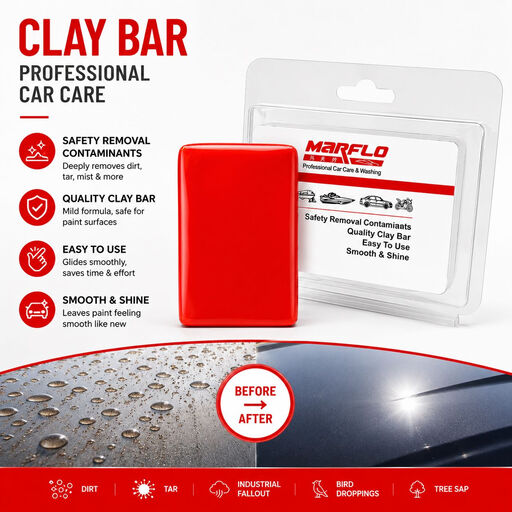
What makes this product stand out: The MARFLO Clay Bar is a traditional detailing clay with a fine-grade abrasiveness. It is designed to safely remove bonded contaminants such as brake dust, industrial fallout, and tree sap. Its soft and flexible consistency makes it easy to knead and conform to curved body panels. It is a solid choice for anyone who wants to control the paint cleaning process with precision.
Benefits:
Who it's for: For detailers and enthusiasts who prefer a precise and controlled method for paint cleaning and want to tackle specific problem areas.

What makes this product stand out: This clay mitt offers an efficient 2-in-1 solution. One side is made of microfibre for a gentle wash, while the other features a polymer clay material for paint decontamination. The ergonomic mitt design allows for faster work on large areas compared to a traditional clay bar and provides a secure grip.
Benefits:
Who it's for: For users who value efficiency and want to decontaminate large vehicle surfaces like roofs, hoods, and doors quickly and comfortably.
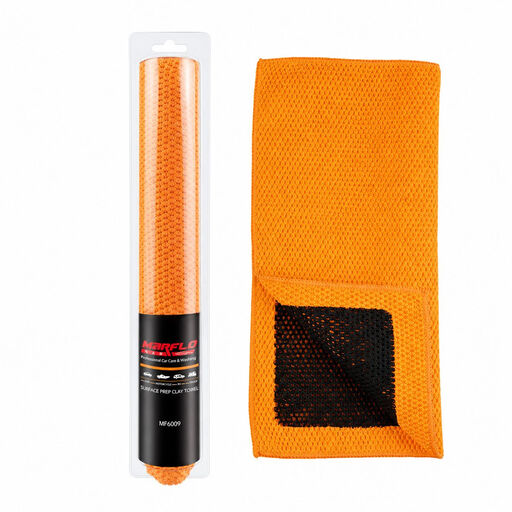
What makes this product stand out: The clay towel combines an advanced nano-polymer surface with a soft microfibre backing. The large, flat shape of the towel makes it ideal for quick and even application on all vehicle surfaces, including glass and chrome. It is flexible and easily conforms to contours, simplifying the cleaning process.
Benefits:
Who it's for: For professional detailers and home users looking for a fast, reusable, and easy-to-handle solution for regular car care.
This selection represents just a fraction of the available solutions for paint care. If you are looking for more tools and products for a flawless vehicle surface, you will find a wider range of options in our category.
Discover more Car Wash Accessories
1. How often should you use a clay bar? Using a clay bar once or twice a year is sufficient for most vehicles. A good time is in the spring to remove winter build-up and in the autumn as preparation for the cold season. Paint decontamination is also always recommended before applying a new layer of wax, a sealant, or a ceramic coating.
2. Can a clay bar damage the paint? When used correctly, a clay bar is safe for the clear coat. Damage can occur if:
Always glide the clay over the well-lubricated surface with light pressure.
3. What is the difference between a clay bar and polish? The clay bar is a cleaning tool. It removes contaminants that are bonded on top of the paint surface. The goal is a clean and smooth surface. A polish, on the other hand, is an abrasive process. It removes a microscopic layer of the clear coat to correct defects in the paint, such as fine scratches, swirl marks, or oxidation. Using a detailing clay is therefore an essential preparatory step before polishing a car.