People responsible for cleaning products
You organise the labelling of bottles filled with different products. When working with hazardous substances, you need to establish what information is required on site; the BAuA covers this in TRGS 201.


For short names on frequently used bottles, a handheld label maker with tape suited to the bottle material is a sensible starting point. For longer information, label space and design options matter more. When working with hazardous substances, the required labelling information must be determined through a risk assessment: a readable product name alone is not automatically enough. As at 25 September 2026, the BAuA lists TRGS 201 as in force; simplified approaches apply only when the specified conditions are met.
You organise the labelling of bottles filled with different products. When working with hazardous substances, you need to establish what information is required on site; the BAuA covers this in TRGS 201.
You need labels that are easy to identify at a glance. If bottles get wet or are handled frequently, the tape and bottle surface should be compatible.
You label different types of bottles or need more space than a narrow strip of tape allows. In that case, label width, printable area and input method are important considerations.
When working with hazardous substances, establish the required labelling information through a risk assessment before choosing a format. As at 25 September 2026, the BAuA lists TRGS 201 as in force.
| Priority | What to check when buying | Who it matters most to |
|---|---|---|
| Space for labelling information | Decide on the required information in advance; check the label width and readability on the bottle. | If I need to fit specified information on a bottle and make sure it is easy to read, I check the printable area first. Around 36% of consumers put space for the required information top of their list. |
| Adhesion and readability in damp conditions | Check that the tape, bottle surface and stated intended use are compatible; test the combination on a sample bottle. | If a bottle is handled or wiped down frequently, I want to know whether the label will stick to that specific surface and remain readable. Around 29% of consumers prioritise durability and adhesion. |
| Readability on different bottles | Test the intended text on the smallest bottle type and compare the tape width with the usable area. | If I label several sizes of bottle, the text needs to be readable on each one and the label needs to fit properly. Around 21% of consumers focus mainly on format and readability. |
| Input method and tape refills | Check whether a keyboard or app suits your workflow and which replacement tapes are compatible. | For labels made where the bottles are stored, I want an input method that works without unnecessary steps, and I need to plan for suitable replacement tapes. Around 14% of consumers put workflow first. |
When working with hazardous substances, further labelling information may be required. This also affects how much space the label needs to provide.
Use a risk assessment to establish the required information before choosing a device and tape.
Durability claims apply to particular materials and conditions. They cannot be applied across the board to every label or type of chemical contact.
Check the exact cassette and intended use, then test a sample bottle under real-world conditions.
Tape widths and cassette compatibility vary. For ongoing use, you need to consider the device and suitable supplies together.
Compare the compatible replacement tapes and check that the material is suitable for your intended use.
P-touch handheld label makers with TZe tape are an option for short labels entered directly on the device.
LabelManager devices use D1 tape; D1 Durable is a separate tape option that you need to select.
The M210 is a portable device for a range of labelling materials, making it a good option when material choice is a priority.
The B1 is a Bluetooth thermal printer for labels with a larger print area.
LabelWorks systems offer standard tape in a range of formats.
Joybuy devices for creating bottle labels using an app.
 No image available
For labels created using a smartphone, tablet or PC; according to the product information, you’ll need the Print Master app.
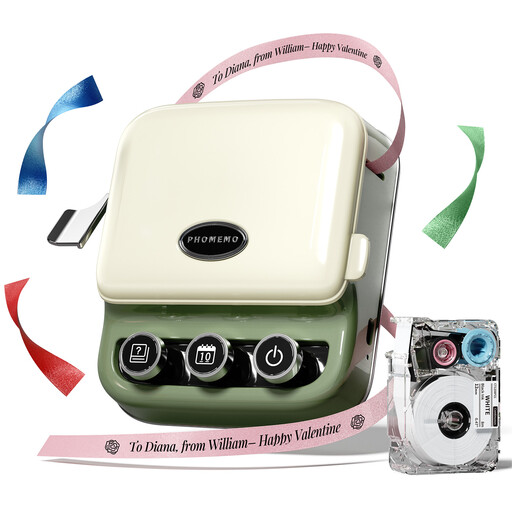
The product description mentions label and gift ribbon printing, as well as a Bluetooth connection. The printer itself should be protected from moisture and extreme temperatures.
For cleaning bottles, check whether the specific consumable is suitable for the bottle surface and intended use.
Not necessarily. In TRGS 201, the BAuA covers classification and labelling when working with hazardous substances; simplified approaches apply only in certain cases and when the relevant conditions are met. The information required for a specific bottle must be established based on the product and the risk assessment. This does not mean that every cleaning bottle needs a complete CLP retail label.
Choose a cassette that is compatible with your device, then check that the label sticks to the cleaned bottle surface and remains readable during intended use. Manufacturer claims about water or household cleaners apply to specific tape products, not every liquid.
DYMO recommends checking tape compatibility and the power supply, and cleaning dust or tape residue from the print head and platen roller if needed.
Compare the cassettes compatible with your model, their usable tape length and how many replacement tapes you’re likely to need. The right combination depends on the labels you need for your bottles.