
Lieferung heute & morgen

Qualitätsgarantie

Willkommens-Angebote freischalten: KOSTENLOSE Lieferung | Bis zu 80 % RABATT | Kostenlose 30-Tage-JoyPlus-Testphase
App herunterladen
By Joybuy Product Recommendation Officer, August 29, 2026
A climbing triangle is more than just a toy; it's a tool that promotes motor skill development and self-confidence in children. Inspired by educational approaches like Montessori and Pikler, this indoor climbing frame has become incredibly popular. But the market is crowded, and not every model delivers on its promises. As your Joybuy Product Recommendation Officer, I'll help you identify the crucial features and avoid common purchasing pitfalls.
Many parents invest in a climbing triangle expecting to get a durable and safe piece of play equipment. Unfortunately, a few common shortcomings often lead to disappointment.
To avoid a bad buy, you should focus your attention on a few objective, technical parameters. These form the basis for a safe and long-lasting motor skills toy for ages 2 and up.
The material is the most important factor for stability and safety. Look for products made from solid wood (e.g., beech, birch). Unlike MDF or particleboard, solid wood offers higher density and strength. The craftsmanship is just as crucial:
The stability of a climbing triangle, often referred to as a Pikler triangle, depends on its geometry and material thickness. A wide base ensures a secure footing and prevents tipping. A crucial, objective value is the maximum load capacity specified by the manufacturer. This should account not only for the child's weight but also for dynamic forces during climbing and play. A load capacity of 50 kg is a good benchmark for models designed for toddlers.
To maintain long-term play value, expandability is a central feature. Check if the climbing triangle is part of a system. The ability to combine a climbing triangle with a slide transforms the device into a small indoor playground. Some systems also offer chicken ladders, climbing nets, or connections to a climbing arch, creating new challenges time and again.
Based on the criteria above, we have selected a few products from our range that are suitable for different user profiles.
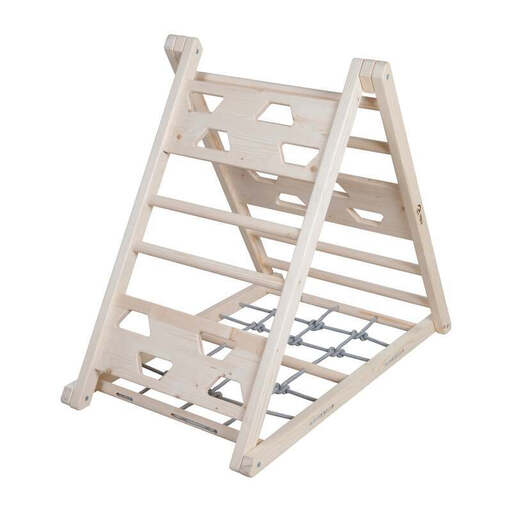
Why This Fits Their Persona: Ideal for parents looking for a classic, high-quality Pikler triangle as an entry-level model. It focuses on the core function of climbing and is designed for children aged 24 months and up.
The solid wood construction provides the necessary stability and durability, thus avoiding the pitfall of wobbly, low-cost models. Compatibility with a separately available slide prevents limited usability.
Versatile 3-sided system with rungs, a climbing rope, and grip surfaces. Supports up to 50 kg.
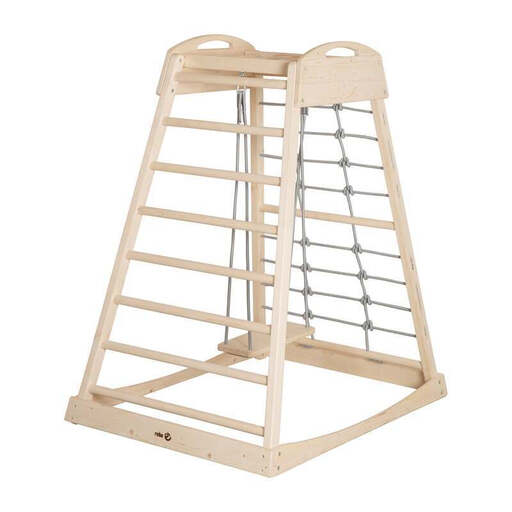
Why This Fits Their Persona: Perfect for families seeking a multifunctional indoor climbing frame that grows with their child over the years and offers more than just climbing.
This model goes far beyond a simple triangle. With climbing rope sides, gymnastic rings, and a solid wood swing, it offers a wide range of activities, escaping the trap of limited usability. The 70 kg load capacity ensures long-term use.
Multifunctional play equipment with a swing and gymnastic rings. High load capacity and also expandable with a slide.

Why This Fits Their Persona: An alternative for parents of very young children (crawling age) or for those who prefer a soft play environment without the fall height of a wooden frame.
This set of foam blocks completely bypasses the stability and material pitfalls of wooden equipment. There are no hard edges or rungs. The EN71 certification confirms compliance with EU toy safety standards.
Encourages climbing and crawling in a soft, safe environment. The covers are removable and machine-washable.
We have compiled a complete, up-to-date list of products that fully meet these strict selection criteria and European safety regulations.
Most manufacturers recommend their climbing triangles from the age of about 24 months. However, some children show an interest in pulling themselves up and climbing even earlier. The important thing is that the child can already stand securely and perform the first climbing movements independently. For younger children at the crawling stage, soft foam climbing elements can be a suitable alternative.
Safety is the top priority. Please observe the following points:
Yes, many high-quality climbing triangles are designed to be modular. The ability to attach a slide or a chicken ladder board is a common feature. When buying, check whether the manufacturer offers compatible accessories or if the design allows for universal compatibility with standard boards. This significantly increases the play value and the lifespan of the equipment.