
Lieferung heute & morgen

Qualitätsgarantie

Willkommens-Angebote freischalten: KOSTENLOSE Lieferung | Bis zu 80 % RABATT | Kostenlose 30-Tage-JoyPlus-Testphase
App herunterladen
Purchasing a new clinical thermometer might seem straightforward at first glance. However, the sheer variety of models and features can quickly lead to a poor choice. When illness strikes, an unreliable or unsuitable device is not just impractical—it can also lead to an incorrect assessment of a person's health. This guide will help you avoid common purchasing pitfalls and identify the right model for your needs.
As your Joybuy Product Recommendation Officer, I have analysed the essential features and drawbacks to provide you with an objective basis for your decision.
Before you make a decision, you should be aware of two common issues that often lead to dissatisfaction:
To make an informed choice, focus on the following three objective criteria. These are the primary determinants of a clinical thermometer's reliability and practicality.
Choosing the measurement method is the most important decision and depends heavily on the user's age.
In the EU, a clinical thermometer is a medical device and must bear a CE marking. This confirms that the product meets essential safety and performance requirements. Manufacturers usually state the measurement accuracy as a tolerance range (e.g., ±0.2°C). Look for models from established brands like Braun clinical thermometers or Medisana thermometers, which often integrate additional technologies to minimise user error. A clinical thermometer review by independent institutes can also offer guidance, but your individual needs are what matter most.
Modern devices offer more than just a temperature display. Some features provide real value for families:
Instead of making a blanket recommendation, we have identified products that meet specific user profiles and avoid the pitfalls mentioned.
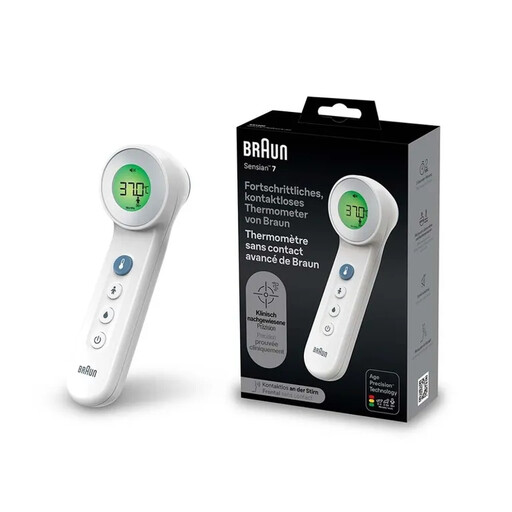
Why it's a good fit: This device combines a gentle contact measurement with a no-touch option, ideal for sleeping babies. The age-dependent fever detection gives parents extra confidence when interpreting the readings.
The positioning aid (PositionCheck technology) minimises user error—a common cause of inaccurate readings with forehead thermometers.
Age Precision technology (age-adjustable fever guidance), silent mode for night-time use, and the ability to measure liquids (e.g., bath water).

Why it's a good fit: For users who want a simple, reliable, and affordable device for rectal, oral, or axillary measurement. It focuses on the core function without distracting extras.
This model deliberately avoids multi-functionality. It is purely a contact thermometer, whose measurement methods (especially rectal) are considered highly reliable and less prone to user error.
Flexible tip for enhanced comfort, waterproof tip for easy cleaning, and an audible fever alarm. A solid, back-to-basics device.
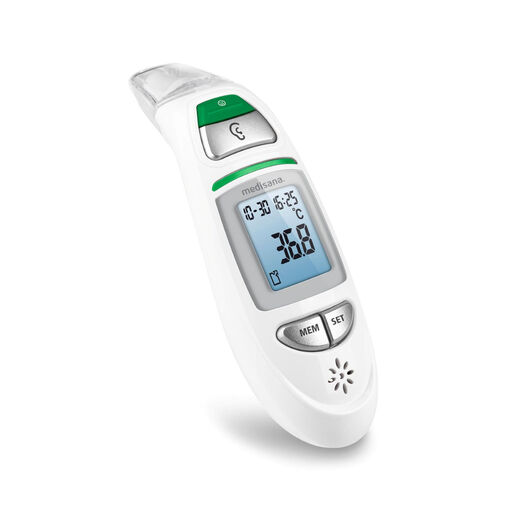
Why it's a good fit: For families who need flexibility. It offers both forehead and ear measurement and can also be used for surfaces and liquids, making it a practical helper in daily life.
Although it is a multi-function device, it comes from Medisana, an established manufacturer of medical products. It combines two recognised measurement methods (ear and forehead), thus avoiding the trap of an inaccurate all-in-one sensor.
Combination of ear and forehead measurement, visual fever alarm via a colour-changing display, and measurement of object and ambient temperature.
We have compiled a complete, up-to-date list of products that fully meet these strict selection criteria and German safety regulations.
Cleaning is crucial for hygiene and measurement accuracy. For contact thermometers, the tip should be disinfected after each use with a cloth soaked in 70% alcohol. The waterproof tip can also be cleaned under lukewarm water with mild soap. For infrared thermometers (ear and forehead), the sensor lens is the most sensitive component. Clean it carefully with a cotton swab lightly moistened with alcohol and allow it to dry completely. Never submerge the entire device in water.
Medically, a rectal measurement with a digital thermometer provides the most accurate core body temperature results for infants and young children. However, this method can be uncomfortable for both the child and the parent. Ear thermometers are a very good alternative for children aged 6 months and older, provided they are placed correctly in the ear canal. Forehead thermometers are the easiest and most gentle to use, but their accuracy can be more dependent on external factors and correct handling.
Battery life depends heavily on the model, frequency of use, and battery type (usually button cells or AAA batteries). Many devices are designed for several hundred to over a thousand measurements. An automatic shut-off function, which most modern thermometers have, significantly helps to conserve the battery. It is advisable to always have a set of spare batteries on hand.