
Lieferung heute & morgen

Qualitätsgarantie

Willkommens-Angebote freischalten: KOSTENLOSE Lieferung | Bis zu 80 % RABATT | Kostenlose 30-Tage-JoyPlus-Testphase
App herunterladen
A double roller blind clip-fix without drilling can provide privacy and protection from the sun in rented homes, owned properties and offices, without leaving holes in the wall or window frame. However, not every blind is suitable for every window. Purchases often go wrong because people compare only colour and price.
Typical problems include:
The product details should therefore be checked against the measurements and installation conditions in your own home before you buy.
A clip-on blind for windows is usually attached to the top of the window frame using clip-on brackets. The WOLTU models featured here are often designed for a frame thickness of 13 to 23 mm. Other versions specify a range of 1.3 to 2 cm.
Before ordering, you should:
According to the product descriptions, the models mentioned are not intended for wooden windows, roof windows, skylights or certain sliding windows and fixed glazing. For doors, you must also check that the double roller blind for doors will not catch on the wall, handle or furniture when the door is opened.
With a duo roller blind, the width shown on the product page generally refers to the overall outside width of the complete blind. Depending on the version, the actual fabric is approximately 3 to 5 cm narrower. To achieve effective privacy, you should therefore measure the width of the glass first.
As a guide, several WOLTU models recommend:
Order width = glass width plus approximately 4 cm
Example: for a pane of glass 46 cm wide, an order width of around 50 cm may be suitable. However, the blind must not obstruct the window handle. The height should be based on the full height of the window frame.
If you are fitting out several windows, measure each one individually. Even minor variations in older buildings or uPVC windows can cause a blind to sit crookedly or allow too much light in at the sides.
A zebra blind or double roller blind consists of alternating light-filtering and opaque fabric stripes. The chain mechanism moves the stripes over one another. This allows you to make the room brighter, partially screened or more private, depending on the setting.
This is not the same as completely blocking out the light. Even an opaque blind can leave gaps at the sides. For bedrooms where a high level of darkness is required, a traditional blackout roller blind with coated fabric is often more suitable. A polyester blind with alternating stripes, on the other hand, is ideal if you want flexible control over privacy and incoming light during the day.
You should also look out for:
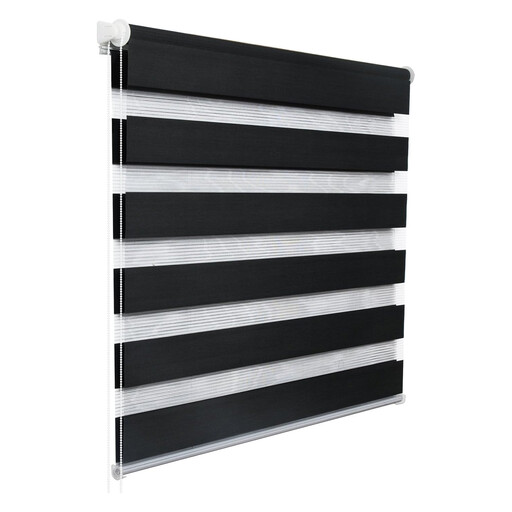
Why this product suits this profile: The compact width is suitable for narrower windows in bedrooms, living rooms or home offices. This model offers clip-fix installation for frames approximately 1.3 to 2 cm thick, as well as a chain mechanism that can be fitted on either side.
The specified frame thickness and narrower fabric width are clearly stated. This allows you to check before buying whether the dimensions are suitable for your window.
100% polyester fabric, three stated light settings and installation without drilling; screw fixing is also supported.
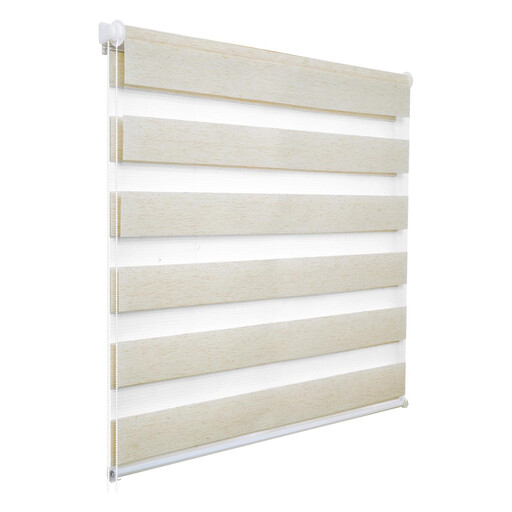
Why this product suits this profile: The beech wood-effect finish works well with neutral interior styles. This model offers a wide fabric, a chain mechanism and a child safety device included in the package.
The product details highlight the fabric width, which is approximately 4 cm narrower, the suitable rebate depth and cleaning with a damp cloth.
100% polyester, clip-fix and screw installation, plus a child safety device; suitable for windows, doors and walls according to the product description.
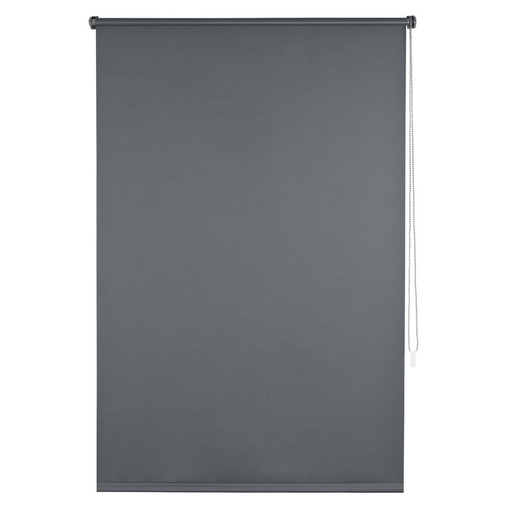
Why this product suits this profile: For bedrooms or rooms requiring stronger protection from light, coated blackout fabric is an alternative to a traditional zebra blind. The clip-on installation is designed for windows and doors.
The coating is clearly identified as a feature for blocking out light. This makes it easy to distinguish the design from a blind that only filters light.
Polyester blackout fabric with thermal coating, aluminium top profile and installation using the supplied clip-fix components.
We have put together a complete, regularly updated list of products that fully meet these strict selection criteria and the safety regulations applicable in the EU.
The window frame should be clean and dry before installation. Position the clip-on brackets evenly so that the roller tube sits level. Then check that the window can still be opened fully and tilted. Do not operate the chain mechanism beyond the designated stop.
For care, many polyester models only require a soft, dry cloth, a soft brush or a low-power vacuum cleaner. The double roller blinds mentioned here are not designed to be washed or machine-washed. Aggressive cleaning products can damage the coating and colour.
The chain must be secured using the designated safety device and kept out of reach of children and pets. Correct installation also reduces the risk of the blind coming loose or becoming misaligned during operation.
Durability depends on the frame, installation and daily use. Suitable clip-on brackets, a level position and a chain mechanism that is not operated with excessive force are all essential. If the window is opened frequently, check regularly that the brackets are still firmly secured.
Some models are designed for use on doors. Before buying, however, you must check the door frame thickness, handle position and range of movement. The blind must not catch when the door is opened or obstruct the door handle.
A duo roller blind with alternating transparent and opaque stripes provides adjustable privacy. If greater darkness is required, a coated blackout roller blind may be more suitable. You should also take side light gaps and the position of the window into account.