
Lieferung heute & morgen

Qualitätsgarantie

Willkommens-Angebote freischalten: KOSTENLOSE Lieferung | Bis zu 80 % RABATT | Kostenlose 30-Tage-JoyPlus-Testphase
App herunterladen
A clip-fix double roller blind without drilling can quickly provide rented homes, children's bedrooms and offices with privacy and flexible light control. It is usually fitted to the window frame, without wall plugs or drill holes. However, not every clip-on blind is suitable for every window.
Typical unsuitable purchases arise for three reasons: the ordering width is confused with the fabric width, the clip brackets do not fit the window frame, or a blind advertised as “opaque” only partially darkens the room. Terms such as thermal blind, privacy blind and blackout blind are not standardised quality categories either. The specific product details are what matter.
For a double roller blind, the stated width often refers to the overall width, including the brackets. Depending on the model, the fabric width may be around 4 to 5 cm narrower. For the most even privacy and sun protection possible, several WOLTU models recommend the following approach:
For a window with a glass width of 46 cm, an ordering width of around 50 cm may be appropriate. This is a recommendation from the relevant product description and must be adapted to the specific window frame. For doors or particularly wide windows, you should also check that the fabric will not rub against handles or fittings when the door or window is opened.
A blind without drilling is not automatically secured firmly to every window. The suitable frame dimensions vary by model:
Before buying, measure the thickness of the movable window frame at several points. Timber windows, roof windows, sloping windows and certain fixed-glazed or sliding windows are expressly excluded for several models. A clip-on blind also needs a suitable, sufficiently sturdy surface to rest on.
A zebra blind or day and night blind consists of alternating transparent and opaque fabric strips. By shifting the strips, you can adjust the amount of light entering the room from light-filtering to largely closed. Even when closed, some light may still enter at the sides.
If you want to keep a bedroom as dark as possible, a specially designated blackout blind with a coated reverse side is usually more suitable. The WOLTU blackout blind is described as having a silver-coated reverse side and, according to the product details, providing complete blackout. This is different from a light-filtering blind for a living room or kitchen.
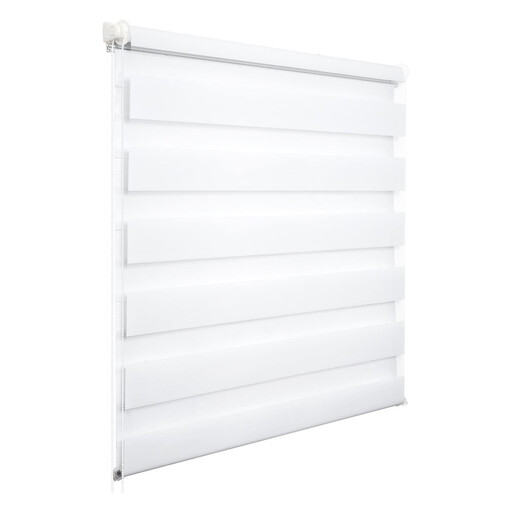
Why this product suits this profile: The compact design is suitable for smaller standard windows in rented homes, bedrooms or home offices. The chain control can be fitted on the left or right.
The description clearly states that the fabric width is approximately 4–5 cm narrower than the overall width. It also specifies a frame range of 13–23 mm.
Alternating polyester strips allow seamless adjustment between light-filtering and dimming. The blind can be installed with clip-fix brackets or screws.

Why this product suits this profile: This model combines clip-fix installation for frames measuring 16–22 mm with a cordless operating system, making it suitable for bedrooms and children's rooms.
The product details clearly distinguish between the overall width and the fabric width and specify the suitable frame range. A handle on the lower aluminium rail replaces the pull cord.
According to the product description, the fabric is made from 200 g/m² polyester with OEKO-TEX certification; the silver-coated reverse side is designed for blackout and heat regulation.
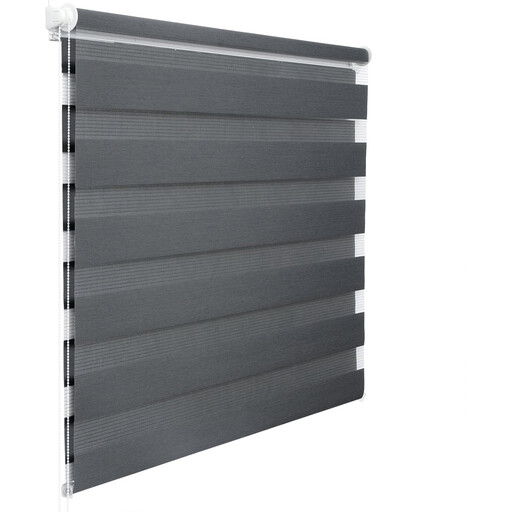
Why this product suits this profile: This design is intended for rooms with changing light requirements, such as kitchens, bathrooms, children's rooms, offices or balcony and patio doors.
The details specify suitability for frame thicknesses of 13–23 mm, as well as restrictions for roof and timber windows. The chain can be fitted on the left or right.
According to the product description, 100% polyester with heat-cut edges helps reduce fraying. The fabric can be cleaned with a damp cloth or a soft brush.
We have put together a complete, regularly updated list of products that fully meet these strict selection criteria and the safety regulations applicable in the EU.
Before installation, the window frame should be clean, dry and free from dust. Clip brackets must sit fully on the frame. The blind should not block the window handle or come into contact with the fittings when the window is opened and closed.
For models with a chain, a child safety device or secure chain guidance is important. Chains and small parts must be kept out of children's reach. A cordless blind must also be securely fitted and checked regularly for loose brackets.
For the models mentioned, a soft cloth or soft brush is generally sufficient for care. Washing machines, harsh cleaning products and abrasive sponges can damage the polyester fabric, coating or mechanism.
Its durability depends on the frame, clip brackets, operating method and frequency of use. The correct frame thickness and careful installation are more important than having the highest possible fabric density. The chain should be operated without sudden or jerky movements. If the window is opened frequently, regular checks of the brackets are recommended.
No. Only door and window frames with the dimensions specified by the manufacturer are suitable. Window handles, seals and protruding components must not interfere with installation. Roof windows and timber frames are excluded for several of the models listed. For a balcony door, you should also ensure that the ordering height matches the entire frame.
The price depends on the size, material, operating method and coating. A double roller blind offers flexible light control through its strips. A pleated blind without drilling, on the other hand, may be a better choice if you want top and bottom operation or particularly flexible positioning. The key consideration is therefore not just the purchase price, but also which function is needed for the specific window.