
Lieferung heute & morgen

Qualitätsgarantie

Willkommens-Angebote freischalten: KOSTENLOSE Lieferung | Bis zu 80 % RABATT | Kostenlose 30-Tage-JoyPlus-Testphase
App herunterladen
A clip-on day and night blind without drilling can quickly provide privacy and sun protection in rented homes, owner-occupied properties and offices. It attaches to the window frame, with no wall plugs or holes in the wall or reveal. Even so, not every model will suit every window. An unsuitable frame size, fabric that is too narrow or an awkward operating mechanism can significantly limit how useful your blind is.
As a Joybuy Product Recommendation Officer, I sift through product descriptions to pick out the details that matter and assess them against how you’ll actually use the blind. Three common buying misconceptions are particularly important to bear in mind.
A clip-on roller blind for windows and doors needs a compatible frame. Many WOLTU day and night blinds require a frame thickness of 13 to 23 mm. Other versions are designed for frames measuring 13 to 20 mm or for different thickness ranges. Depending on the model, wooden windows, roof windows, sliding windows and fixed-glazed windows may not be suitable.
Before buying, measure the rebate or frame thickness in several places. Make sure the window handle can still move freely, too.
For a day and night blind, the stated width often refers to the overall width, including the brackets. According to the product details, the fabric is usually around 4 to 5 cm narrower. If you only cover the glass, you may end up with visible gaps at the sides.
As a guide, several WOLTU models recommend adding around 4 cm to the glass width. However, your order should not extend beyond the window handle. For a door or particularly wide windows, check the actual overall dimensions and clearance separately.
A zebra blind, also known as a day and night blind, combines transparent and opaque stripes. A chain mechanism moves the stripes against each other, allowing you to adjust the light and privacy levels from light-filtering to partly private and fully private.
This is not the same as a fully blackout blind. If you need to keep residual light to a minimum in the bedroom, consider a separate blackout roller blind for indoor use with a coated backing. A traditional day and night blind is better suited to adjusting light and privacy throughout the day.
Before ordering, check:
Many models include fittings for screw mounting as well as clip-on fitting. This may be useful for homeowners, while a roller blind for a rented home will often be fine with the no-drill option. Make sure the brackets are fully in place and tightened before use.
First measure the glass width, then the full height of the window frame. Remember that the fabric may be narrower than the overall width. For doors, check whether the fabric will catch when you open or tilt the door.
A height of 150 or 220 cm refers to the available blind drop. It doesn’t automatically mean the blind will reach the floor on every type of window. A longer model may be more suitable for balcony or patio doors.
A polyester roller blind is easy to care for and holds its shape well. The WOLTU versions listed are mainly made from 100% polyester and can be cleaned with a soft cloth, a soft brush or, in some cases, a slightly damp cloth. Do not use harsh cleaning products or put the blind in the washing machine.
A roller blind with a chain mechanism can be fitted with the chain on the left or right, if the model offers this option. In homes with children, secure the chain using the supplied safety device and keep it out of children’s reach. If you’d rather not have an operating chain, you can also choose a model with a pull handle.
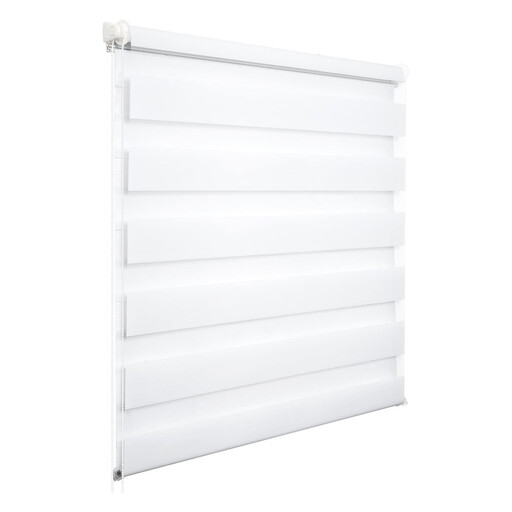
Why this product suits this profile: The standard size works well for many small to medium-sized windows. You can fit the chain on the left or right, and the brackets are designed for frames measuring 13 to 23 mm.
The product details specify frame compatibility and explain the difference between the overall width and the fabric width.
100% polyester fabric, a wipe-clean surface and optional screw mounting.

Why this product suits this profile: This model combines adjustable stripes with a specified chain safety device. The controls can be fitted on either the left or right.
The product details clearly state the narrower fabric width and list exclusions such as roof windows, wooden windows and certain other window types.
Clip-on or screw mounting, 100% polyester, and cleaning with a soft brush or damp cloth.

Why this product suits this profile: For bedrooms, children’s rooms or spaces where you need more effective room darkening, this model has a pull handle instead of a chain mechanism.
This is not a zebra blind with alternating stripes, but a separate blackout blind with a coated backing.
Cord-free pull-handle operation, 200 g/m² polyester and clip-on brackets for frames measuring 16 to 22 mm.
We’ve put together a complete, regularly updated list of products that meet these strict selection criteria and fully comply with the safety regulations in force in the EU.
The brackets are placed over the top of the window frame and secured in position. The frame thickness must match the manufacturer’s specifications. Depending on the version, the WOLTU models mentioned here are designed for frames measuring 13 to 23 mm or 13 to 20 mm.
Its lifespan depends on how it is fitted, operated, exposed to sunlight and cleaned. Polyester fabric is easy to care for, but should not be washed, ironed or treated with harsh products. A securely fitted blind and gentle use of the chain help reduce wear.
No. A manual day and night blind or blackout blind is operated by a chain or handle and does not need an electrical connection. There are no ongoing energy costs; you only need to consider the purchase price, care and any replacement parts.