
Lieferung heute & morgen

Qualitätsgarantie

Willkommens-Angebote freischalten: KOSTENLOSE Lieferung | Bis zu 80 % RABATT | Kostenlose 30-Tage-JoyPlus-Testphase
App herunterladen
A clip-on day and night blind without drilling can provide privacy and flexible light control for windows and doors, without leaving drill holes. The clip-on fitting is particularly handy in rented homes. However, not every model will fit every window. Unclear measurements, unsuitable frames or misjudging how much light a blind blocks can quickly lead to the wrong purchase.
Clip-on brackets need a suitable space on the window sash. Many WOLTU day and night blinds are designed for frames 13 to 23 mm thick. Other models may be made for frames measuring 13 to 20 mm or 16 to 22 mm. If the frame is too thin or too thick, the clip-on blind may not sit securely.
Before ordering, you should:
For a day and night blind, the stated width is usually the overall width, including the brackets. On various WOLTU models, the fabric itself is around 4 to 5 cm narrower. If you order based on the fabric width alone, you may end up with a blind that’s too narrow to provide enough privacy.
As a practical guide:
Always follow the measuring instructions for the specific product, as brackets and dimensions can vary between models.
A day and night blind, also known as a zebra blind, is made up of alternating translucent and opaque fabric stripes. You can shift the stripes using the chain. Depending on their position, they provide a light-filtering, partially privacy-screening or mostly opaque effect.
This is different from a traditional blackout blind with a coated backing. If you want to keep a bedroom as dark as possible, check the specific product description carefully. A light-filtering, privacy-screening blind is a good choice for a living room, kitchen, home office or bathroom when you still want to let daylight in.
A day and night blind for windows and doors is usually attached to the moving window sash. The clip-on fitting requires no drill and may be suitable as a blind for rented homes. Some products also include screws for permanent fitting to a wall, ceiling or window frame.
Not every model is suitable for roof windows, wooden windows or certain fixed-glazed windows. Before buying, check that the stated areas of use are compatible with your existing window design.
The day and night blinds listed are mostly made from 100% polyester. Depending on the model, you can clean the fabric with a soft cloth, a soft brush or a lightly dampened cloth. Harsh cleaning products and vigorous rubbing can damage the surface.
For kitchens and bathrooms, it’s also worth checking whether the manufacturer says the product is suitable for humid rooms. This doesn’t mean the fabric should be exposed to direct water or heavy condensation for long periods.
A blind with a chain can be adjusted to any position and, depending on the model, fitted on either the left or right. The operating chain must be secured safely and kept out of reach of young children. In homes with children or pets, a model without an operating chain, such as a handle-operated blind, may be an alternative.
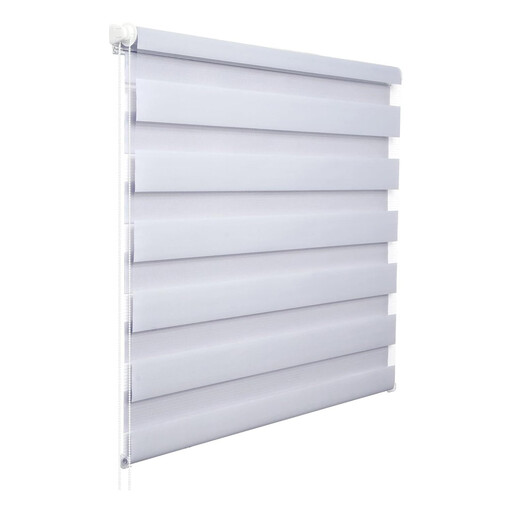
Why this product suits this type of buyer: The 110 × 150 cm size is suitable for interior windows of the corresponding width. This model combines clip-on fitting, chain operation and grey polyester fabric.
The product details specify a suitable frame thickness of 13–23 mm and note that the fabric is narrower than the overall width. This makes it easier to check the measurements against your window before ordering.
Clip-on and screw fitting, stepless light control, and a chain that can be fitted on the left or right.
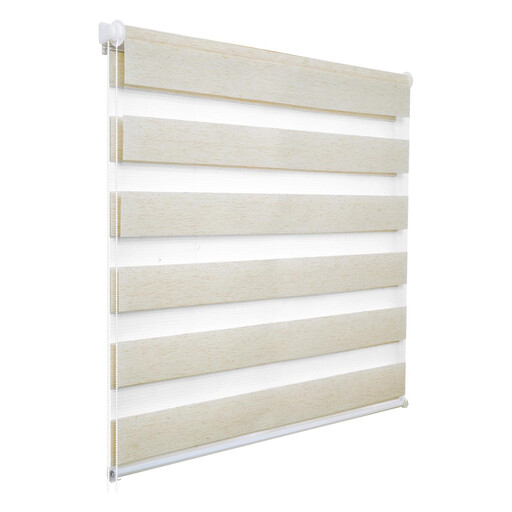
Why this product suits this type of buyer: The wood effect works well with a range of interior styles. The striped fabric lets you adjust the balance between light and privacy.
The product details state a rebate depth of 1.3–2 cm, a fabric width around 4 cm narrower than the ordered width, and that a child safety device is included.
100% polyester, a wipe-clean surface, clip-on or screw fitting, and chain operation.

Why this product suits this type of buyer: This model is worth considering if you’re looking for a blind that blocks more light for a bedroom, home office or living space, and would rather not have an operating chain.
The product details clearly distinguish it from a traditional zebra blind: it has a coated backing, is operated by a handle and is designed for frames measuring 16–22 mm.
Clip-on or screw fitting, handle-operated height adjustment and 200 g/m² polyester fabric, according to the product description.
We’ve put together a complete, regularly updated list of products that meet these strict selection criteria and the safety regulations in force in the EU.
Clean the window frame before fitting the blind, then attach the clip-on brackets according to the instructions. Once hung, the blind should move smoothly without touching the window handle. Check that it’s secure before using it for the first time.
A soft, dry cloth or a soft brush is usually all you need for routine care. For wipe-clean fabrics, you can use a lightly dampened cloth. Don’t yank the chain or pull it with excessive force.
How long it lasts depends on the frame thickness, fitting, use and weight of the blind. A clip-on bracket that fits properly can hold securely. Make sure all the brackets are firmly attached before use, and check them regularly.
This is possible with models designed for that purpose. Check the door width, make sure the handle can move freely and take the height of the door frame into account. If you open the door frequently, a smooth-running chain or a handle-operated system may be a good choice.
No. A traditional chain-operated blind is operated by hand and doesn’t need an electrical connection. The only ongoing costs are for cleaning and, if needed, replacement parts.