
Lieferung heute & morgen

Qualitätsgarantie

Willkommens-Angebote freischalten: KOSTENLOSE Lieferung | Bis zu 80 % RABATT | Kostenlose 30-Tage-JoyPlus-Testphase
App herunterladen
A clip-on double roller blind with no drilling required is suitable for rented homes, owner-occupied properties and any room where you want to leave the window frames or walls untouched. Alternating sheer and opaque fabric stripes let you adjust the amount of light in stages. Depending on the setting, you can let in more daylight, enjoy partial privacy or reduce the light considerably.
Before you buy, it’s worth avoiding a few common pitfalls. Not every model described as a ‘no-drill blind’ will fit every window frame. Details about fabric width, room darkening and installation are also often misunderstood.
For many clip-on blinds, the stated width refers to the whole blind, including the brackets. Because of the way they’re made, the fabric is usually around 4 to 5 cm narrower. If you measure only the glass and don’t check the product details, you may end up with a blind that’s too narrow to provide the privacy you need.
As a general guide for many models:
This recommendation depends on the model. Always refer to the details on the relevant product page.
A day-and-night blind or zebra blind with opaque stripes can considerably reduce the amount of light entering the room. However, light may still come through gaps between the fabric and at the sides. A light-filtering room-darkening blind is therefore not automatically the same as a blind with a coated backing that blocks out the light completely.
For bedrooms, consider whether you need flexible light control or the most complete blackout possible. A traditional double roller blind is designed primarily to give you flexible control over privacy and light. If you want to block out as much light as possible, a specialist room-darkening blind with a coated backing may be a better choice.
The clip-on brackets need to fit the rebate or frame thickness. For several WOLTU models, the stated range is 13 to 23 mm; other versions are designed for 13 to 20 mm or 1 to 10 mm. Depending on the model, wooden windows, roof windows, sliding windows and certain fixed-glazed windows may not be suitable.
Before ordering, you should:
A clip-on blind is usually attached to the top of the window frame using brackets. You won’t need a drill or wall plugs. Some versions also include screws for a more permanent fit to the wall, ceiling or frame.
Clip-on fitting is particularly suitable for rented homes. However, it will only be secure if the frame thickness and bracket are compatible. If you’re fitting a blind to a door that’s opened frequently, make sure it’s firmly in place and that the chain is guided appropriately.
The WOLTU models described here are mostly made from 100% polyester. Heat-cut edges can help reduce fraying. Depending on the model, care recommendations include using a soft cloth, a soft brush or a vacuum cleaner on a low setting. Many versions must not be washed or machine-cleaned.
A polyester blind that can be wiped clean with a damp cloth is practical for kitchens and bathrooms. Avoid harsh cleaning products, as they can damage the fabric and its coating.
A chain-operated blind lets you adjust the sheer and opaque stripes in stages. On some models, the chain can be fitted on either the left or right. Secure the chain using the safety device supplied and keep it out of children’s reach. This is particularly important in children’s bedrooms and homes with pets.
If you’d prefer a blind without a chain, you could consider a room-darkening blind with a bottom rail that can be operated by hand. However, it works differently from a traditional double roller blind.
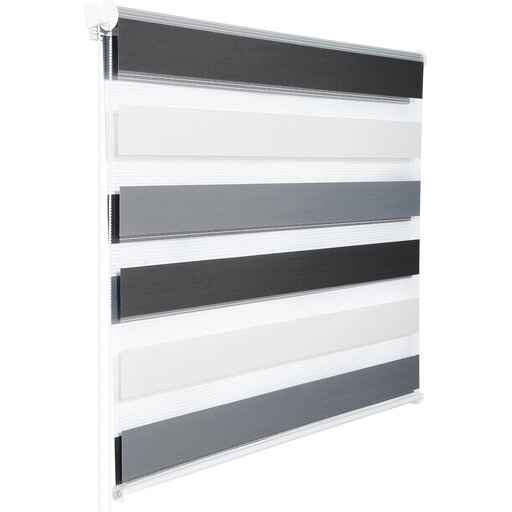
Why it suits this profile: The wood-effect finish works well in living rooms and home offices, while the 120 cm width can cover larger windows.
The product details specify a suitable frame range of 1.3 to 2 cm and note that the fabric is around 4 cm narrower.
100% polyester, chain operation, clip-on and screw-fixed fitting, plus a surface that can be wiped clean with a damp cloth.

Why it suits this profile: The product description mentions a chain holder, a white bottom rail and the option of screw-fixed fitting.
The required frame thickness of 13 to 23 mm is clearly stated, along with exclusions for roof windows, wooden windows and certain non-standard windows.
100% polyester, chain that can be fitted on the left or right, clip-on and screw-fixed fitting, plus stated OEKO-TEX and GRS features.
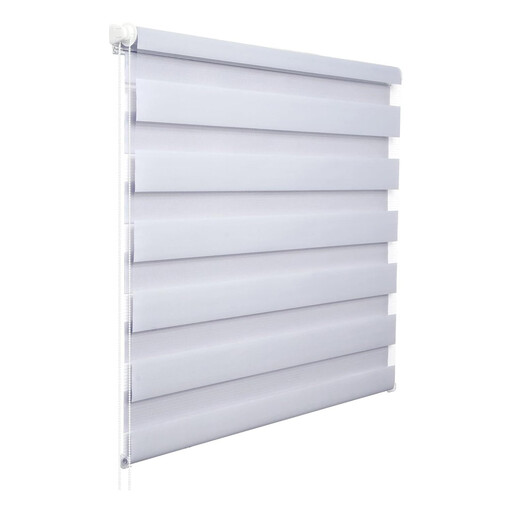
Why it suits this profile: This version is designed for living rooms, offices and more humid areas, and offers flexible operation using the side chain.
The details specify a frame range of 13 to 23 mm, a narrower fabric width and that the blind is not suitable for roof or wooden windows.
Heat-cut polyester edges, a surface that can be wiped clean with a damp cloth, and a chain that can be fitted on the left or right.
We’ve put together a comprehensive, regularly updated list of products that meet these strict selection criteria and fully comply with the safety regulations applicable in the EU.
Fit the clip-on brackets as instructed and tighten them evenly. The blind must not rest against the window handle or prevent the window from moving fully. Before using it, check that the bracket is secure and the chain moves smoothly.
A soft, dry or slightly damp cloth is usually all you need for cleaning. You can use a soft brush on delicate fabrics. Do not wash the blind, rub it vigorously or clean it with abrasive products.
No. The frame thickness required depends on the model. A range of 13 to 23 mm is often specified, but some versions need different measurements. Roof windows, wooden windows, sliding windows and fixed-glazed windows may not be suitable.
Measure the width of the glass and the height of the entire window frame. For many WOLTU models, the recommended order width is the glass width plus around 4 cm. Also check that the window handle will remain unobstructed and that the fabric is narrower than the overall blind.
Its lifespan depends on how it’s fitted and operated, how much sunlight it gets and how it’s cared for. A securely fitted bracket, a chain that moves without being forced, and cleaning in line with the manufacturer’s instructions can all help keep it in good working order. It’s not possible to give a general lifespan without knowing the conditions in which it will be used.