
Lieferung heute & morgen

Qualitätsgarantie

Willkommens-Angebote freischalten: KOSTENLOSE Lieferung | Bis zu 80 % RABATT | Kostenlose 30-Tage-JoyPlus-Testphase
App herunterladen
A clip-on dual roller blind without drilling can quickly provide privacy and sun protection in rented flats, homes and offices. The key benefit is that it is fitted to the window sash, without drilling holes into the wall or frame. However, not every blind is suitable for every window. Incorrectly measured widths, unsuitable frames or an underestimated chain mechanism often mean that the blind does not run smoothly or fails to provide the desired level of privacy.
With a dual roller blind, the stated width is usually the overall width of the blind, not the fabric width alone. On several WOLTU models, the fabric is approximately 4 to 5 cm narrower than the order width. If you only measure the glass area and order that exact measurement, the blind may not provide enough coverage at the sides.
As a practical guide:
The specific installation instructions and details for the relevant model take priority.
A clip-on blind is normally attached to the window sash. The frame must therefore fit within the specified range. On various WOLTU dual roller blinds, the suitable frame thickness is 13 to 23 mm or 1.3 to 2 cm.
Depending on the model, the following are not suitable:
Before buying, you should also check whether a continuous seal or the window handle could obstruct the clamp brackets. For balcony and patio doors, a blind for windows and doors is a sensible choice, provided that installation on the door sash is expressly supported.
A zebra blind or duo blind consists of alternating light-filtering and opaque stripes. The chain mechanism shifts the stripes, positioning them over one another in different ways. This usually creates several levels of light control: transparent, partially opaque and more heavily screened.
This is practical for living rooms, kitchens and offices. However, if you need as little residual light as possible in the bedroom, bear in mind that a light-filtering blind with opaque stripes is not automatically a full blackout blind. Gaps at the sides can also allow light in if the fabric is significantly narrower than the window area.
Measure the frame thickness where the clamp brackets will be positioned. A no-drill blind should sit securely on the window sash, but it must not permanently compress the seal. Many models also include screws and fittings for wall or ceiling installation. This is an option for homeowners, while the clip-on version is particularly suitable as a blind for rented accommodation.
The order width includes the side brackets and winding mechanism. For improved privacy, the glass width plus approximately 4 cm is often recommended. With very narrow windows, doors or handles positioned close to the edge, the specific installation situation must still be checked.
For tall windows and doors, versions with heights of 150 or 220 cm are available. A longer model may be suitable for a balcony door, while a more compact version is often sufficient in a bathroom or on a small kitchen window.
A dual roller blind with chain allows the stripes to be adjusted continuously. Depending on the model, the chain mechanism can be fitted on the left or right. This makes it easier to adapt the blind to furniture, window handles and doors.
The WOLTU models mentioned are made from 100% polyester. Some feature thermally cut fabric edges, which may make them less prone to fraying. In most cases, a soft brush, dry duster or slightly damp cloth is all that is needed for cleaning. Washing and harsh cleaning products should be avoided. In kitchens and bathrooms, you should also ensure that the blind is securely installed and that there is adequate ventilation.
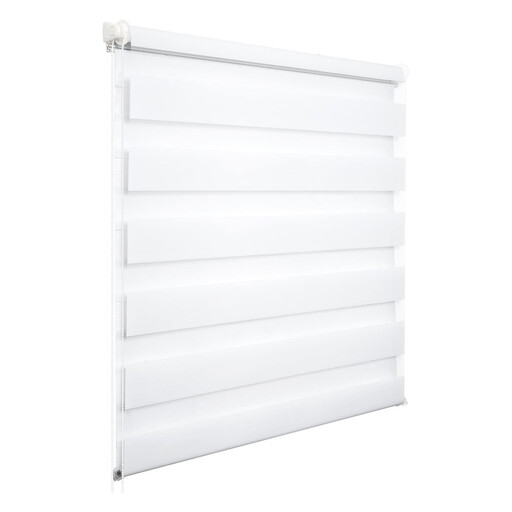
Why this product suits the profile: The 120 cm width is suitable for larger standard windows. The chain mechanism can be fitted on the left or right, allowing flexible operation without tools.
The product details specify the suitable frame range of 13–23 mm and point out that the fabric is narrower. This makes it easier to check whether installation is suitable before buying.
100% polyester, clip-on and optional screw installation, plus continuous light adjustment with a chain.
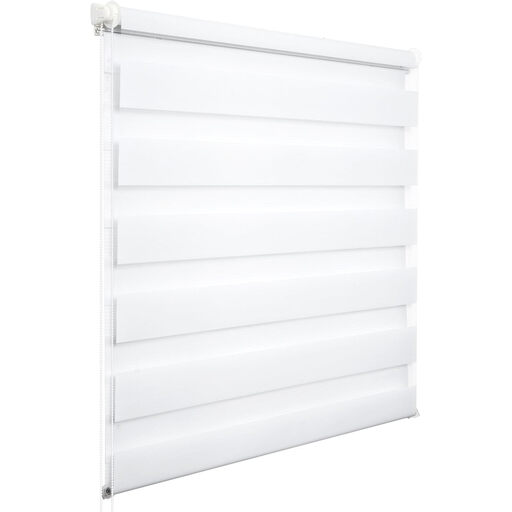
Why this product suits the profile: The 220 cm height is ideal for tall windows, balcony doors or patio doors, provided that the frame and opening direction are suitable for installation.
The product details limit use to suitable windows and doors and exclude roof windows, wooden frames and certain non-standard windows.
Tall design, chain operation possible on either side, and cleaning with a soft brush or damp cloth.
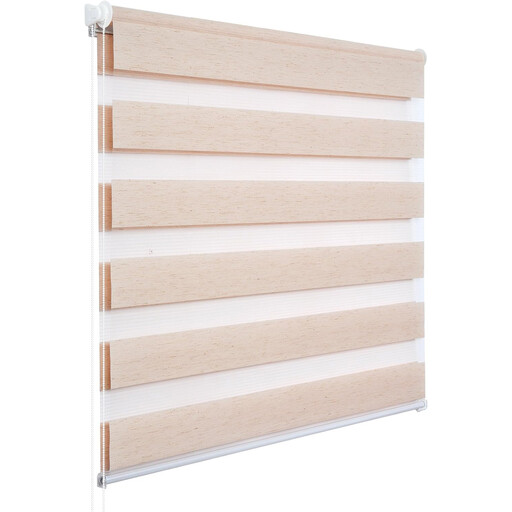
Why this product suits the profile: The wood-effect finish suits living rooms, bedrooms or offices where a warmer look is desired. This version is designed for everyday use.
The measurements take into account that the fabric is narrower than the overall width. Suitability for windows, doors and walls is specified separately from the clip-on frame depth.
100% polyester, wipe-clean surface and flexible light adjustment through transparent and opaque stripes.
We have put together a complete, regularly updated list of products that fully meet these strict selection criteria and the safety regulations applicable in the EU.
Measure the visible glass width and add approximately 4 cm for the models mentioned. The height is usually measured across the entire height of the window sash or frame. The handle must not be covered or restricted in its movement.
Its service life depends on installation, operation, exposure to sunlight and care. A correctly secured bracket, careful use of the chain and regular dusting can help maintain the blind’s functionality. It would not be reliable to give a general lifespan.
A duo blind provides variable privacy and different levels of light control thanks to its opaque stripes. However, it does not necessarily replace a specially coated blackout blind. For bedrooms where as little residual light as possible is desired, the fabric density, gaps at the sides and specific product description should all be considered together.