For class reunion interviews, the right option depends on whether you’re recording one or two voices, which recording device you’re using and whether people will be moving around. A wired lavalier suits a fixed position with a compatible input; a wireless set can accommodate conversations on the move or two people wearing microphones. A lavalier with a pocket recorder captures audio locally, without relying on a wireless connection. Shure recommends positioning the microphone closer to the speaker. A test recording with the fan running will show whether their voice remains clear in the room.
Who are these recording options suited to?
Interviewers recording in a room with a fan
If the fan will be running during the conversation, test the microphone position where you plan to record and assess speech clarity with a test recording. Shure recommends placing the microphone closer to the speaker; RØDE suggests clipping it to the chest as a possible starting point.
Teams recording two people in conversation
If the interviewer and interviewee might speak at the same time, check whether each person needs their own microphone and whether you want to record their voices on separate tracks. DJI says the Mic Mini can connect to two transmitters at once; the set contents and track mode are key.
Anyone capturing a one-off story
If a story will be difficult to retell, check that recording has started and is still in progress, then back up the file after the conversation. Zoom lists a HOLD switch and microSD card storage for the F2.
What should you look for when choosing?
Wired lavalier connected to a recording device
Best suited to: Conversations that take place mostly in one spot, with a microphone and device input that are compatible.
Trade-off: Cable length and positioning can restrict movement.
Wireless clip-on microphone set
Best suited to: People who need to move around, or situations where both speakers need their own close-worn microphone.
Trade-off: The number of transmitters, device connection, batteries and the track separation you want all need to suit your recording setup.
Lavalier with a pocket recorder
Best suited to: Recording one person locally, without relying on a wireless connection.
Trade-off: Check the recording status and memory card, and plan how you’ll transfer the file afterwards.
| Priority |
What to check before buying |
Who is this important to? |
| Clear speech with a fan running |
Position the microphone close to the speaker; make a test recording at the actual location with the fan running. |
If I can’t turn off the fan, I mainly want to be able to hear the speaker clearly. Around 31% of consumers prioritise clear speech when there’s fan noise. |
| Two voices and freedom to move |
Check the number of transmitters and receivers, and whether audio is recorded on a combined or separate track. |
If both people might speak at once or move around, I need a recording setup that captures both voices. Around 25% of consumers prioritise recording two voices up close or being able to move freely. |
| Connection to your existing device |
Check your device model and microphone input against the specific connector; USB-C and 3.5 mm TRS are different connection types. |
If I want to use my existing phone, camera or recorder, the connection needs to be compatible. Around 25% of consumers prioritise connecting to their recording device. |
| Saving a one-off recording locally |
Check how to start recording, how to prevent accidental stopping, the power supply and the memory card. |
If a story will be difficult to retell, I want to be able to check the recording and file storage right there with the speaker. Around 19% of consumers prioritise saving a single voice locally. |
Which buying decisions can go wrong?
-
Assuming noise reduction means you can skip a test recording
Noise reduction features are designed for certain types of background noise. Microphone distance and room acoustics still affect how clearly a voice is captured.
Make a test recording in your planned location with the fan running, then listen back before the interview.
A story that’s difficult to retell may be of limited use if the audio is unclear.
-
Choosing a set with one transmitter to record two separate voices
A close-worn microphone is only on one person. And even two transmitters don’t automatically mean the voices will be recorded on separate tracks.
Make sure the number of transmitters and the track mode of the specific set suit your conversation and editing workflow.
-
Assuming a suitable plug means your device is compatible
The Sennheiser XS Lav USB-C and RØDE Lavalier GO use different connection types. A plug that fits isn’t enough to confirm that a device supports the microphone signal.
Before buying, check your device model, microphone input and the specific microphone version.
A guide to the key brands
DJI
The Mic Mini is a compact wireless set for one person or, depending on the set version, two people wearing microphones.
- DJI describes two levels of noise reduction, including one for consistent indoor noise.
- This doesn’t confirm how well it works with a particular fan. The number of transmitters and the connection need to suit your recording setup.
RØDE
The Lavalier GO is a lavalier microphone for compatible 3.5 mm TRS inputs or transmitters. Wireless Micro is a separate wireless recording option.
- RØDE says the Wireless Micro has an optional feature to reduce persistent background noise.
- This feature shouldn’t be attributed to the Lavalier GO; the noise reduction described isn’t designed for every sudden sound.
Sennheiser
The XS Lav USB-C is a wired lavalier microphone for compatible mobile devices or computers.
- Sennheiser lists a 2 m cable, a USB-C plug and an included foam windscreen for this model.
- USB-C alone doesn’t confirm compatibility with every device; there’s no evidence that this model has built-in fan noise reduction.
Shure
The CVL is a lavalier microphone for compatible Shure wireless systems, making it an option if you already have the right wireless equipment.
- Shure describes a cardioid pickup pattern designed to reduce unwanted noise.
- A TA4F connector and a compatible system are required; recording without a suitable transmitter isn’t supported.
Zoom
The F2 is a body-worn recorder with a lavalier microphone for recording one person locally.
- Zoom lists 32-bit float recording, a HOLD switch and microSD card storage.
- Saving and transferring the file are part of the recording process; 32-bit float won’t remove fan noise.
Joybuy products for interviews
The Joybuy products below are wireless clip-on microphone sets, including versions with two transmitters. Check the connection and set contents for each product before choosing a recording setup.
 No image available
DJI Mic Mini 2S (2 TX + 1 RX + Ladeetui)
The two transmitters are useful if you want to mic up both people in the conversation at the same time.
Set contents as listed in the product name: 2 TX, 1 RX and charging case.
View at Joybuy
 No image available
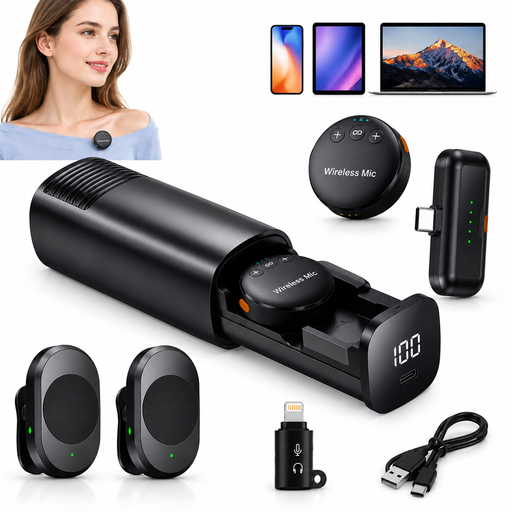
Wireless Lavalier Microphone Set (2 Transmitters, USB-C and Lightning)
The listed set contents include two transmitters, making it relevant for conversations where both people need to wear a microphone at the same time.
The product name lists 2.4 GHz, DSP noise reduction, latency under 20 ms, a range of up to 40 m and a 500-mAh charging case.
View at Joybuy
 No image available
Moman M1CXT (USB-C, 2 TX + 1 RX)
The two transmitters suit situations where both people need to be recorded at the same time, each with their own microphone; the listed connection is USB-C.
The product name lists a range of 150 m.
View at Joybuy
 No image available
SYNCO P1XT USB-C Wireless Microphone
For interviews with a compatible USB-C recording device; Android devices must support OTG.
The product name specifies a USB-C connection.
View at Joybuy
 No image available
Moman MS1X(C) (2 TX + 1 RX, USB-C für Android)
The product name describes a set for USB-C Android phones with two transmitters; check that it suits your device and recording setup.
The product name lists 2.4 GHz transmission.
View at Joybuy
Frequently asked questions
Can noise reduction remove the fan completely from a recording?
You shouldn’t rely on it to do that. RØDE describes the Wireless Micro’s feature as reducing persistent hum and hiss, not every kind of unwanted noise. Shure also recommends moving the microphone closer or recording in a quieter environment for clearer speech. Make a test recording with the fan running.
Where should I clip a lavalier microphone for an interview?
As a general starting point, RØDE recommends clipping it to the chest, around 20–30 cm from the mouth. Keep the capsule clear of rubbing clothing and check its position with a test recording.
What extra equipment should I plan for?
Check what’s included in the set and how it connects to your device before buying. A wired microphone may need a different input; a wireless setup requires compatible transmitters and receivers. A Zoom F2 uses batteries and a memory card.
Can I simply record conversations at a class reunion and share them?
Not necessarily: § 201 StGB makes recording speech spoken in private without permission, and sharing a recording made in this way, a criminal offence. Check whether you’re allowed to record before you start. When processing personal data, you also need an appropriate legal basis under Article 6 of the GDPR, as explained by the Federal Commissioner for Data Protection and Freedom of Information. Whether a particular conversation is private and which legal basis applies to your planned sharing will depend on the circumstances.


