Who are the different types of clothes airer suitable for?

Households that use face cloths frequently

If you need small cloths back in rotation soon as part of your weekly routine, a heated airer may be worth considering. Adler lists 18 heating elements for the AD 7821, but this doesn’t mean any particular drying time for individual cloths.

Households with a mixed weekly wash

If you want to dry small cloths alongside clothes or larger textiles, usable spacing and hanging room are key. Leifheit describes the Pegasus Ultra as having holders for small items; its stated drying length doesn’t tell you how well your particular mix of washing will fit.

People short on floor space

If you need to put your airer away after laundry day, compare its dimensions when open, the height between tiers and its folded size with the space you have available. Adler lists different open and folded dimensions for the AD 7821 and AD 7831.

What should you look for when buying?

Heated winged airer

A good fit if: You can hang small cloths and other items side by side, and have room for the wings when open.

Bear in mind: Heat uses electricity; the number of rails and the rated power don’t tell you how long your washing will take to dry. Adler lists 18 heating elements, 220 W and open dimensions of 148 × 52,5 × 90 cm for the AD 7821.

Heated tower airer or airer with a cover

A good fit if: Floor space is limited, or separate tiers would help you accommodate smaller and larger items. Adler lists 30 heated rails and open dimensions of 73 × 58 × 139 cm for the AD 7831; Silvergear offers a model with a cover and temperature and timer settings.

Bear in mind: Check the height of each tier and the airflow. A cover doesn’t remove moisture produced during drying from the room.

Unheated clothes airer

A good fit if: Your weekly wash can dry without a set deadline, and hanging space matters more to you than heated rails. Leifheit lists 23 m of drying space and holders for small items for the Pegasus Ultra.

Bear in mind: The airer doesn’t need electricity, but it won’t speed up drying with heated rails. Ventilation is still important indoors.

Electric airer with airflow

A good fit if: You’re looking for moving air rather than heated hanging rails. EASYmaxx describes its Elektro-Wäscheständer 900 as using cool air, with two tiers and clips for small items.

Bear in mind: This isn’t an airer with heated rails. Check the appliance’s rating plate for its exact power rating before working out electricity costs.

What matters What to look for when buying Who is this most relevant to?
Drying face cloths with space between them Check the number and layout of hanging spaces, and whether the care instructions for your textiles allow for the heat you plan to use. If I need the cloths again soon, I want to hang them with space between them. Around 37 % of consumers prioritise having dry face cloths available again soon.
Room for a mixed load Compare the usable spacing and tier heights with both small and longer items; manufacturers’ claims about load capacity don’t guarantee that your particular mix will fit. I need room for the whole weekly wash, without larger items pushing small cloths out of the way. About 27 % of consumers prioritise capacity for a mixed load.
Floor space and storage Measure the airer when open, including any washing that may overhang, and compare its folded size with your storage space. If space is tight, I want to know where I can set up the airer and where I can put it away afterwards. Around 18 % of consumers prioritise a small footprint.
Electricity use and room humidity For heated models, the rated power and actual running time affect your electricity bill. Remember to ventilate the room regularly too; the German Environment Agency recommends this when drying wet washing indoors. If I want to keep ongoing electricity use as low as possible, I compare using a heated airer with drying without electricity. Around 18 % of consumers put low running costs first.

Which assumptions should you avoid?

  • Assuming heated rails provide hygienic cleaning

    A clothes airer dries textiles that have already been washed. A heating function doesn’t demonstrate any cleaning or disinfecting effect.

    Treat washing and drying as separate tasks, and don’t infer hygiene benefits from the temperature of the rails.

  • Assuming the number of rails tells you whether it can handle a whole weekly wash

    Small cloths and longer items of clothing need different types of hanging space. A high number of rails alone doesn’t show whether your particular mix can be hung with enough room between items.

    Picture how you’d arrange your washing on the tiers, and check the overall height, spacing and clearance for hanging items.

  • Assuming a cover will solve damp air in the room

    A cover can help keep heat around the airer, but the moisture released as clothes dry still needs to be removed from your home.

    Choose a suitable spot that can be ventilated, and follow the instructions for the specific appliance. The German Environment Agency recommends ventilating regularly when drying wet washing indoors.

Which brands and product ranges are worth considering?

The product ranges below illustrate different designs and features; mentioning them doesn’t amount to a blanket recommendation of any brand.

Adler

Heated winged and tower airers for different space requirements.

  • Adler lists 18 heating elements, 220 W and open dimensions of 148 × 52,5 × 90 cm for the AD 7821. For the AD 7831, the manufacturer lists 30 heated rails and open dimensions of 73 × 58 × 139 cm.
  • These features don’t demonstrate a drying time for face cloths or a full mixed load. Check the spacing, the space needed when open and the care instructions for your textiles.

Silvergear

A heated clothes airer with a thermal cover and temperature and timer settings.

  • Silvergear lists 20 heated tubes and temperature and timer settings for its Premium model.
  • The supplier’s claims about faster drying aren’t independent measurements for this particular mix of washing. Also consider airflow and ventilation in the room.

Leifheit

Unheated clothes airers with hanging space and options for small items.

  • Leifheit lists 23 m of drying space and holders for small items for the Pegasus Ultra.
  • This model doesn’t have a heating function. The manufacturer’s drying-length figure doesn’t tell you how your particular mix of washing will fit on the airer.

EASYmaxx

An electric airflow alternative without heated rails.

  • The supplier describes the Elektro-Wäscheständer 900 as providing cool air circulation, with two tiers and clips for small items.
  • This isn’t a heated airer. Check the appliance’s exact power rating before calculating costs.

Joybuy products for mixed loads

This selection covers freestanding clothes airers for mixed loads. The product name mentions two rails and a shelf at the bottom.
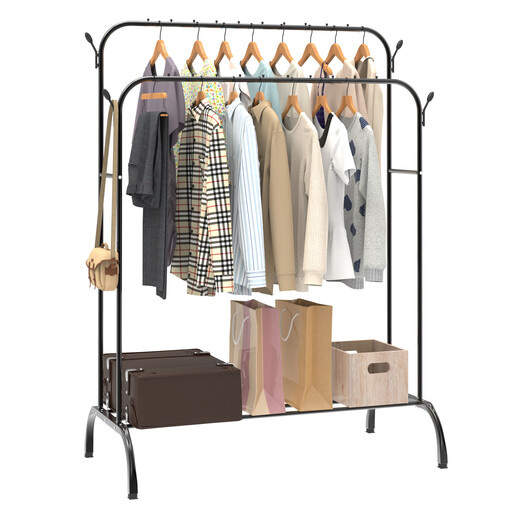
Freestanding clothes airer with two rails and a shelf at the bottom

Freestanding clothes airer with two rails and a bottom shelf

The two rails are useful if you’re planning to hang a mixed load across more than one rail.

The product name also mentions a shelf at the bottom.

When drying washing indoors, ventilate regularly; this is recommended by the German Environment Agency when drying wet washing.

Joybuy

Frequently asked questions

Does the heating function mean I don’t need to ventilate when drying clothes at home?

No. The German Environment Agency advises against drying washing at home where possible, and recommends ventilating regularly if you’re drying wet washing indoors. A heating function doesn’t remove moisture from the room.

How can I estimate the running costs of a heated airer?

Multiply the power in kilowatts by the actual number of hours it runs and your electricity price per kilowatt-hour. Adler lists 220 W for the AD 7821; two hours running continuously at its rated power works out at 0,44 kWh. This isn’t a measurement of a drying cycle.

What should I check before setting up an electric model?

Compare the space it takes up when open and the cable length with the spot you have in mind, and follow the instructions for the specific appliance. Adler lists 220–240 V, a 2-m cable and IP22 for the AD 7821; this doesn’t mean it’s suitable for every damp area.

Which markings are relevant for an electrical appliance sold in Germany?

Within its area of responsibility, Germany’s Federal Network Agency checks, among other things, the CE marking, whether the appliance and manufacturer can be identified, and whether the appliance comes with German instructions including the required safety warnings.

What rights do you have when buying online from a business seller?

For qualifying distance sales, you generally have a 14-day right to cancel; exceptions and rules on return costs also apply. According to information from the European Union, faulty goods are covered by a legal minimum guarantee of two years from the date you receive them. An additional manufacturer’s guarantee doesn’t replace these rights.