A folding clothes airer with heated bars may suit you if you wash towels regularly, provided you have enough space, the load capacity is right and you can ventilate the room. For longer or delicate outdoor garments, care instructions, cleaning and enough space between items matter more than extra heat. The SEECODE model’s manual limits its use to clothes washed in water, while Germany’s Federal Environment Agency recommends airing rooms regularly when drying damp laundry. Before choosing an electrical appliance, check the information and documentation for the specific model.
Who is this decision relevant to?
Households with towels that are often damp
If you regularly dry thick, freshly washed towels, you’ll need enough drying space and should air the room to remove the extra moisture. Germany’s Federal Environment Agency recommends airing rooms regularly when drying damp laundry.
People with outdoor layers
After wet or muddy activities, clean and dry each garment according to its care instructions. Bergans recommends following the washing instructions and hanging hardshell clothing up to dry afterwards.
Homes with limited space
Consider both the dimensions when the airer is open and its folded size, as well as the space between hanging items. Adler lists specific dimensions for the AD 7821, while Brabantia offers HangOn models in different designs.
What should you look for when buying?
Heated folding airer
A good fit if: you regularly dry freshly washed towels indoors and have room for the airer when it’s open.
Consider: the bars need electricity, and you’ll still need to leave enough space between items and air the room regularly.
Unheated clothes airer
A good fit if: you want to hang longer jackets or trousers with plenty of space around them and avoid applying heat to your clothes.
Consider: the bars aren’t heated, so drying time and space requirements still depend on the amount of laundry and the room.
Fan for an existing airer
A good fit if: you already have a suitable airer and would rather use moving air than heated bars.
Consider: a fan isn’t a clothes airer, so it needs to fit your airer; you’ll also still need to ventilate the room.
| Priority |
What to check when buying |
Who might find this important? |
| Drying space for towels |
Check the line length, spacing between bars and load capacity against the towels you own. SEECODE lists 22 heated bars and a 15 kg load capacity for its model. |
If I want to dry several thick towels at once, I need enough room and space between them. Around 33% of consumers say towel capacity is their main priority. |
| Caring for outdoor clothing |
Check the care label and cleaning instructions before applying heat. The SEECODE manual says the appliance is only for clothes washed in water; Bergans recommends following the care instructions for hardshell clothing. |
If I’m drying muddy jackets or trousers, I want to know how to clean them first and what sort of drying the fabric can withstand. Around 27% of consumers put fabric care first. |
| Space and storage |
Compare the open and folded dimensions with the space available. Adler lists the AD 7821 as 148 × 52,5 × 90 cm when open and 113 × 52,5 × 8 cm when folded. |
If space is tight in my home, the airer needs to fit when in use and be easy to put away afterwards. Around 20% of consumers say available floor space is their main priority. |
| Electricity and room humidity |
Consider the rated power and planned running time together: running at the full rated power of 280 W for one hour would use 0,28 kWh. Make sure you can ventilate the room; Germany’s Federal Environment Agency recommends airing rooms regularly when drying damp laundry. |
If I dry laundry in a living space, I want to estimate the extra electricity use and be able to clear the moisture. Around 20% of consumers pay particular attention to running costs and room humidity. |
Common pitfalls
-
Confusing heated bars with cleaning muddy technical clothing
A clothes airer won’t remove dirt. Patagonia says that dirt can affect a hardshell’s durable water-repellent finish; the manual for the SEECODE model reviewed limits its use to clothes washed in water.
Remove dirt according to the garment’s care instructions, then choose a suitable drying method.
-
Treating drying-time claims as directly comparable test results
Different brands’ drying-time claims aren’t necessarily based on the same fabrics, load sizes or room conditions.
Check which fabrics and conditions a drying-time claim applies to, and compare dimensions, load capacity and usage restrictions too.
-
Assuming a heated airer will solve high room humidity
When you dry clothes indoors, moisture is released into the room. Germany’s Federal Environment Agency recommends airing rooms regularly when there are extra sources of moisture, such as damp laundry.
Choose a spot where you can air the room regularly.
-
Assuming an unheated airer, a fan and a heated towel rail are the same thing
An unheated clothes airer doesn’t have heated bars, while a fan needs a suitable airer. A fixed heated towel rail also won’t necessarily provide a movable drying space for longer garments.
Before comparing products, check the type, how it’s installed and how much usable drying space it offers.
Brands and product ranges to consider
SEECODE
An electrically heated, folding clothes airer for indoor use.
- The Mobiset GmbH / SEECODE instruction manual lists 22 heated bars and a load capacity of up to 15 kg.
- According to the manual, the appliance is intended only for clothes washed in water and for private indoor use.
Adler
The AD 7821 is a compact, folding electric clothes airer.
- Adler lists 18 heating elements, 220 W and dimensions of 148 × 52,5 × 90 cm when open and 113 × 52,5 × 8 cm when folded for this model.
- The claimed reduction in drying time is a manufacturer’s claim, not a comparative test result verified here.
HEYDRY
An unheated fan that moves air around an existing clothes airer.
- HEYDRY lists two power settings of 14 and 18 W, and operation without heat.
- Check that the fan fits your existing airer. The claimed reduction in drying time hasn’t been independently confirmed.
Brabantia
The HangOn range includes unheated clothes airers in a variety of designs.
- Depending on the model, Brabantia lists different line lengths, hanger hooks and independently folding tiers.
- Features of individual models don’t necessarily apply to the whole range; these airers don’t have an electric heating function.
Joybuy product selection
This selection includes freestanding clothes airers for natural drying and a folding clothes airer with a heating function. Compare the product type with your available space and your clothes’ care requirements.
 No image available
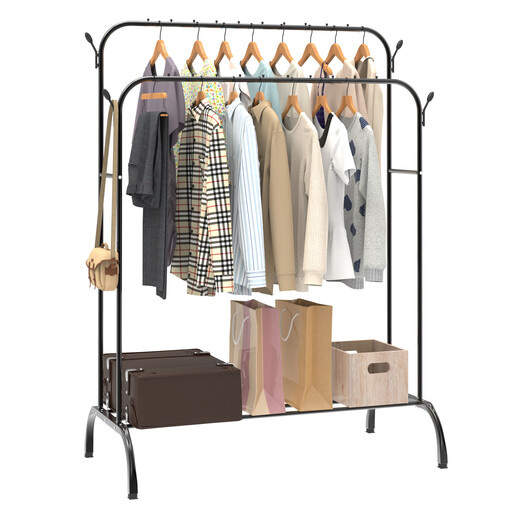
Freestanding double-rail clothes airer with shelf
According to the product description, this freestanding double-rail design is suitable for jackets and coats.
The description lists a load capacity of 20–30 kg and a lower shelf.
Joybuy
 No image available
Folding clothes airer with heating function, 144 × 53 × 96 cm
This folding design may suit washed laundry that needs a heated drying surface; check the documentation for the specific appliance before buying.
Dimensions: 144 × 53 × 96 cm (L × W × H). The product description lists 230 W, 45–55 °C and a load capacity of up to 10 kg.
Buying link unavailable
 No image available
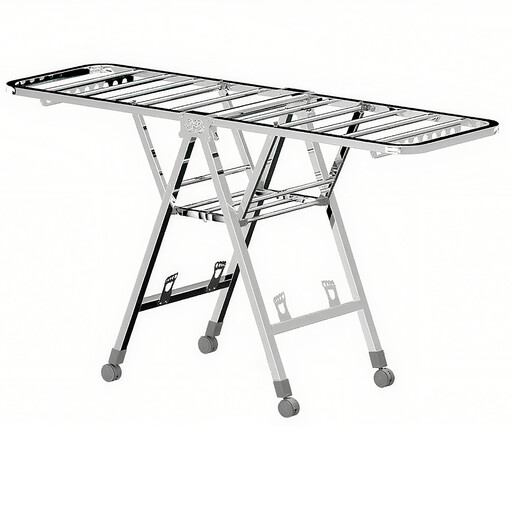
SNSP stainless steel winged clothes airer
According to the product description, the fold-out wings provide extra drying space for larger items.
This model is described as a folding stainless steel airer that can be folded away for storage.
Joybuy
Frequently asked questions
Can I put muddy outdoor jackets straight on heated bars?
Not without checking the garment’s care instructions first. Remove dirt as directed, then choose a suitable drying method. The manual for the SEECODE airer reviewed here is for clothes washed in water only.
Does a heated clothes airer mean I don’t need to ventilate?
No. Drying damp laundry releases moisture into the room, so Germany’s Federal Environment Agency recommends airing rooms regularly and paying particular attention when there are additional sources of moisture.
How should I set up and clean the SEECODE airer reviewed here?
The manual says it’s for use in private indoor spaces. Unplug it before cleaning or when it’s not in use. Don’t immerse it in water, and have a damaged power cable replaced only by the manufacturer or an authorised service centre. Follow the relevant manual for other models.
How can I estimate the electricity use of a heated clothes airer?
Multiply the rated power in kilowatts by the number of hours it’s used. At 280 W, one hour of continuous use at full rated power would use 0,28 kWh. Actual consumption and costs depend on factors including running time, power draw and your electricity tariff.
What should I know about buying and warranties for electric models?
Check the CE marking information and EU declaration of conformity for the specific appliance. According to the European Commission, the manufacturer is responsible for ensuring that a product meets the applicable requirements. New goods bought from a trader in the EU generally come with a legal guarantee of at least two years. This is separate from a voluntary manufacturer’s warranty.


