People with a limited laundry slot
You share washing or drying times and want to free up the communal drying space once your laundry is dry.


A folding heated airer may be a good fit if you need to dry clothes indoors and only have access to the drying space for a short time. However, you can’t work out how long a summer dress will take to dry from the heating function or rated power alone. For long dresses, or those that the care label says should be dried flat, the way you hang them and the space between them may matter more than heated bars. If you’re drying clothes indoors, factor in ventilation, and check the markings and conformity documents for the specific appliance before buying an electric model.
You share washing or drying times and want to free up the communal drying space once your laundry is dry.
You need an airer that suits the length of your dresses and the drying instructions on their care labels.
You need an airer that you can put away or position flexibly. If you dry clothes indoors, managing moisture is part of the plan; the Verbraucherzentrale (German consumer advice centre) recommends this too.
First, decide whether your shared schedule calls for a heated option or more room for suitable hanging space. In either case, you’ll also need to consider the floor space available, ventilation and electricity use.
A good fit if: you need to dry clothes indoors and want to free up the drying space once your laundry is dry.
The trade-off: A heating function doesn’t guarantee a set drying time; you’ll also need to factor in electricity use and ventilation.
A good fit if: you need to hang long dresses freely and can allow more drying time or have a suitable outdoor space.
The trade-off: This option doesn’t have a heating function; the weather and available space may affect your schedule.
A good fit if: several people share the drying space and you want to keep tiers free for different garment lengths or move the airer around.
The trade-off: The total capacity doesn’t tell you how many long dresses will fit at once with enough space between them.
| Buying priority | What to check | Who it matters most to |
|---|---|---|
| Free up the drying space in time | How many dresses fit on the set-up airer with enough space between them, and whether another suitable drying space will be available afterwards. | If I need to free up the shared space quickly after my laundry is dry, I need a routine that works for my clothes. Around 33% of consumers would put freeing up the drying space in time at the top of their list of priorities. |
| Hang dresses appropriately | Check the drying symbols, dress length, available height and width, and the distance from other laundry. | For long or delicate dresses, I first want to know whether the care label and the way I hang them are compatible. Around 27% of consumers would put finding a suitable way to hang their clothes at the top of their list. |
| Floor space and room humidity | Consider the set-up and folded dimensions, clear walkways, ventilation options and ways to monitor humidity. The Verbraucherzentrale points out that drying laundry releases moisture into the air in your home. | If the airer has to go in a shared room, I need a suitable spot and a way to get rid of the moisture. Around 20% of consumers would make space and room humidity their top buying priority. |
| Weigh up electricity use | Check the rated power of the specific model, how long you expect to use it and your own electricity tariff. | If I want to limit extra electricity use, I compare a heated airer with an unheated option and take my planned running time into account. Around 20% of consumers would make electricity costs their main buying priority. |
A rated power or heating function doesn’t tell you how long a particular summer dress will take to dry in your room.
Check the usable drying space, and don’t rely on power ratings or marketing claims to give you a set finish time.
Long dresses and fabrics that the care label says should be dried flat need to be arranged appropriately and have enough space.
Check the care label first, then measure the clear height and width of the airer when it’s set up.
As laundry dries, it releases moisture into the air in your home. The Verbraucherzentrale recommends airing the room to remove this moisture and keeping an eye on humidity.
Choose a spot that you can ventilate, especially if several people will be drying laundry there one after another.
For this use, the specific model 850-048 is a folding heated airer designed for indoor use.
The AD 7821 is a folding electric clothes airer. Adler lists its power as 220 W, its voltage as 220–240 V and its dimensions when open as 148 × 52,5 × 90 cm.
The unheated Pegasus Family Maxx 18m is an alternative for long garments that need to be hung up to dry. Leifheit lists a wing height of 1,28 m and 18 m of drying space.
The unheated HangOn Tower Drying Rack, 23m, offers flexible drying space. Brabantia lists three individually foldable tiers and four wheels.
The Joybuy range includes folding and wheeled clothes airers, including a heated model. It gives you a few options to compare when weighing up hanging space, floor space and storage as part of a shared laundry schedule.
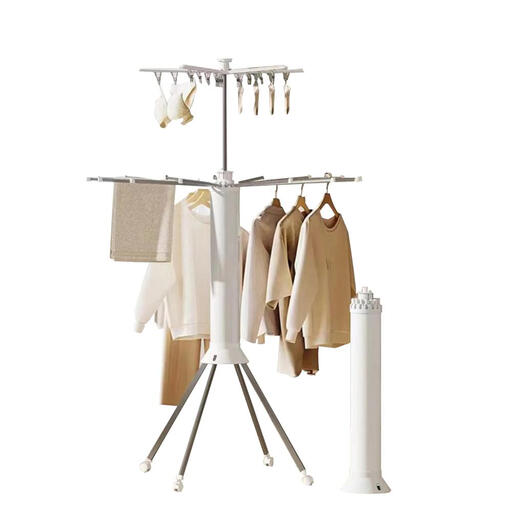 No image available
A wheeled, foldable design may suit you if you want to use the drying space flexibly and put the airer away afterwards.
The product description lists 16 extendable drying bars, 360° rotation and wheels.
 No image available
This folding heated option may suit you if you need to dry clothes indoors and its hanging space is compatible with the care instructions for your dresses.
Product details: 45–55 °C and dimensions of 144 × 53 × 96 cm (L × W × H). Before buying, check the CE marking and conformity documents for the specific appliance on offer.
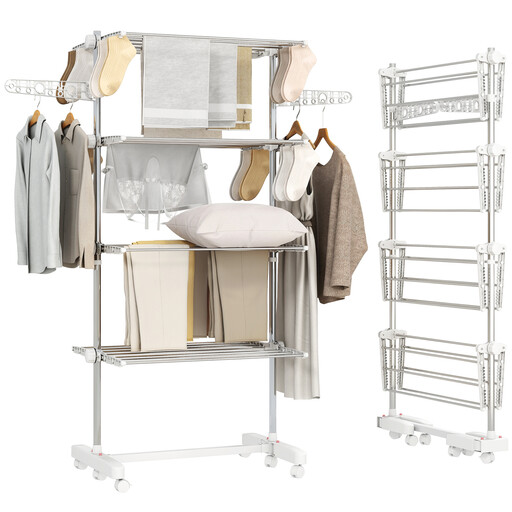 No image available
Several shelves and side arms can be useful if you want to arrange a wheeled drying space flexibly.
The product description lists four shelves, side arms and wheels.
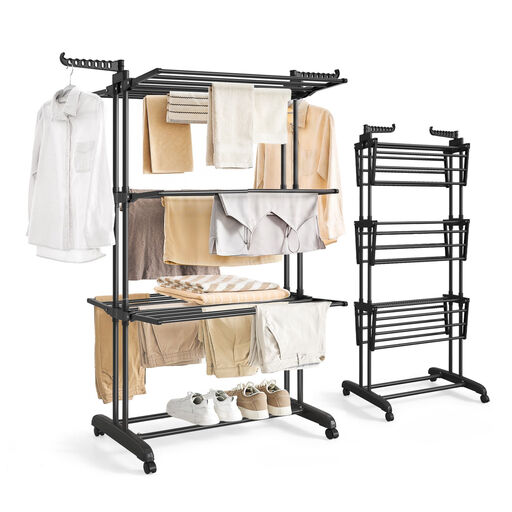 No image available
This multi-tiered, wheeled design may suit you if you want to arrange the drying space flexibly and fold the airer away after use.
The product description lists four tiers, two rotating wings, wheels and a foldable design. Dimensions when open: 64,2 × 126,6 × 169,2 cm.
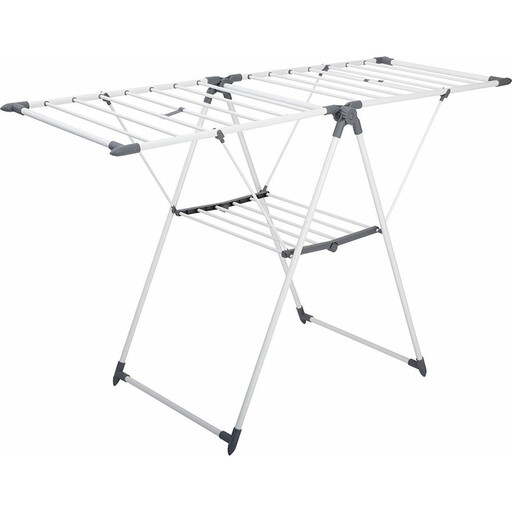 No image available
A freestanding design may suit you if you’re looking for an indoor clothes airer that folds away after use.
The product description lists dimensions of 150 × 61 × 96 cm.
No, you can’t tell from the fabric name alone. Check the drying symbol on each dress: GINETEX distinguishes, among other things, between line drying and drying flat. The care label and appliance instructions must also be compatible with how you plan to use it.
Yes. As laundry dries, water gets into the air in your home. The Verbraucherzentrale recommends airing the room to remove moisture and keeping an eye on humidity. A heating function doesn’t mean the room is being dehumidified.
Multiply the rated power of the specific model in kW by the running time in hours. To work out the cost, you’ll also need your price per kWh. Based on the 220 W that manufacturer Adler lists for the AD 7821, one hour running continuously at full rated power would use 0,22 kWh. This isn’t a measurement of actual consumption or of a complete drying cycle.
If a product is faulty, your statutory consumer rights are against the seller. A guarantee is an additional voluntary promise, and its scope depends on the terms and conditions. The Verbraucherzentrale therefore advises against treating an advertised guarantee as equivalent to your statutory rights when goods are faulty.
For an appliance sold in Germany with a rated voltage of 50 to 1.000 V AC, the EU Low Voltage Directive applies. As EUR-Lex summarises, the required conformity assessment and CE marking must be in place before the product is put on the market. At the end of its life, the electrical appliance should go to separate collection, not household waste, as explained by the German Federal Ministry for the Environment.