If you need individual uniform items ready again by the next school day and have space to put away a folding airer, a model with switchable heated bars may be a good fit. If there’s no rush, an unheated clothes airer is an option that uses no electricity. The key things to consider are the space it takes up when in use and folded away, the gaps between garments, care instructions and ventilation – heat doesn’t remove moisture from the room.
Who are the different options suitable for?
Families with limited storage space
If you need to put the airer away after drying, its folded size and the space it takes up when in use are two separate things to consider. Adler gives a folded size of 113 × 52.5 × 8 cm for the AD 7821; even a narrow airer needs enough room when fully opened.
Families who need uniforms ready the next morning
If you wash individual items in the evening, you could consider a model with switchable heat. However, manufacturers’ details about heated bars or temperature settings don’t guarantee a particular drying time.
Households with delicate uniform items
For shirts, skirts or trousers with specific care instructions, check the care label on the garment and the appliance instructions before drying. Only use heat if it’s suitable for the item in question.
What should you consider when buying?
Folding heated airer
A good fit if: you want to switch on the heat occasionally and fold the airer away flat afterwards.
Bear in mind: it needs electricity to run. Leave enough space between garments and remember to ventilate the room.
Wall- or ceiling-mounted warm-air airer
A good fit if: keeping the floor clear is especially important and you have a suitable wall or ceiling, as well as a connection for installation.
Bear in mind: installation and connection are more involved than with a freestanding folding model.
Unheated, narrow airer
A good fit if: there’s no rush or heat isn’t suitable for a uniform item. An over-bath model needs the bath to be free while the laundry dries.
Bear in mind: there’s no option to switch on heat.
Airer with a cool-air flow
A good fit if: hanging space and air circulation matter more to you than heated bars.
Bear in mind: an air-circulation appliance isn’t automatically heated. Check how the specific model works.
| What you need |
What to check before buying |
Who should pay particular attention? |
| Setting up and storing away |
Measure the dimensions when open, the folded size and the space needed for hanging uniform items separately. |
If the airer needs to fit into a narrow alcove, I’ll check its folded size and footprint separately; around 28% of consumers prioritise storage space. |
| Drying between school days |
Check the heating method, whether it can be switched off and whether there’s room to hang items separately. |
If an item is needed again the next morning, I want the option to switch on the heat when needed, without assuming a fixed drying time; around 22% of consumers are particularly concerned about time pressures. |
| Moisture in the home |
Choose a suitable drying spot where you can ventilate the room. |
When drying laundry indoors, I need a spot where I can ventilate the room; around 22% of consumers place particular importance on removing moisture. |
| Different uniform fabrics |
Follow the garment’s care label and the appliance instructions. A tumble-drying symbol alone doesn’t tell you whether heated bars are suitable. |
If uniform items have specific care instructions, I follow them and check that the hanging method is suitable; around 17% of consumers put fabric care first. |
| Running costs per use |
Consider the power rating and actual running time; to estimate energy use, use kWh = kW × hours. |
If I only want to use heat when needed, I compare energy use and running time rather than looking at the wattage alone; around 11% of consumers prioritise electricity costs. |
Common clothes airer buying mistakes
-
Assuming “electric” means “heated”
An electric clothes airer may circulate cool air without offering heated bars or warm air.
Check how the specific model heats (or circulates air) in its product details rather than relying on the product name alone.
-
Comparing only the folded size
An airer that folds away flat could still block a walkway when open or leave too little room for clothes to hang freely.
Measure both the space it takes up when in use and its folded size, allowing enough room for shirts and trousers.
-
Assuming heat will solve damp in the room
Even when laundry is dried with heat, moisture from the clothes gets into the room air. The German Environment Agency recommends extra ventilation when drying laundry indoors.
Choose a suitable spot that you can ventilate, and let the moisture out by airing the room.
-
Using the wattage to work out a fixed cost per uniform
The rated power alone doesn’t tell you how much energy a full drying cycle uses; the actual running time matters too.
Only calculate costs using appliance details that clearly relate to the specific model and your actual usage.
A guide to relevant brands
Adler
Adler’s AD 7821 is a folding clothes airer with heated bars, designed for households that need an airer that folds away flat.
- The manufacturer lists 18 heating elements, 220 W and a folded size of 113 × 52.5 × 8 cm.
- According to the manufacturer, the model measures 148 × 52.5 × 90 cm when open; these specifications don’t guarantee a particular drying time.
InnovaGoods
The product range includes both a folding heated airer and a covered warm-air dryer.
- For Warmat, the manufacturer lists 230 W, 20 heated bars, six temperature settings from 35–60 °C and a timer of up to twelve hours.
- According to the manufacturer, Dupledry Blue is a covered warm-air dryer rated at 1200 W; the power rating alone doesn’t prove that it dries better or is suitable for every uniform.
Foxydry
According to the manufacturer, Foxydry Pro is a ceiling- or wall-mounted airer with cool- and warm-air settings, for homes where keeping the floor clear is important.
- The manufacturer lists remote-controlled lowering and 750 W for warm-air operation.
- The installation location and electrical connection need to be suitable for your home. The wattage doesn’t measure the energy used per drying cycle.
Leifheit
The Pegasus Bath 12m is an unheated alternative that, according to the manufacturer, can be placed over a bath.
- Leifheit lists a width of 43 cm and 12 m of drying space.
- There’s no option to switch on heat, and the bath needs to be available as a place to set it up while the laundry dries.
EASYmaxx
According to the manufacturer, the Elektro-Wäscheständer 900 circulates cool air; it isn’t a heated airer.
- The manufacturer lists nine metres of drying space and room for up to 15 hangers.
- If you need heat, check before buying that the specific model really does have heated bars or warm-air drying.
Joybuy products for drying uniforms
This selection includes a folding clothes airer with a heating function and a folding electric tumble dryer with hot air. Before buying, check the details for the specific appliance and make sure it’s suitable for caring for your uniform items.
 No image available
Folding clothes airer with heating function, 45–55 °C
The folding design and heating function may suit you if you want to put the airer away after drying and switch on the heat when needed.
The product name gives a temperature range of 45–55 °C and dimensions of 144 × 53 × 96 cm (L × W × H). Before buying, check the conformity information that applies to the specific offer; a CE mark isn’t an independent quality mark.
Joybuy
 No image available
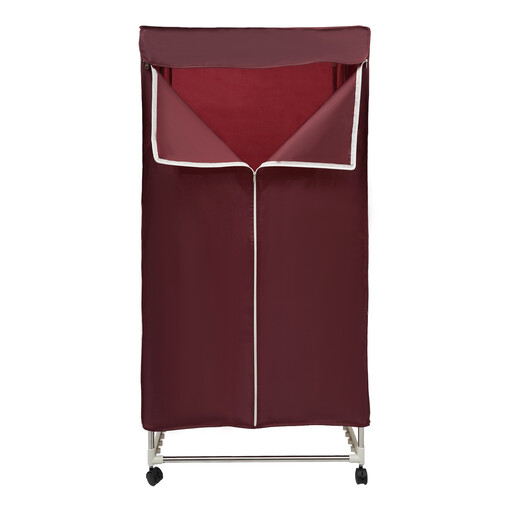
Folding electric clothes dryer with hot air and timer
A folding design may appeal to households that want to put an electric appliance away after use. The product description refers to a clothes dryer, not specifically to an open clothes airer.
The product description lists hot-air circulation, four timer settings and adjustable single- or double-tier configurations. Before buying, check the conformity information that applies to the specific offer; a CE mark isn’t an independent quality mark.
Joybuy
Frequently asked questions
Does a heated clothes airer need a CE mark in Germany?
If an appliance is covered by harmonised EU rules that require CE marking, it must carry the mark. The European Union explains which products need CE marking, while Germany’s Federal Network Agency includes checks on marking and manufacturer information as part of its market surveillance. The CE mark isn’t an independent quality mark.
Does heating mean you don’t need to ventilate?
No. Drying laundry indoors releases moisture into the room air. The German Environment Agency recommends extra ventilation to help remove this moisture.
Can you put a uniform marked “Do not tumble dry” on heated bars?
The symbol alone doesn’t tell you whether direct contact with heated bars is suitable. Check the care instructions for the specific uniform item and the appliance manual; don’t assume it’s suitable.
What should you do if an appliance bought online is faulty?
Your statutory rights for faulty goods are against the seller; a voluntary guarantee is separate. The German consumer advice centre explains that online purchases generally also come with a 14-day right to cancel. Check the specific requirements and exceptions that apply to your purchase.


