What should you look for when buying?
First, measure the available space and hanging clearance where you plan to put the airer. Then decide whether you need heat and how you’ll manage moisture in the room.
| Consideration |
What to check |
Who is it important to? |
| Footprint and hanging clearance |
Measure the airer when open and folded, as well as the distance to the floor. Adler gives the dimensions of the AD 7821 as 148 × 52,5 × 90 cm when open and 113 × 52,5 × 8 cm when folded. |
If I’m using a narrow corner, my longest dress still needs to hang freely. Consumers who prioritise footprint and hanging clearance make up roughly 31%. |
| Gentle hanging |
Check the care instructions, appliance manual and clearance from heated parts. The tumble-dryer symbol describes drying in a tumble dryer; it doesn’t indicate whether a garment is suitable for heated rails. |
If I’m hanging delicate summer dresses, I want to follow the care instructions and leave space between layers of fabric. Consumers who prioritise this make up roughly 25%. |
| Extra warmth |
Compare the heating method and, where available, the timer on the specific model. The wattage alone can’t tell you how long a dress will take to dry. |
If I’ll need a dress again soon, I check what kind of heating support the appliance actually offers. Consumers who prioritise extra drying assistance make up roughly 19%. |
| Room humidity |
Think ahead about how you’ll ventilate the drying area. The German Environment Agency recommends regular ventilation when drying damp laundry indoors; heat from the airer won’t remove moisture from the room. |
If I’m drying clothes at home, I need a practical way to get rid of the moisture. Consumers who prioritise room humidity make up roughly 13%. |
| Electricity use |
Consider how long the appliance will actually run and whether a non-electric airer would also meet your needs. The German Environment Agency lists clothes airers and washing lines as energy-efficient ways to dry clothes. |
If I dry clothes regularly, I want to know how long the appliance is likely to run and whether I need heat at all. Consumers who first weigh up electricity use make up roughly 12%. |
Joybuy products for small laundry spaces
The products below include a folding heated airer, a portable warm-air dryer and a non-electric wall-mounted option. Choose based on the space available, the care instructions for your clothes and whether you want to use extra heat.
 No image available
Folding heated clothes airer, 45–55 °C, 144 × 53 × 96 cm
This folding design is worth considering if its stated dimensions fit your space and you’d like to put the airer away after use.
The title gives a temperature of 45–55 °C and dimensions of 144 × 53 × 96 cm; the description lists 230 W and a maximum load of 10 kg. The listing gives a height of 96 cm in the title and 91 cm in the description. Check the dimensions before buying. The temperature stated doesn’t mean the airer is suitable for all delicate clothes.
View at Joybuy
 No image available
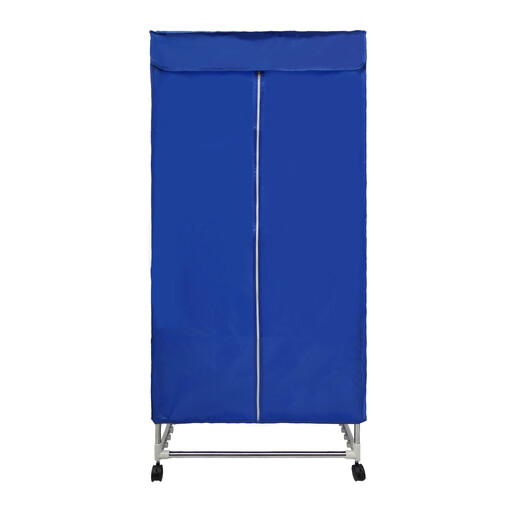
Portable folding electric clothes dryer, Blue
This warm-air design is worth considering if a covered, folding dryer will fit in your available space.
The description lists a timer, an Oxford fabric cover and an adjustable single or double tier. The stated power rating is 1.200–1.500 W; electricity use depends on how long it runs. Check the care instructions for each dress.
View at Joybuy
 No image available
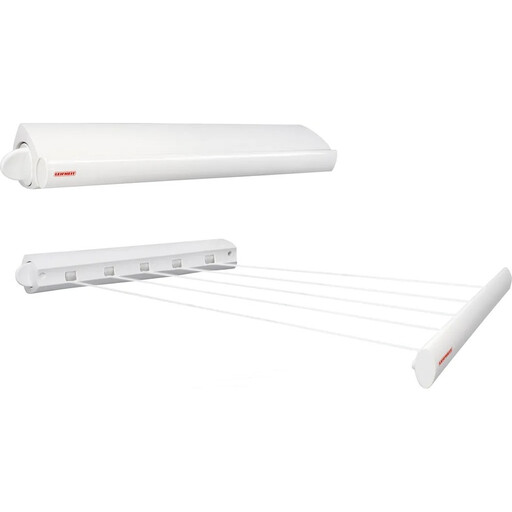
Leifheit Rollfix 210 Longline
This non-electric wall-mounted option is suitable if you don’t need a heating function and can install it in an appropriate spot.
The description lists five lines, each up to 4,20 m long, and a retractable mechanism. You’ll also need enough hanging clearance for long dresses, so check that the hem won’t touch the floor where you plan to install it.
View at Joybuy
Frequently asked questions
Does a crossed-out tumble-dryer symbol tell me whether or not to use a heated airer?
No. The symbol refers to drying in a tumble dryer; it neither explicitly approves nor specifically prohibits contact with heated rails. Check the garment’s full care instructions and the appliance manual.
What should I check before wall-mounting an airer?
At the intended installation point, check the fixings, clearance for lowering and hanging clothes, and access to a power socket, following the instructions for your chosen version. DOMO lists mounting kits for the DO7117DR; Foxydry describes brackets and the lowering clearance for Pro for walls. These details don’t automatically apply to other models.
Do I still need to ventilate the room when using a heated airer indoors?
Yes. The German Environment Agency recommends taking particular care to ventilate regularly when drying damp laundry indoors. The heating function won’t remove moisture from the room.
How should I interpret the power rating of a heated airer?
The power rating doesn’t tell you how long a particular dress will take to dry. For the Adler AD 7821, 220 W running continuously at its rated power for one hour works out at 0,22 kWh; this isn’t a measured figure for one drying cycle.
Does an electric clothes airer need CE marking in Germany?
Equipment covered by the EU Low Voltage Directive 2014/35/EU – including equipment designed for 50 to 1.000 V AC – must meet the relevant conformity requirements, including CE marking. Check the details on the specific appliance; the mark alone isn’t an independent performance test.


