
Lieferung heute & morgen

Qualitätsgarantie
App herunterladen
Kategorien
Choosing the right clothing storage is a practical decision, dependent on your available space and specific organizational needs. A garment rack offers a flexible and often space-saving alternative to traditional wardrobes. This article breaks down the key technical criteria for selecting a model and presents various configurations to help you make an informed choice.
The functionality of a garment rack is determined by its construction, material, and dimensions. A thorough analysis of these parameters is fundamental to selecting a product that meets your needs.
The durability and stability of a garment rack are directly linked to the materials used.
The maximum load capacity is one of the most critical technical specifications. It is usually stated separately for the hanging rail and for individual shelves.
Adaptability to the available space is a key criterion, especially in smaller living spaces.
The following models represent different approaches to clothing storage and have been selected for their specific functional properties.
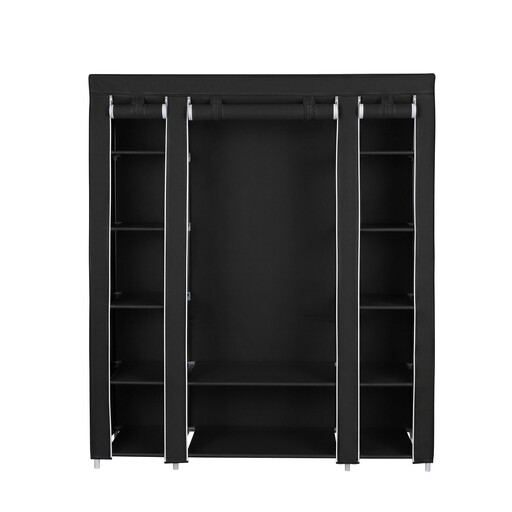
Why We Feature This Product: This model combines the functions of a clothing rack with the protection of an enclosed wardrobe. The construction of 16 mm metal tubes and a 120 g/m² non-woven fabric cover represents a balanced solution of stability and functionality. With 12 shelves and one hanging rail, it offers high organizational capacity on a 150 x 45 cm footprint.
Pros:
Best For: Those looking for a cost-effective, enclosed, and quick-to-assemble alternative to a solid wardrobe. Ideal for students, for use in a basement, or as a temporary solution.
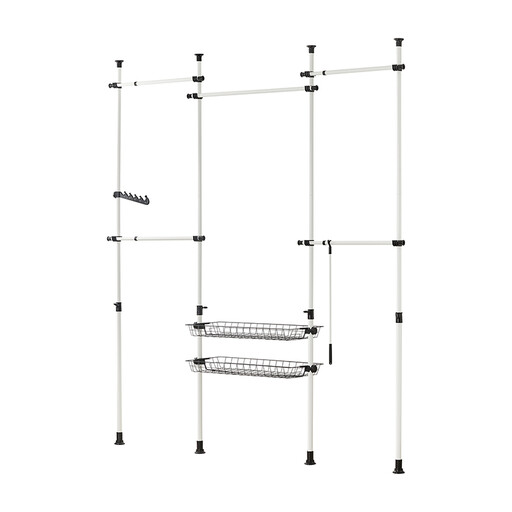
Why We Feature This Product: This wardrobe system stands out for its excellent adaptability. It can be infinitely adjusted in width (209–311 cm) and height (200–285 cm) and tension-mounted between the floor and ceiling. This allows for full utilization of the space without drilling. The total load capacity of up to 65 kg is remarkable for a system of this type.
Pros:
Best For: Users who want to create a walk-in, open closet solution for alcoves or entire walls and who value high load capacity and damage-free installation.
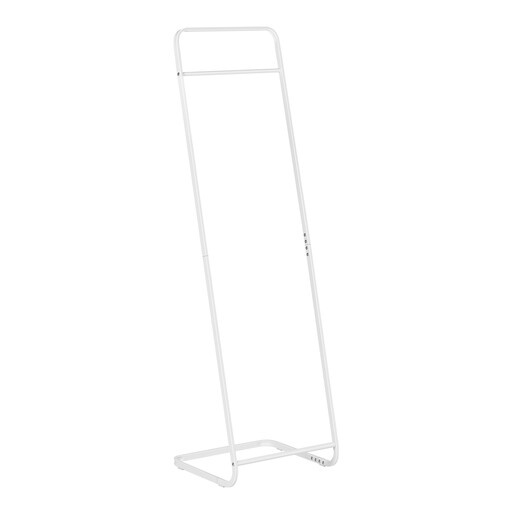
Why We Feature This Product: This coat rack is designed for maximum space efficiency in corners. With a footprint of just 40 x 40 cm (0.16 m²), its 140 cm high rail offers space for jackets and coats without taking up valuable floor space. The L-shape and an additional base crossbar provide the necessary stability.
Pros:
Best For: Individuals with very limited space who need a minimalist solution for the hallway, bedroom, or office to keep everyday clothing within easy reach.
The models presented cover specific use cases. If they do not fully meet your requirements, a wide range of other systems exists. An overview of different configurations, from simple clothing racks to more complex modular solutions, can be helpful in making a final product selection.
Discover more options in our Wardrobe for Clothes category.
1. How much weight can a garment rack hold? The load capacity varies greatly depending on the model and construction. Simple, lightweight models often support only up to 10 kg. Sturdy metal racks or telescopic systems can have a capacity of 15 kg per rail up to 65 kg or more for the entire system. The exact specification for maximum static load capacity is essential product information provided by the manufacturer.
2. How can a garment rack be stabilized? Several factors contribute to stability: even weight distribution on the hanging rail, the use of base crossbars, and placement on a level surface. For taller or heavily loaded models, using an included anti-tip kit to secure the rack to the wall is a recommended safety measure.
3. What is the difference between a garment rack and a coat rack? The terms are often used interchangeably. Technically, a coat rack is typically designed for an entryway and primarily serves to store jackets and coats, often featuring hooks instead of a continuous rail. A garment rack is a broader term and serves as general clothing storage in a bedroom or dressing room, usually equipped with one or more hanging rails and optional shelves.