
Lieferung heute & morgen

Qualitätsgarantie

Willkommens-Angebote freischalten: KOSTENLOSE Lieferung | Bis zu 80 % RABATT | Kostenlose 30-Tage-JoyPlus-Testphase
App herunterladen
A clothes rack is more than just a makeshift solution. It's a flexible and often stylish alternative to a bulky wardrobe, ideal for small apartments, rental properties, or as an open closet to showcase select pieces. However, the market is flooded with models of widely varying quality. Before you make a decision, it's crucial to understand the typical weak points that separate a good buy from a frustrating one.
As your Joybuy Product Recommendation Officer, I'll help you separate the wheat from the chaff. We'll focus on the facts so you can make an informed choice.
Many buyers focus on price or promotional images, overlooking critical design flaws. These three mistakes most often lead to disappointment:
To avoid the pitfalls mentioned above, you should carefully examine three technical parameters. These determine the durability, stability, and functionality of your new clothes storage solution.
The foundation of any stable clothes rack is its material. Look for models made of steel or stainless steel. These offer significantly higher strength than aluminium. Another indicator of stability is the tube diameter. Tubes with a diameter of over 25 mm are generally more torsion-resistant and designed for heavier loads. For a heavy-duty clothes rack, welded joints or solid metal screw connections are a clear sign of quality compared to simple plastic plug-in systems.
Don't just rely on the maximum specification in kilograms. Check how this load can be distributed. A good manufacturer will specify how much weight the clothes rail can hold and how much any shelves can support. As a rule of thumb: calculate the weight of your clothes and choose a model whose stated load capacity is at least 30% higher. This creates a safety margin and prevents the rail from sagging.
Different designs are suitable depending on your needs:
Here are some models that represent a considered choice for specific use cases, based on their objective features.

Why This Fits Their Persona: Ideal for those seeking a functional storage solution that also acts as a design element in the room. The combination of gold-coloured metal and an integrated shelf creates order without visually cluttering the space. Perfect for the bedroom or entryway.
The sturdy, floor-mounted metal construction prevents the wobbling common with lightweight plug-in systems. The clean structure with one rail and one shelf avoids overloading.
Combines a clothes rail and shelf in one slim design. The freestanding construction requires no wall mounting and offers flexible placement options.
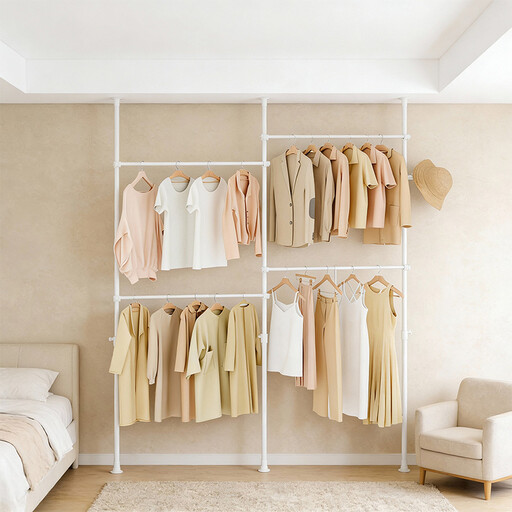
Why This Fits Their Persona: Perfect for renters who are not allowed to drill holes in the walls or need an adaptable solution for changing living situations. The system utilizes the full height of the room and can be adjusted in width to fill niches or entire walls.
The tension system between the floor and ceiling ensures high stability without wobbling. The flexible dimensions (height 200–295 cm, width 124–226 cm) solve the problem of ill-fitting measurements and make optimal use of available space.
Assembly without drilling or tools. According to the manufacturer, the system can hold up to 65 kg and offers enormous storage space with 3 telescopic poles and 4 clothes rails.

Why This Fits Their Persona: For anyone who needs to store a large wardrobe with many heavy items like winter coats, suits, or jeans. Its high load capacity and robust construction also make it suitable for commercial use or in a basement.
This model directly addresses the trap of misleading load capacity claims. With a stated maximum static load capacity of 150 kg and a frame made of steel tubes, it is designed for heavy weights and prevents sagging.
Very high load capacity and mobility thanks to lockable castors. The top bar is extendable, creating additional space for bags or accessories. According to the manufacturer, assembly is tool-free.
We have compiled a complete, up-to-date list of products that fully meet these strict selection criteria and UK safety regulations.
1. How much weight can an average clothes rack hold? The load capacity varies greatly. Simple models under ?30 often only hold 10-15 kg, which is quickly reached. Sturdy steel models start at around 40 kg capacity. Heavy-duty garment racks can support 100 kg or more. Always check the manufacturer's specific rating and plan for a safety margin.
2. How do I assemble a no-drill telescopic clothes rack? A telescopic clothes rack uses a spring tension system. You adjust the vertical poles to the approximate height of your room and then clamp them firmly between the floor and ceiling by compressing or twisting them. The pressure ensures a secure hold without damaging surfaces. The horizontal rails are then attached at the desired height between the vertical poles.
3. Are clothes racks on wheels stable enough for daily use? Yes, as long as you pay attention to the quality of the wheels and the frame. Models with four lockable swivel castors made of metal or robust PP plastic offer good stability. Once the brakes are engaged, the garment rack stands securely in place. However, for very heavy loads or uneven floors, a stationary model may be the safer choice.