
Lieferung heute & morgen

Qualitätsgarantie

Willkommens-Angebote freischalten: KOSTENLOSE Lieferung | Bis zu 80 % RABATT | Kostenlose 30-Tage-JoyPlus-Testphase
App herunterladen
A clothes rack can create additional storage space, keep clothing visible and make small rooms feel less cluttered. However, not every clothes rail is suitable for every wall, and a low price says little about stability or everyday practicality. Before buying, you should therefore check how much space is actually available, what types of clothing you want to hang up and whether permanent installation is an option.
The stated maximum load capacity does not automatically apply to every application. A clothes rack for lightweight shirts is subjected to different demands from a model used for winter coats, jeans or filled clothes boxes. In addition, the permitted load for wall-mounted models may vary depending on the wall surface.
Pay attention to:
Although a space-saving clothes rack requires little floor space, it must not block doors, drawers or walkways. With a clothes rack for small rooms, you should consider not only the width and depth, but also the height and how far the clothing extends outwards. Coats can project much further into the room than thin blouses.
Measure the intended area at several points. In rooms with sloping ceilings, alcoves or uneven floors, flexible systems are often more practical than rigid models.
A wall-mounted clothes rail makes use of unused wall space, but requires a suitable surface and proper fastening. Depending on the construction of a plasterboard wall, you may need suitable wall plugs. A product’s stated load capacity only applies under the mounting conditions specified by the manufacturer.
A freestanding clothes rack avoids the need for drilling. However, it must stand on a level surface and must not be loaded unevenly. A telescopic clothes rack is tensioned between the floor and ceiling. Before buying, check that the stated height and width adjustment ranges are suitable for your room.
The right type depends on your living situation:
Metal tubes or steel frames are common features of many clothes racks. The material description is not the only important factor: tube thickness, connecting elements and the base also matter. Powder-coated surfaces can protect the frame from everyday scratches, but they do not replace careful use.
For shelves made from engineered wood, observe the stated load limit and avoid contact with liquids. Non-slip feet reduce the risk of the rack moving and can help protect delicate flooring.
For a bedroom, the desired hanging length is important: short tops require less height than dresses or long coats. Adjustable systems offer more flexibility, but may contain more components and connection points.
If you want to store shoes and accessories together, a clothes rack with shelves or hooks is a practical choice. For a narrow hallway, on the other hand, a white wall-mounted solution can keep the floor clear. A white clothes rack can usually be combined discreetly with light-coloured walls and furniture.
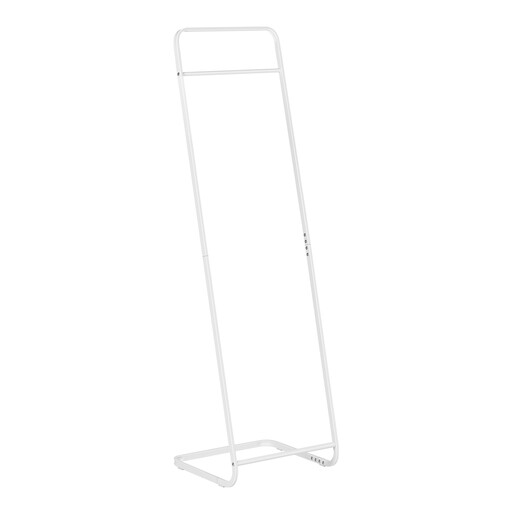
Why this product suits this profile: According to the product specifications, this compact model measures 40 × 40 × 140 cm and requires approximately 0.16 m² of floor space, making it suitable for corners in bedrooms, hallways or offices.
The L-shaped design and a reinforcing brace at the base are designed to provide stability. Nevertheless, the stated maximum load of 10 kg should not be exceeded.
Compact dimensions, metal frame, non-slip feet and freestanding, drill-free installation.
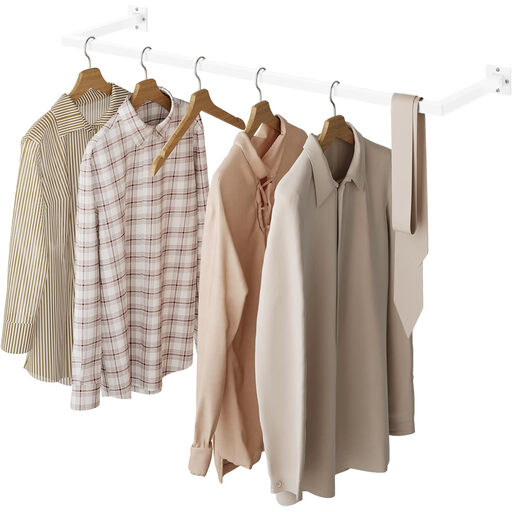
Why this product suits this profile: The 114 cm metal rail makes use of wall space and keeps clothing measuring 30 cm in depth away from the wall.
The product specifications distinguish between a load of up to 50 kg on a concrete wall and 75–100 kg on a panel wall. Check the wall type and fixing materials before installation.
Metal construction, installation kit and illustrated instructions; open storage for clothing, shoes and accessories.
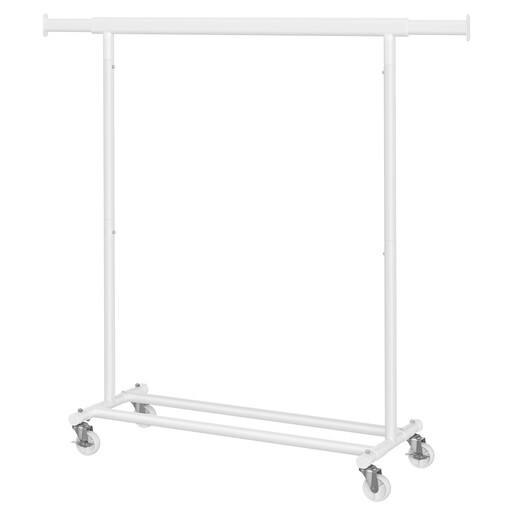
Why this product suits this profile: This mobile clothes rack is suitable for bedrooms, dressing rooms, utility rooms or changing uses. Its width can be adjusted from 92 to 132 cm.
Four swivel castors make it easy to move, while two castors can be locked. The stated static total load is 100 kg, with the weight distributed evenly.
Steel tubes, extendable clothes rail, two lower crossbars and tool-free assembly according to the product description.
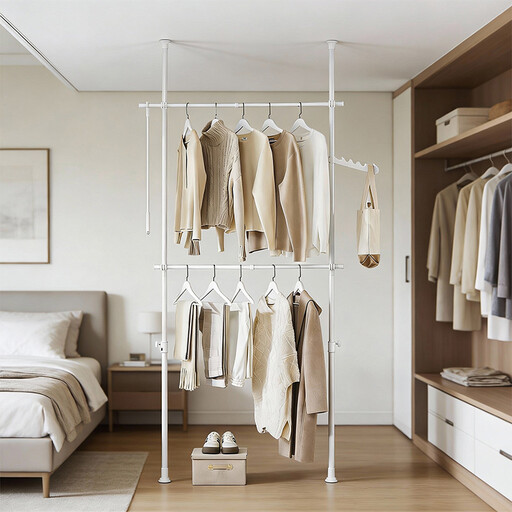
Why this product suits this profile: The system is tensioned between the floor and ceiling and can be adjusted in width from 75 to 126 cm and in height from 200 to 295 cm.
Check the room height and ceiling condition before buying. The stated load capacity of up to 25 kg is designed for light to medium-weight clothing.
No permanent wall mounting, adjustable dimensions and a side hook for bags, scarves or ties.
We have put together a complete, regularly updated list of products that fully meet these strict selection criteria and the safety regulations applicable in the EU.
Check the following before placing your order:
This depends on its type, materials, construction and installation. Always observe the maximum total load, as well as separate load limits for rails, hooks and shelves. For wall-mounted models, the wall type is also crucial. The permitted load must not be exceeded.
First mark the height and drilling points, check for cables and pipes in the wall, and use wall plugs suitable for the surface. The wall-mounted clothes rail must be secured at load-bearing points. After installation, check all connections and increase the load gradually.
Place a freestanding model on a level surface and distribute heavier items evenly. If your clothes rack has castors, engage the brakes before loading it. Tighten screws and push-fit connections regularly and avoid overloading one side.