
Lieferung heute & morgen

Qualitätsgarantie

Willkommens-Angebote freischalten: KOSTENLOSE Lieferung | Bis zu 80 % RABATT | Kostenlose 30-Tage-JoyPlus-Testphase
App herunterladen
A clothes rack creates additional storage space without the need to install a full wardrobe. An open wardrobe can be particularly practical in small flats, bedrooms, utility rooms or dressing rooms. However, models vary considerably in terms of load capacity, footprint, assembly and mobility.
If you focus only on the price or an appealing product photo, it is easy to overlook important details. Three common purchasing and marketing pitfalls are particularly relevant:
Pay attention to the stated maximum static load capacity. This generally describes the weight the rack can support when standing still and when the load is distributed evenly. It should not automatically be interpreted as a recommendation for sudden movements, pulling or climbing.
A compact clothes rack may be sufficient for lightweight clothing, shirts and individual jackets. If you want to store coats, suits or a large number of garments, choose a sturdy clothes rack with a steel frame, a broad base and a clearly stated load capacity. Heavy items should be distributed as evenly as possible.
A height-adjustable clothes rack or telescopic clothes rack can adapt to different ceiling heights and alcoves. Before buying, check:
An adjustable clothes rail is particularly useful if the room layout may change in future. With a model clamped between the floor and ceiling, the condition of the ceiling should also be taken into account. The structure must be fitted securely and correctly; for suspended or delicate ceilings, the manufacturer’s information is decisive.
A clothes rack with wheels is suitable for changing locations, such as the bedroom, utility room or a temporary cloakroom. Two lockable castors can prevent the mobile clothes rack from rolling away unintentionally. For carpets and uneven floors, check whether the castors are suitable.
A clothes rack with shelf provides additional space for shoes, storage boxes or bags. However, shelves often increase the rack’s footprint. If you only want to hang clothes, a narrow clothes rail for the bedroom can help you make better use of the available space.
The following models differ mainly in terms of adjustability, castors, load capacity and additional storage. The information is based on the respective product details.

Why this product suits this profile: This model can be fitted between the floor and ceiling without drilling. Its width can be adjusted from 75 to 126 cm and its height from 200 to 295 cm. This makes it suitable for alcoves and rented homes where permanent wall mounting is not desired.
The stated adjustment range makes planning the available space more straightforward than with a fixed standard width. The specified load capacity of up to 25 kg helps you assess its suitability for everyday clothing.
Two adjustable rails, a side hook and drill-free assembly; weight according to the product details: 3.5 kg.
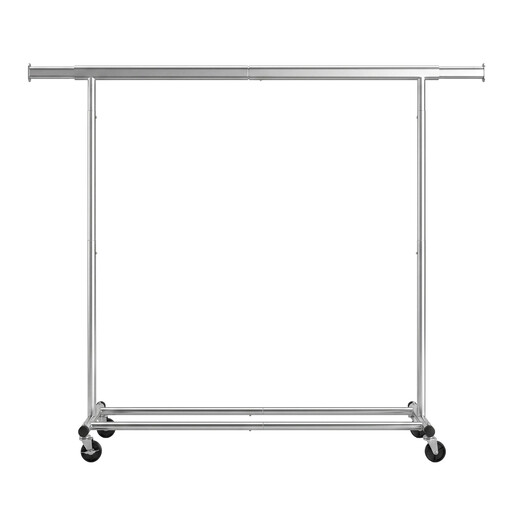
Why this product suits this profile: The steel construction is ideal for users who want to store a large number of garments or heavy clothing on a clothes rack with wheels. According to the product details, the width can be extended from 160 to 200 cm.
The load capacity is clearly specified as up to 150 kg. Four swivel castors, including lockable castors, help address the risk of the rack rolling away unintentionally.
Width-adjustable upper rail, two lower shelf or support areas and tool-free assembly according to the product description.
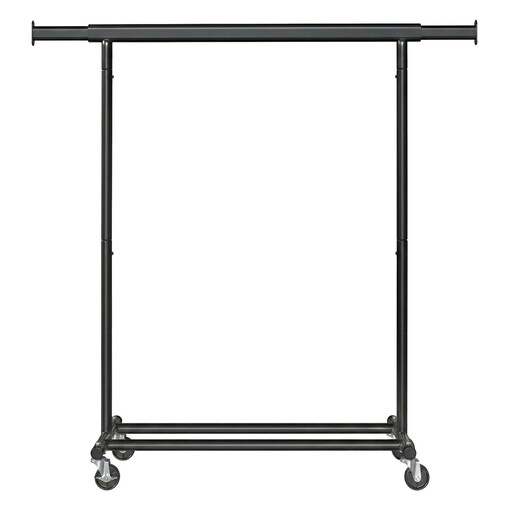
Why this product suits this profile: This mobile model is designed for bedrooms, utility rooms, dressing rooms or temporary cloakrooms. The width can be adjusted between 92 and 132 cm when you need additional space for clothing or accessories.
The stated static load capacity of up to 100 kg is clearer than general terms such as “Heavy Duty”. Two lockable castors help keep the rack securely in place.
Steel tubes, four swivel castors, an extendable clothes rail and two lower rails for boxes; tool-free assembly according to the product details.
We have compiled a complete, regularly updated list of products that fully meet these strict selection criteria and the safety regulations applicable in the EU.
A clothes rack that requires no drilling can stand securely if the floor, ceiling and adjustment mechanism are compatible. With clamp-mounted models, correct assembly is essential. Check the permitted load, the surface and the manufacturer’s instructions before buying.
A lower load capacity may be sufficient for a few shirts and jackets. For winter coats, several suits or a frequently used cloakroom, models with a clearly stated higher static load capacity are a sensible choice. The overall figure is not the only important factor; the clothing must also be distributed evenly.
Wheels are useful if you regularly move the rack between rooms or only use it temporarily. For a permanent location, feet are often sufficient. On a mobile clothes rack, at least some of the castors should be lockable so that the structure stays where you want it.