
Lieferung heute & morgen

Qualitätsgarantie

Willkommens-Angebote freischalten: KOSTENLOSE Lieferung | Bis zu 80 % RABATT | Kostenlose 30-Tage-JoyPlus-Testphase
App herunterladen
A clothes rack can quickly create extra storage space in a hallway, bedroom or student accommodation. However, open wardrobes, clothes rails and portable wardrobes differ considerably in terms of floor space, load capacity, material and stability against tipping. An appealing product image or a high number of hooks therefore says little about whether the furniture will actually meet your needs in everyday use.
A narrow, tall coat stand makes good use of vertical space. At the same time, a small base can reduce stability, particularly when several heavy coats or bags are hanging on one side. Before buying, check the total load capacity, the load capacity per hook and whether wall mounting is possible.
A clothes rack with hooks is suitable for coats, scarves or bags. For folded clothing, shoes and storage boxes, however, you need shelves, compartments or a shoe bench. A model with lots of hooks does not automatically replace an open wardrobe.
The stated width is not the only relevant measurement. When choosing a hallway coat rack, you must also consider depth, the door-opening area and passage width. A portable wardrobe may be suitable for rented accommodation, but once filled it is often no longer easy to move.
Measure the intended area at several points. For small homes, a space-saving clothes rack with a vertical design is usually more practical than a wide model. In the hallway, there should be enough room next to the furniture for putting on and taking off shoes and coats. Skirting boards and uneven floors can also affect the actual usable depth.
Also check whether the dimensions refer to the furniture itself or its packaging. A model around 40 to 45 cm wide may appear compact, but hooks or protruding garments can require additional clearance.
The load capacity should ideally be specified separately:
Heavy items should always be placed in the lower sections. On open shelving, this lowers the centre of gravity and can improve stability. A stated load limit is not a recommendation to use the furniture at that limit continuously. Furniture must also never be used as a climbing aid.
Powder-coated steel is a common finish for metal models. Check whether the coating is intended for indoor use and whether connection points need to be tightened after assembly. For wood-based materials, details such as MDF, particle board or the E1 formaldehyde emissions standard are relevant. The E1 reference for the Jano model comes from the product description and should be understood as a manufacturer’s specification.
The assembly method also affects how the furniture can be used: some clothes rails are assembled with tools, while others use push-fit connections. For tall furniture, wall mounting or an anti-tip device is particularly important, provided this is specified in the instructions.
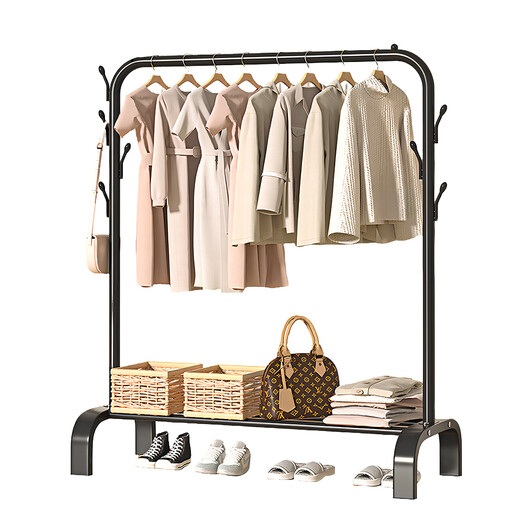
Why this product suits this profile: The 105 cm-high clothes rail is designed for a compact wardrobe, seasonal clothing or a guest room. The coated carbon steel construction can be repositioned when needed.
The low height and straightforward design make its intended use clearer than that of multi-purpose furniture. Before use, check the permitted load capacity in the instructions.
Carbon steel frame, black coating and compact design; suitable for indoor use and occasional repositioning.
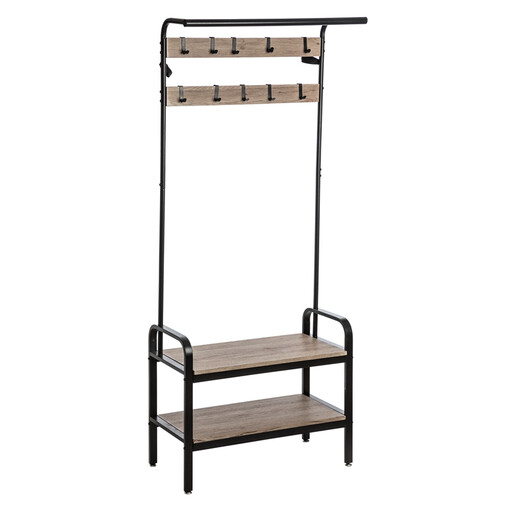
Why this product suits this profile: This clothes rack combines a reinforced clothes rail, six hooks and ten tiers. It is therefore suitable for households looking to organise clothing, shoes and accessories on a single vertical piece of furniture.
The product details state a total load capacity of 50 kg and 5 kg per shelf. Wall mounting, a level surface and even weight distribution are nevertheless still required.
Powder-coated steel, wood-based shelves and several separate storage areas; the manufacturer states that the materials meet the E1 emissions standard.
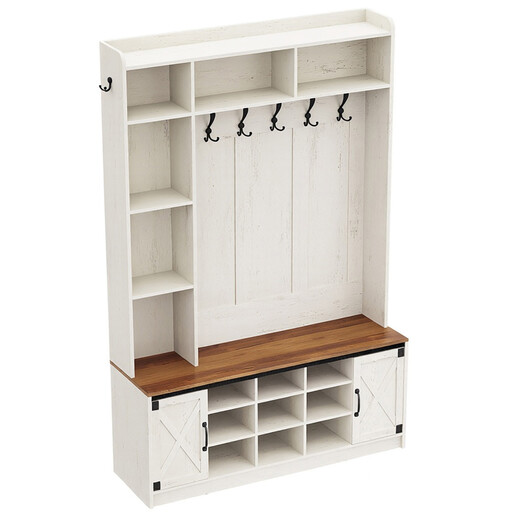
Why this product suits this profile: The combination of a clothes rack, seven hooks, 15 open compartments, cupboard sections and a shoe bench is designed for families or households with high storage needs in the hallway.
The different storage areas mean that hooks do not have to be used for shoes and bags as well. According to the description, the shelves are removable and some can be adjusted in height.
Dimensions according to the specification: approximately 40.8 × 120.5 × 191.5 cm, seven hooks and a stated load capacity of up to 150 kg for the shoe bench.
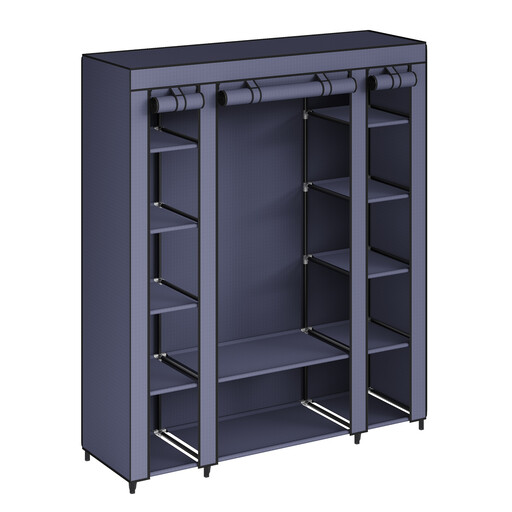
Why this product suits this profile: Measuring 150 × 45 × 175 cm, the fabric wardrobe has a closable cover, a movable clothes rail and twelve shelves. It is suitable for bedrooms, student accommodation and seasonal clothing.
The load limits are specified separately: up to 15 kg for the clothes rail and up to 5 kg per shelf. Garments must be removed before moving the unit, and the anti-tip device must be installed.
Tool-free push-fit assembly, dust protection from the fabric cover and a frame made from metal tubes with plastic connectors.
We have compiled a complete, regularly updated list of products that fully meet these strict selection criteria and the safety regulations applicable in the EU.
For a fabric portable wardrobe, the cover should be kept dry. Direct sunlight can affect materials and textiles over time. To maximise its service life, it is also essential not to exceed the specified load limits.
In addition to the product width, you must allow for hooks, clothing and the necessary passageway. For narrow hallways, models with a shallow depth or a vertical coat stand are often more suitable. Before buying, measure the area with the front door and cupboard doors open.
That depends on your storage needs. A clothes rail is sufficient for hanging garments. A clothes rack with shelving is useful if you also need to store shoes, boxes, bags or folded textiles. However, more shelves usually mean a larger footprint and more involved assembly.
Use the furniture within its stated load limits, distribute the weight evenly and regularly check the screws and connecting elements. Keeping it indoors in a dry environment and cleaning it without harsh products will help protect the surface and material. On a tall model, a correctly installed anti-tip device contributes to safe use.