
Lieferung heute & morgen

Qualitätsgarantie

Willkommens-Angebote freischalten: KOSTENLOSE Lieferung | Bis zu 80 % RABATT | Kostenlose 30-Tage-JoyPlus-Testphase
App herunterladen
A clothes rack can keep clothing organised in the bedroom, hallway or dressing room without the need for a large wardrobe. However, models vary considerably in load capacity, footprint, assembly and suitability for different wall types. A stylish appearance alone says little about whether a clothes rail will remain stable in everyday use or provide enough space for coats, shirts and accessories.
Before buying, you should therefore check three common pitfalls:
The stated maximum load capacity should always be considered in relation to the rack’s construction. For example, a metal clothes rack may have a higher permitted total load than the load capacity of its individual hooks. Heavy winter coats should not all be hung on one side, as this can affect stability.
Look out for the following specifications:
For wall-mounted solutions, the manufacturer’s load rating is only relevant when the stated installation conditions are met. A wall-mounted clothes rail for concrete or solid brick may have different requirements from one installed on plasterboard.
Measure the intended area before buying. Width and height are important, but so is depth: clothing needs sufficient clearance from the wall and from people walking past. In the bedroom, an open wardrobe with several levels may be a practical choice, while a narrow wall-mounted coat rack is often enough for a hallway.
A height-adjustable clothes rack can be adapted more flexibly to different rooms. With a telescopic clothes rack, however, you should check whether its adjustment range matches the actual room height. Models that are clamped between the floor and ceiling require firm, suitable contact surfaces and should be checked regularly to ensure they remain secure.
Metal tubes provide a sturdy structural basis for many clothes racks. Plastic connectors can make assembly easier, but they should be properly clicked into place or screwed together. A wall-mounted model requires drilling, while a freestanding version may be assembled without tools.
Useful features include:
Cleaning usually involves a soft, slightly damp cloth. Abrasive cleaning products can damage surfaces. Before fully loading the rack, check all connections and fixing points.
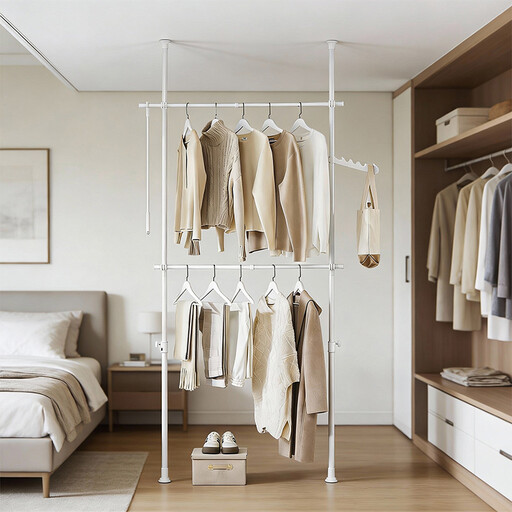
Why this product suits this profile: Its height- and width-adjustable design is suitable for bedrooms or small dressing areas where permanent installation is not wanted.
The product specifications state an adjustable width of 75–126 cm, a height of 200–295 cm and a maximum load capacity of up to 25 kg.
Two adjustable rails, a side hook and no-drill assembly support flexible clothes storage.
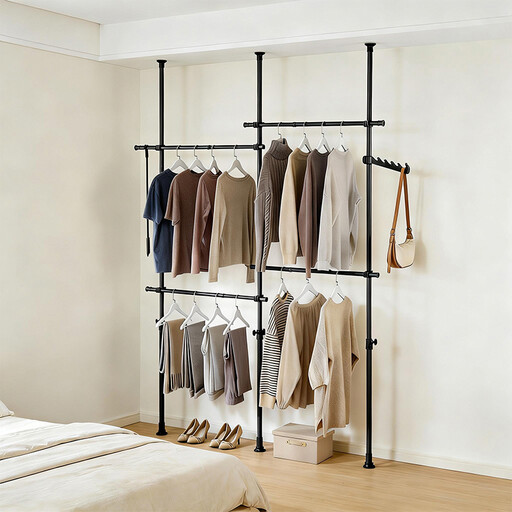
Why this product suits this profile: This system is designed for households with a large amount of clothing that need adjustable dimensions and a higher stated total load capacity.
The product description specifies a width of 124–226 cm, a height of 200–295 cm and a load capacity of up to 65 kg. The load should nevertheless be distributed evenly.
Three adjustable rails allow up to four clothes rails; side hooks and ten additional coat hangers provide extra storage.
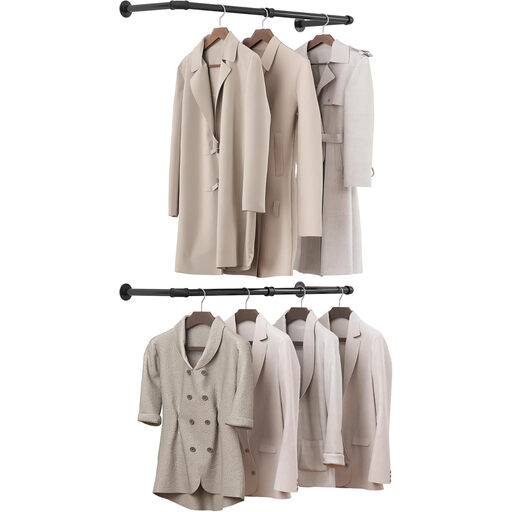
Why this product suits this profile: These wall-mounted clothes rails make use of vertical space and are suitable for hallways, bedrooms or additional hanging storage on a solid wall.
The stated static load capacity is up to 50 kg per rail when mounted on a solid wall. For lightweight walls, the fixing hardware must be checked separately.
The set contains two 100 cm metal rails and makes use of wall space without taking up additional floor space.
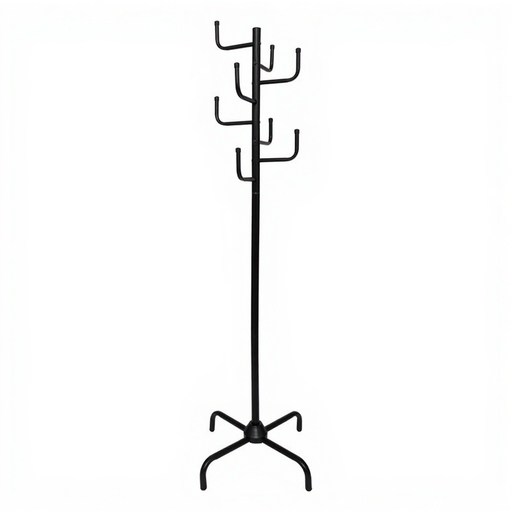
Why this product suits this profile: This slim freestanding coat rack is designed for jackets, bags and accessories when you need a vertical solution with a small footprint.
The maximum total load is 15 kg, with up to 2 kg specified per hook. Even distribution and a level surface are therefore important.
The model is 43 cm wide, 170 cm high and weighs 1.91 kg. Eight hooks provide several hanging points.
We have put together a complete, regularly updated list of products that fully meet these strict selection criteria and the safety regulations applicable in the EU.
That depends on how you intend to use it. A lower load capacity may be sufficient for a few jackets in the hallway. For numerous coats or an open wardrobe, you should check the total load as well as the load capacity of individual rails and hooks. Clothing should be distributed evenly.
A telescopic clothes rack can be installed without drilling into the wall or clamped between the floor and ceiling. Its stability depends on suitable dimensions, firm contact surfaces, correctly assembled connections and even weight distribution. Before use, all rails must be aligned securely and checked regularly.
Do not exceed the stated load limit, avoid loading one side more heavily than the other and place the rack on a level surface. For wall-mounted solutions, the screws and wall plugs should be suitable for the wall type. Regularly checking the connections and cleaning the rack with a soft cloth will help ensure long-lasting use.