
Lieferung heute & morgen

Qualitätsgarantie

Willkommens-Angebote freischalten: KOSTENLOSE Lieferung | Bis zu 80 % RABATT | Kostenlose 30-Tage-JoyPlus-Testphase
App herunterladen
A clothes rail creates extra storage space, but the wrong choice can quickly become impractical. In small flats, student rooms, hallways or dressing rooms, design and price are not the only considerations. Dimensions, load capacity, fixing method and whether you also need to store shoes and accessories are all important factors.
A high maximum load may sound convincing at first. However, it does not automatically apply to every component. With a combination of clothes rail, hooks and shelves, each part may have its own limit. Wall material, fixings, floor condition and even weight distribution also affect the actual stability.
You should therefore check:
A freestanding clothes rail needs sufficient depth and floor space. For a wall-mounted clothes rail, you need to consider the drilling points, wall width and the position of doors or radiators. Telescopic clothes rails are flexible, but only fit within the specified height and width range.
Measure the available space at several points. Also allow enough clearance from the wall so that jackets, dresses and shirts do not catch or become permanently creased.
A clothes stand with shelving may appear versatile, but the number of shelves says little about how practical they are to use. Check the height between levels, the depth available for shoe boxes and the load limit for each shelf. With a clothes rail featuring a shoe rack, there should also be enough space between the hanging rail and the shelves so that longer garments do not rest on the shoes.
A wall-mounted clothes rail makes use of the room’s height while keeping the floor clear. It is suitable for hallways, alcoves or small bedrooms, but requires a sturdy wall and appropriate fixings. The wall plugs supplied are not automatically suitable for every surface.
A freestanding clothes rail can be moved around and does not require any drilling. It is a practical option for rented flats or changing room layouts. Look for non-slip feet, a sufficiently wide base and good stability if the rail is loaded more heavily on one side.
An extendable clothes rail, also known as a telescopic clothes rail, can be adjusted in width or height. With tension-mounted models, the contact between the rail, floor and ceiling should be checked regularly. This type of solution should not be treated as equivalent to a permanently screwed-in wall construction.
A metal clothes rail provides a strong foundation when properly designed. However, the tube diameter, wall thickness, connectors and design of the feet are also important. Plastic connectors can make assembly easier, but they must be correctly clicked into place or screwed together.
For furniture made from MDF or chipboard, pay attention to the edges, surface care and maximum load of the shelves. A white clothes rail can blend neatly into its surroundings, but it needs a surface that can be cleaned with a slightly damp cloth.
First, sort out what you actually intend to hang or store:
Do not plan to use the stated maximum load continuously. Particularly with an open wardrobe, the weight should be distributed evenly along the entire length. For wall-mounted models, the lower of the product’s stated load limit and the wall’s actual capacity always applies.
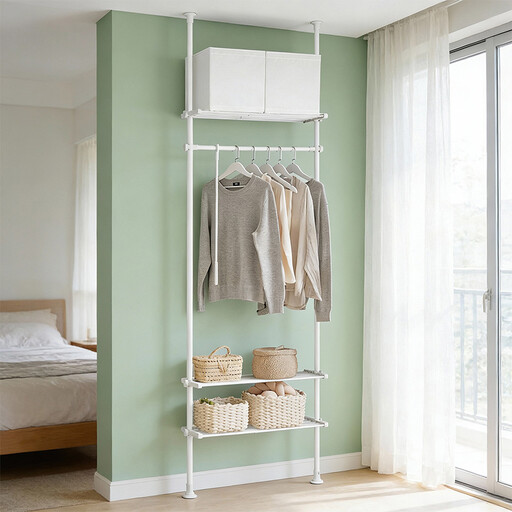
Why this product suits this profile: The slim design makes good use of an alcove or edge of a room and is tension-mounted between the floor and ceiling, so no drilling is required.
The stated dimensions of 52–80 cm in width and 233–295 cm in height make it easier to check the available space before buying. The total load capacity is stated as up to 16 kg and should not be exceeded.
Two telescopic rails, three adjustable shelves and an additional laundry rail; assembly instructions and fittings are included.
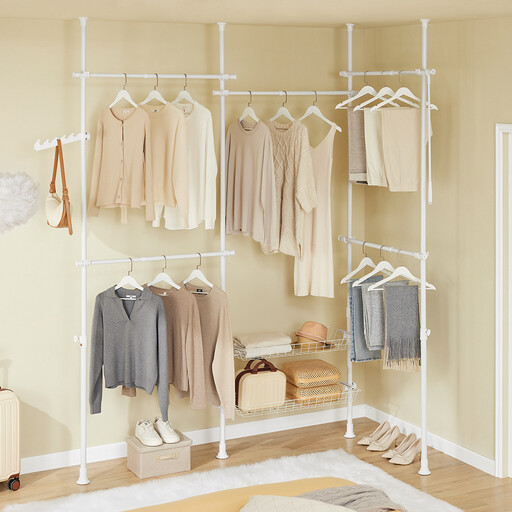
Why this product suits this profile: For a large bedroom or dressing room, this system offers an adjustable design without permanent installation. It combines hanging space with additional storage elements.
The width of 209–311 cm and height of 200–295 cm should be checked against the room dimensions in advance. The stated load capacity is up to 65 kg.
Four adjustable rails, five clothes hangers, two baskets and a side hook; according to the product information, the metal frame weighs 9,1 kg.
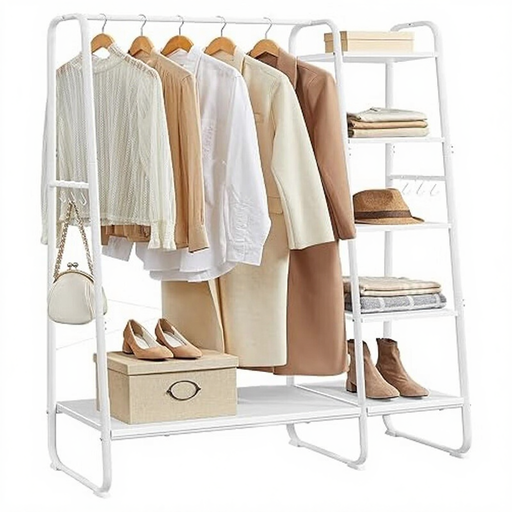
Why this product suits this profile: The combination of a hanging rail, hooks and five shelves is ideal for households that want to organise clothes, shoes and bags in one place.
The product information specifies separate load capacities for the clothes rail, hooks and shelves. The hanging rail is rated for up to 40 kg, while each hook can hold up to 4 kg.
Freestanding design measuring 45 × 120 × 160 cm, with a metal frame, chipboard shelves and non-slip feet.
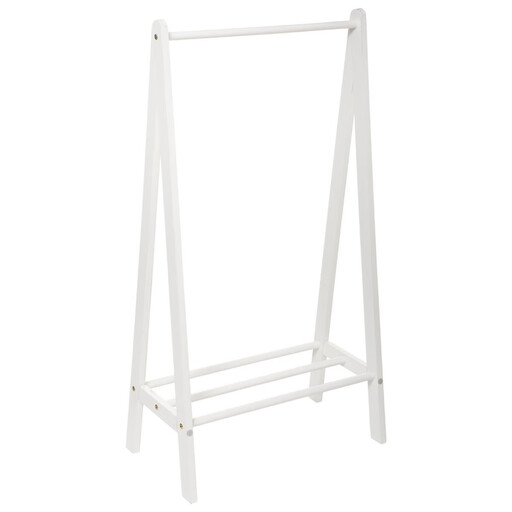
Why this product suits this profile: Its height of 115 cm and compact dimensions of 58 × 30 cm are designed for smaller rooms and children's clothes.
The manufacturer states a maximum total load of 10 kg. A wall safety strap is also provided for anti-tip protection; the fixings required for this are not included.
White MDF construction, one clothes rail, a product weight of 4,5 kg and a compact footprint. Children should not climb on or hang from the furniture.
We have put together a complete, regularly updated list of products that fully meet these strict selection criteria and the safety regulations applicable in the EU.
With a wall-mounted clothes rail, check the wall surface before drilling. Use fixings that are suitable for the wall and check all screw connections after assembly. The stated load capacity for a concrete wall cannot be applied to a plasterboard wall.
The following measures can help with a freestanding solution:
This depends on its design, material and fixing method. The product information for the individual rail is the key reference. With wall-mounted models, the load capacity of the wall type must also be taken into account. A clothes rail with a maximum load of 50 kg is therefore not automatically suitable for 50 kg on every wall.
A tension-mounted design can be installed without drilling if the height, contact surfaces and base are within the manufacturer’s specifications. It should not be overloaded and should be checked regularly to ensure it remains secure. For consistently high loads, screwed-in installation may be more suitable.
A wall-mounted or extendable clothes rail can work well in narrow alcoves. If you also need to store shoes and bags, a compact clothes stand with shelving provides more organisational space. Before buying, compare the width, depth, door clearance and permitted load.