
Lieferung heute & morgen

Qualitätsgarantie

Willkommens-Angebote freischalten: KOSTENLOSE Lieferung | Bis zu 80 % RABATT | Kostenlose 30-Tage-JoyPlus-Testphase
App herunterladen
Well-planned clothes storage helps keep hallways, bedrooms, guest rooms and dressing rooms tidy. However, not every solution suits every household. A slim coat stand may be enough for jackets and bags, while families or people with a large amount of seasonal clothing are likely to need a spacious wardrobe.
Three common mistakes often lead to unnecessary costs when buying:
The key consideration is therefore not just appearance, but the combination of dimensions, material, load capacity, mobility and assembly requirements.
Before buying, measure the intended space. Consider not only the width and height, but also doors, radiators, windows and the room needed to move around.
A freestanding clothes rack is suitable for jackets, scarves, bags and clothes that are worn regularly. Models with hooks make use of the room’s height without taking up much floor space. This type of space-saving storage is practical in a hallway or bedroom when you want clothes to be visible and easy to reach.
Look for:
A wheeled clothes rack is useful if clothing needs to be moved between the bedroom, utility room, guest room or dressing room. Lockable castors prevent the rack from moving uncontrollably once it is in position. With extendable models, the maximum width should match both your room layout and the load capacity.
A telescopic clothes rail offers additional flexibility, but should not automatically be assumed to provide high stability. Check whether the stated load capacity applies to your clothing and whether it covers the full extended width.
A wardrobe offers better protection against dust and creates separate areas for folded and hanging textiles. A sliding-door wardrobe requires less clearance in front of the furniture than a wardrobe with hinged doors, making it suitable for smaller homes.
A wardrobe with a mirror combines storage with a dressing function. However, consider the weight of the furniture, the assembly requirements and the need for wall anchoring. With larger wardrobes, the internal layout, number of shelves and position of the clothes rail are more important than size alone.
The external dimensions do not always indicate how much clothing can actually be stored. With a coat stand featuring hooks, the number of hanging points is what matters. With a wardrobe, the internal width, compartment height and distance between the clothes rail and the floor are relevant.
Leave a little space between hanging garments so that coats, shirts and dresses are not permanently compressed. For hallways, compact models with a small footprint are often more suitable than wide clothes rails.
The maximum load capacity should be clearly stated in kilograms. Depending on the product, it may refer to the entire rack, an individual rail or specific storage surfaces. Steel and carbon steel are commonly used for clothes racks. A coating can protect the surface from everyday signs of use, but it is no substitute for secure positioning.
For wardrobes made from 16 mm laminated chipboard, edge sealing, door mechanisms and wall fixing are important points to check. Wall anchoring should be considered for safety reasons with tall or heavy furniture, particularly in households with children.
Castors with locking functions make it easier to move and secure the rack. With stationary models, the floor should be level. Self-assembly is common for many clothes racks and wardrobes. Check in advance whether two people are needed for assembly and transport.
A soft, slightly damp cloth is usually sufficient for cleaning. Abrasive cleaning products can damage coatings, edges or mirror surfaces. Metal racks should be used indoors in dry areas unless the manufacturer specifies otherwise.
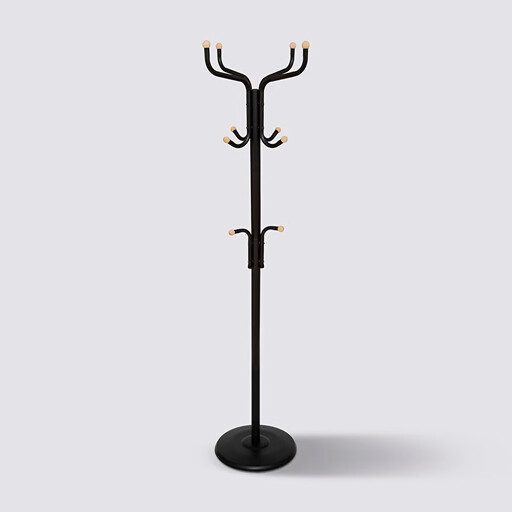
Why this product suits this profile: Standing 178 cm tall, this rack offers 11 hooks for jackets, hats, bags and scarves. With a base measuring 43 × 43 cm, it is suitable for hallways or bedrooms where space is limited.
The product data specifies a maximum load capacity of 15 kg as well as a weight of 5.23 kg. This makes it easier to assess how it can be used than with a model that provides no load information.
11 hooks, steel construction, black design and freestanding use. Assembly is carried out by the customer.

Why this product suits this profile: Measuring 150 cm wide and 215 cm high, this sliding-door wardrobe combines enclosed storage with an integrated mirror. Six adjustable shelves and a clothes rail support separate organisation.
The sliding doors do not require any additional clearance to swing open. The required wall anchoring and assembly by two people must nevertheless be taken into account.
16 mm laminated chipboard, aluminium sliding mechanism, matt finish and six adjustable shelves.
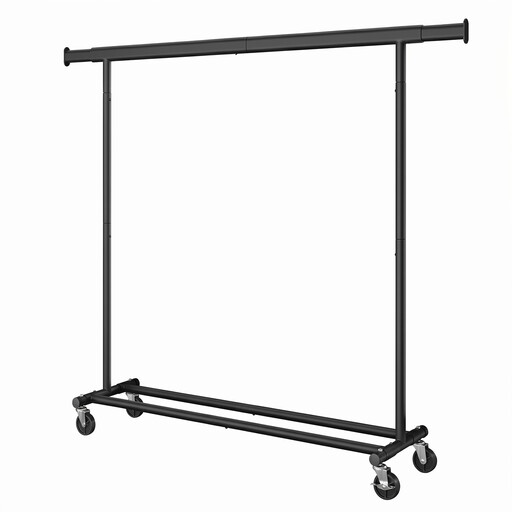
Why this product suits this profile: The extendable clothes rail can be adjusted from 160 to 200 cm. Lockable castors make it easier to use in the bedroom, utility room or guest room, or for temporary clothes storage.
The product description specifies a maximum static load capacity of 150 kg. When using the rack, this figure should nevertheless be understood as applying to an even distribution of weight and stable positioning.
Steel frame, adjustable width, lockable swivel castors, lower storage shelves and tool-free assembly according to the product information.
We have put together a complete, regularly updated list of products that fully meet these strict selection criteria and the safety regulations applicable in the EU.
A slim freestanding coat stand is suitable for jackets and frequently worn accessories. A wheeled clothes rack can be moved when needed or stored away temporarily. For larger clothing collections, a sliding-door wardrobe saves space because no clearance is needed in front of the doors.
That depends on the weight and number of garments. Coats and densely hung textiles create more load than lightweight shirts. Choose a model with clear manufacturer specifications and distribute the clothing evenly. The maximum load capacity must not be exceeded.
Its service life depends on the material, load, assembly and care. Check screw connections, castors and feet regularly. A clothes rack should stand on a level surface and should not be used as a climbing aid or for hanging items it was not designed to support.