
Lieferung heute & morgen

Qualitätsgarantie

Willkommens-Angebote freischalten: KOSTENLOSE Lieferung | Bis zu 80 % RABATT | Kostenlose 30-Tage-JoyPlus-Testphase
App herunterladen
A storage bench is a smart solution for many households. It creates order by stowing blankets, toys, or shoes out of sight, while also offering an additional place to sit. But not every model delivers on its promise. Many buyers get frustrated with unstable constructions or materials that wear out quickly.
As your Joybuy Product Recommendation Officer, I'm here to help you separate the good from the bad. This guide will show you what to look for to find a functional and durable storage chest that perfectly fits your needs.
Before you make a decision, you should be aware of the typical weaknesses that often only become apparent after a few weeks of use.
To avoid these pitfalls, you should carefully examine three core parameters. These will give you an objective basis for your purchasing decision.
The durability of a chest bench depends heavily on its construction. Most models are made of MDF (Medium-Density Fibreboard) panels. Look for the specified quality class (e.g., E1), which indicates a low-emission and stable panel.
Even more important is the maximum static load capacity. This value indicates how much weight the bench can support in a static state.
The available storage space is specified in litres (L). To give you an idea: a volume of 80 litres already offers space for several cushions, blankets, or a large collection of board games. A long ottoman with storage of over 100 litres can even hold bedding or winter jackets.
Also, pay attention to functional details:
The cover of an upholstered storage bench determines not only its look but also its everyday practicality.
Here are some models that, based on objective features, are suitable for different user profiles.
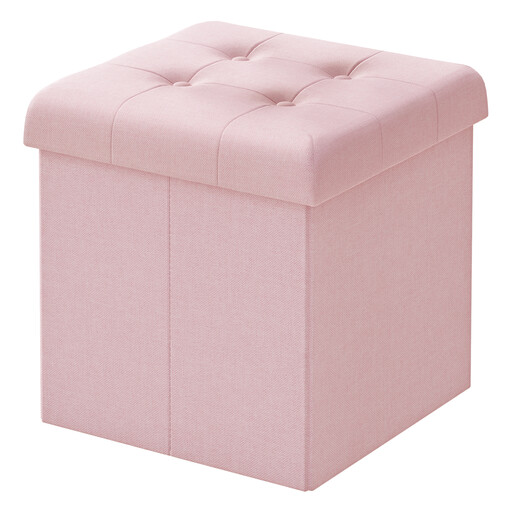
Why This Fits Their Persona: This compact storage stool is ideal for small apartments, shared living spaces, or as a flexible addition to the living room. It serves as a footrest, extra seat, or small side table and can be folded flat when not in use.
It avoids the instability trap with a robust MDF construction (Class E1) that, according to the manufacturer, allows for a static load capacity of up to 300 kg. This is a remarkable figure for a foldable stool.
High storage volume (43 L) relative to its compact size. The foldable design allows for space-saving storage (down to a height of 6 cm).
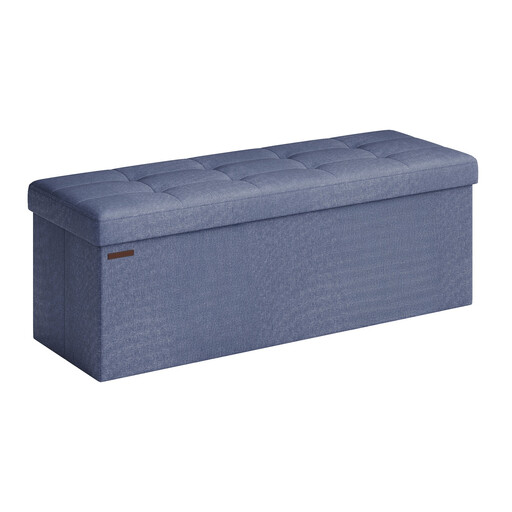
Why This Fits Their Persona: At 110 cm long, this bench is ideal for the foot of a bed or as a long seating option in the living room. It offers enormous space to store pillows, blankets, and other large items while being a stylish addition to your decor.
Despite its length and foldable design, the manufacturer states it has a high static load capacity of 300 kg. The thick MDF panels and solid overall construction prevent sagging in the middle, a common problem with long, foldable benches.
Very large storage volume (approx. 131 L) and a removable divider for organisation. Assembly takes just a few seconds.
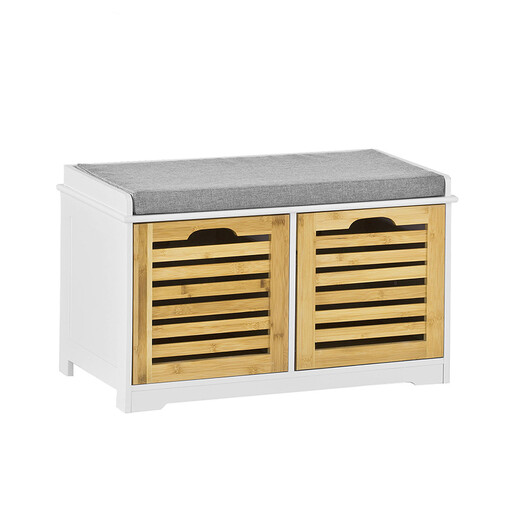
Why This Fits Their Persona: This bench is specifically designed for the entryway. It combines a comfortable seat for putting on shoes with practical, removable baskets for hats, scarves, or shoes. It's a durable and functional solution for the hallway.
As a non-foldable piece of furniture made from MDF and bamboo, it offers an inherently stable and durable construction. The open baskets are more practical for quick access in the hallway than a closed lid.
Specialised storage thanks to two baskets and an open compartment. The solid build is designed for the daily wear and tear of an entryway.
We have compiled a complete, up-to-date list of products that fully meet these strict selection criteria and relevant safety regulations.
The load capacity varies greatly depending on the model. Foldable stools for one person can often withstand up to 150 kg of static weight. Larger, more robust benches designed for two people are often rated for up to 300 kg. Always check the manufacturer's specifications for the maximum static load capacity to ensure the bench is suitable for your intended use.
Yes, the mechanism on most models is very simple. You typically just need to unfold the side walls, insert the base plate for stability, and place the lid on top. The entire process usually takes less than a minute and requires no tools.
Covers made from linen-look fabrics (usually 100% polyester) are generally the most straightforward. They are abrasion-resistant and easy to clean with a damp cloth. Velvet or teddy fleece are more delicate and require more care to maintain their appearance.