Choose your monitor based on how many views need to be readable at once, how much space is available on the shared desk and which laptops will be connected. A compact monitor with USB-C can make switching between devices easier, as long as the laptop, cable and charging power are compatible. Larger models offer more screen space, but need more room and a text scaling setting that keeps everything easy to read.
Who is this guide for?
People creating timetables
If you want to work on appointments, spreadsheets and supporting information side by side, check that the windows remain easy to read at your preferred text size. Dell lists the S2725DSM as a 27-inch QHD model, while ASUS specifies a 27-inch screen and 4K resolution for the PA279CRV. How easy your timetable is to read also depends on the scaling.
People who switch laptops
If several people use the same workspace, a suitable USB-C connection can make it easier to swap devices. EIZO specifies 70 W USB-C power delivery for the EV2490. Check that each laptop supports video output over USB-C and that the available power is sufficient.
Organisers short on desk space
If you need room on the desk for paperwork alongside your monitor, compare the full dimensions, including the stand, with the space available. LG specifies a width of 1215.1 mm with the stand for the 49WQ95X-W; this measurement applies to that model only.
What should you look for when buying?
First, consider your preferred window layout and readability. Then check the connections for every laptop you use, followed by the space available for the monitor and paperwork.
| Priority |
What to check before buying |
Who is this particularly important to? |
| A timetable you can read at a glance |
View your timetable and typical extra windows at your intended text scaling; consider screen size and resolution together. |
If I want to keep a calendar, spreadsheet and supporting information in view at the same time, a readable window layout is essential. Around 36% of consumers say an at-a-glance overview is their top priority. |
| Switching between laptops |
Check USB-C video output, the cable and charging power for every laptop you use. |
If several people connect their laptops at the same desk, I want to avoid unnecessary cable swapping. Around 29% of consumers put switching between devices first. |
| Adjusting the monitor for different people |
Check the height adjustment and other suitable settings, as well as readability in the monitor’s actual location. |
If people sit in different positions and at different distances from the screen, I want to be able to adjust the display to suit them. Adjustability is the top buying priority for around 21% of consumers. |
| Desk space and power consumption |
Compare the monitor’s footprint with the available desk space; use the EU energy label for the specific model to compare energy efficiency. |
If I need to leave room for paperwork beside the monitor, I also consider the space it takes up and ongoing costs. Around 14% of consumers prioritise space and keeping costs under control. |
Common selection mistakes
-
Focusing only on 4K or a high refresh rate
Resolution and refresh rate describe different features. On their own, they don’t tell you whether text in your timetable will be easy to read or whether you can arrange several windows to suit your needs.
Try your timetable with your preferred text size and window layout before prioritising individual specifications.
-
Assuming USB-C guarantees a one-cable connection
The right connection also depends on whether your laptop can output video over USB-C and whether the cable and charging power are suitable for it. EIZO specifies 70 W for the EV2490, while ASUS specifies 96 W for the PA279CRV; these figures apply to those models.
Check the connections and power requirements of every laptop you actually use against the specific monitor.
Depending on your laptop, you may also need a separate power supply or a different connection.
-
Checking only the screen size
The space a large monitor takes up also depends on its stand and depth. LG specifies a width of 1215.1 mm and a depth of 281.0 mm for the 49WQ95X-W, including the stand.
Measure the space available on your desk and allow room for paperwork and any other work essentials.
Brands to consider
EIZO
The FlexScan EV2490 is a compact office option for laptops that are connected frequently.
- EIZO specifies a 23.8-inch Full HD screen and 70 W USB-C power delivery for this model.
- Its screen offers less room for viewing several timetable layouts at once than larger models.
Dell
The S2725DSM is a 27-inch QHD option for spreadsheets and calendars.
- Dell specifies a 144 Hz refresh rate for this model.
- The refresh rate alone does not prove that this monitor is better for creating a timetable. Check that the specific monitor has the connections you need.
ASUS
The ProArt PA279CRV combines a 27-inch 4K display with USB-C.
- The German ASUS specification sheet lists 96 W USB-C, a USB hub and height adjustment.
- With 4K, set the text scaling so the text is easy to read; colour specifications alone are not a reason to buy a monitor for creating a timetable.
LG
The 49WQ95X-W is an extra-wide option for keeping multiple views open side by side.
- LG specifies KVM and Picture-by-Picture for this model.
- With the stand, the monitor is 1215.1 mm wide, according to LG; its typical power consumption is 103 W, according to the manufacturer. These figures apply to this model only.
Joybuy monitors for shared workspaces
The models below cover 27-inch 4K and QHD workspaces. USB-C connections, docking features and adjustable stands vary from model to model.
 No image available
INNOCN CB27U1 27-inch 4K monitor
An option if you want to arrange a timetable and additional views on a 27-inch monitor.
3840 × 2160, IPS, 120 Hz, PIP and PBP, 90 W USB-C Power Delivery; height-adjustable stand.
View at Joybuy
 No image available
Philips 276B9 27-inch QHD monitor
A QHD option for spreadsheets and calendars; check whether the display can be adjusted to suit the different people using it.
2560 × 1440, IPS, 75 Hz, 65 W USB-C Power Delivery and a USB hub. According to the product specifications, the stand offers 150 mm of height adjustment, tilt, swivel and pivot.
View at Joybuy
 No image available
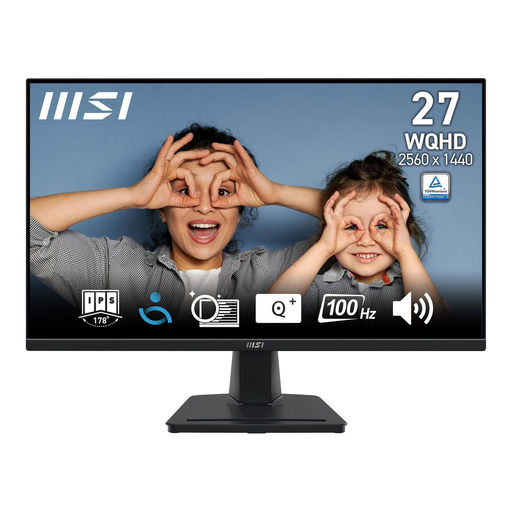
MSI PRO MP275QDE 27-inch WQHD monitor
A QHD option for working with timetables and spreadsheets, if you want to adjust the viewing angle at a shared desk.
2560 × 1440, IPS, 100 Hz, integrated speakers; tilting stand.
View at Joybuy
 No image available
MSI PRO MP275QPDGDE 27-inch WQHD docking monitor
A docking option if you need to switch between laptops at a shared workspace and adjust the screen position.
WQHD, IPS, 100 Hz, 98 W USB-C Power Delivery, daisy chain and KVM; the stand offers height adjustment, tilt, swivel and pivot.
View at Joybuy
 No image available
Dell Pro Plus P2725DE 27-inch QHD monitor
An option if you want to connect a laptop at a shared workspace and adjust the display for different users.
2560 × 1440, IPS, up to 90 W USB-C Power Delivery and a four-port USB hub. The stand offers height adjustment, tilt, pivot and swivel.
View at Joybuy
Frequently asked questions
Does a shared club desk have to comply with ASR A6?
Not simply because several club members use the workspace. The Federal Institute for Occupational Safety and Health explains in ASR A6 the scope of its rules for screen-based workstations in workplaces and teleworking environments; use in private settings is excluded. Whether a particular club workspace falls under these rules depends on how it is actually used.
Can any laptop be connected and charged using just one USB-C cable?
No. You can’t tell from the monitor’s USB-C port alone. Check the laptop’s video output, the cable being used and its power requirements. EIZO specifies 70 W for the EV2490, while ASUS specifies 96 W for the PA279CRV; each figure applies to the model named.
How can I get the monitor ready for the next person at the desk?
Adjust the screen position and text scaling, then check that the next person’s laptop connects properly. The German specification sheet for the ASUS PA279CRV lists 0 to 130 mm of height adjustment; whether that range is enough depends on the seating position at the desk.
How can I compare the power consumption of different monitors?
Compare the EU energy labels for the specific models rather than just their screen sizes. The European Commission rates electronic displays on a scale from A to G; you can find further model information in EPREL. You can’t work out annual costs from typical power consumption alone without knowing how long the monitor is used and your electricity tariff.
Are the manufacturer’s warranty and your statutory rights for faulty goods the same thing?
No. For consumer purchases in Germany, statutory rights for faulty goods are against the seller; for ordinary cases, section 438 of the German Civil Code generally sets a period of two years from delivery. An additional manufacturer’s warranty has its own terms and conditions. For sales contracts from 31 July 2026, the Verbraucherzentrale also describes a one-off 12-month extension when you choose repair rather than replacement for a fault. Different contract and purchase circumstances should be assessed separately.


