
Lieferung heute & morgen

Qualitätsgarantie

Willkommens-Angebote freischalten: KOSTENLOSE Lieferung | Bis zu 80 % RABATT | Kostenlose 30-Tage-JoyPlus-Testphase
App herunterladen
For many expectant parents, a co-sleeper is at the top of the shopping list. The idea of having your newborn safe and within arm's reach is reassuring. However, the market can be overwhelming, and many products don't live up to their promises. Certain design flaws or exaggerated marketing claims often mean the supposed dream crib becomes unusable after just a few months or even poses a safety risk. This guide will help you identify the crucial features and make an informed decision.
Before you choose a model, you should be aware of the typical weaknesses that often only become apparent in everyday use.
To avoid these pitfalls, focus on three objective criteria. These define the safety, functionality, and longevity of a co-sleeper.
The most important feature of a baby bed is its safety. Look for certification according to the current European safety standard DIN EN 1130:2019. This standard sets requirements for:
A co-sleeper that meets this standard provides a tested foundation for safe use.
A bedside crib must dock seamlessly with the parent's bed. Before buying, measure the height of the top of your mattress (from the floor).
The first few months fly by. A bed that serves no purpose afterwards is a short-term investment. Models with a thoughtful design offer added value beyond the initial period.
Based on the criteria above, we have identified several models that are well-suited for different needs.
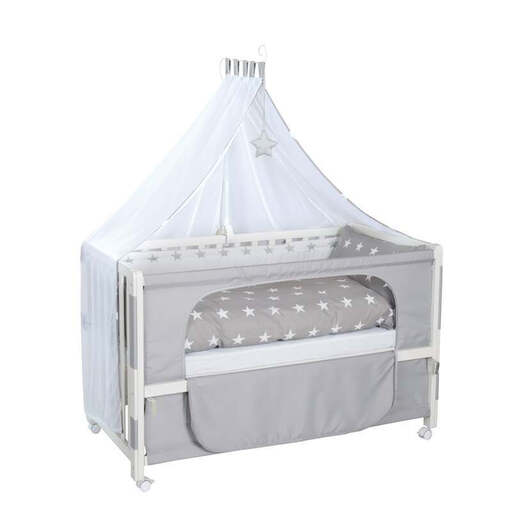
Why This Fits Their Persona: Ideal for parents seeking a long-lasting solution. Thanks to its 60x120 cm size and convertibility into a toddler bed, it grows with your child and serves as an investment for several years.
It bypasses the short-lifespan trap with its 3-in-1 functionality. It's not just a co-sleeper, but also a full-fledged baby bed and, later, a toddler bed.
6-level height adjustment for a precise fit; All-inclusive set including mattress, bedding, and casters.
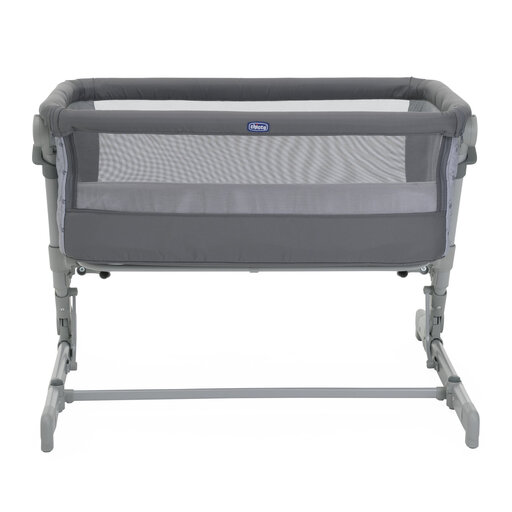
Why This Fits Their Persona: Perfect for parents who are often on the go or want to use the bed flexibly around the house. The quick-folding mechanism and included travel bag make it an ideal travel companion.
Solves the problem of inflexibility. Instead of a heavy wooden bed, this model features a lightweight aluminium frame and, according to the manufacturer, folds down in seconds.
Quick-fold system without disassembly; 6-level height adjustment and incline function; Includes travel bag and mattress.
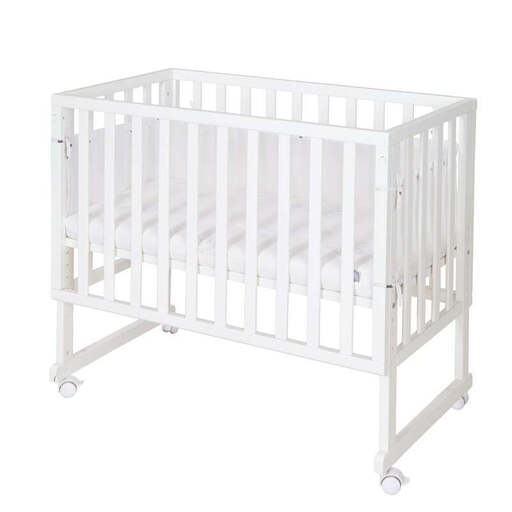
Why This Fits Their Persona: A great choice for parents who want maximum safety and a high-quality mattress from the start, without stretching the budget for a larger, long-term model.
Addresses the pitfall of low-quality bundles by including the breathable 'safe asleep' quality mattress and being certified according to EN 1130:2019.
Patented safety system with a canvas barrier; 7-level height adjustment; Convertible to a bench seat.
We have compiled a complete, up-to-date list of products that fully meet these strict selection criteria and safety standards.
The sleeping surface of the co-sleeper should be exactly level with the top of the parent's mattress. There should be no step up or down. Measure the height of your mattress from the floor and compare this value with the co-sleeper's adjustment options. Models with many or continuous adjustment settings have an advantage here.
The duration of use depends on the model and your child's development. Classic co-sleepers with a sleeping surface of about 45 x 90 cm are typically designed for the first 6 months (or up to a weight of 9 kg). As a rule of thumb: as soon as your child starts to sit up, kneel, or pull themselves up independently, the bed should no longer be used as an open co-sleeper for safety reasons. Convertible and grow-with-me baby beds (e.g., 60 x 120 cm) can often be used afterwards as a closed crib until the age of 4-5 years.
A co-sleeper with a mattress and casters can be very practical, as all parts are designed to fit together. The advantage lies in saving time and getting a perfectly matched setup. However, pay close attention to the quality of the individual components. The mattress should be point-elastic, firm, and breathable. Check if the textiles (e.g., bumper pads) are air-permeable to ensure good air circulation. Sometimes it makes more sense to buy a basic bed and purchase a high-quality mattress separately.