
Lieferung heute & morgen

Qualitätsgarantie

Willkommens-Angebote freischalten: KOSTENLOSE Lieferung | Bis zu 80 % RABATT | Kostenlose 30-Tage-JoyPlus-Testphase
App herunterladen
For many expectant parents, a co-sleeper is at the top of the baby essentials list. The idea of keeping your newborn safe and within arm's reach makes nights significantly easier. But the market is crowded, and many products fail to live up to their marketing promises in practice. Many models turn out to be impractical or simply incompatible with your own bedroom.
This guide will help you navigate the common pitfalls. We focus on the crucial, objective criteria that define a quality bedside crib, so you can make an informed decision you'll be happy with for the long term.
The 2 Most Common Mistakes When Buying a Co-Sleeper:
To avoid these issues, you should carefully check three key technical features before buying. These define the safety, functionality, and longevity of a bedside crib.
A reliable bedside crib must be stable, secure, and free of harmful substances. Look for compliance with the current European safety standard EN 1130:2019. This standard sets requirements for:
Flexibility is crucial. A good co-sleeper should offer stepless or multi-level height adjustability that covers a wide range. Measure the height to the top of your mattress and compare it with the co-sleeper's specifications.
A co-sleeper that sits unused after six months is not a sustainable investment. Models with 3-in-1 or 4-in-1 functionality offer real added value. They can be converted into:
When considering a co-sleeper with a mattress, scrutinise its quality. A good baby mattress is breathable, point-elastic, and has a washable cover.
Based on these objective criteria, we have identified several models that are well-suited for different requirements.

Why it's a great fit: Ideal for parents seeking a safe and functional solution for the first 6-12 months without compromising on mattress quality.
Avoids the "complete set trap" with its included, breathable 'safe asleep' brand mattress. The 7-level height adjustment (up to 44.6 cm) fits many beds.
Meets the EN 1130:2019 safety standard and offers extended use thanks to its 3-in-1 function (co-sleeper, bassinet, bench).
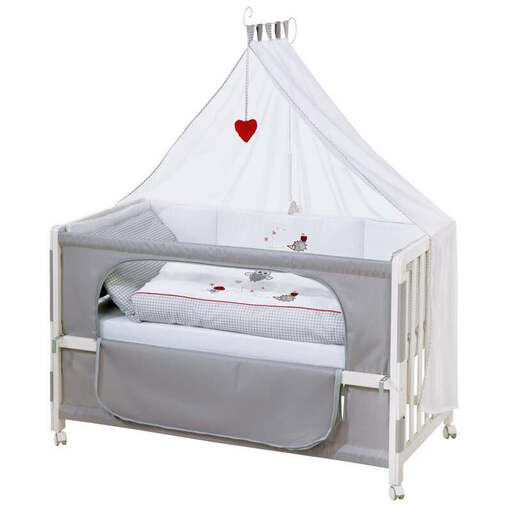
Why it's a great fit: For parents looking for an all-in-one solution that grows with their child from infancy to the toddler years, making it a sustainable investment.
This convertible baby bed (usable for up to approx. 4 years) is more than just a short-lived co-sleeper. The large 120x60 cm sleeping surface and its convertibility into a toddler bed maximise its lifespan.
Delivered as a complete baby bed set with a mattress, bedding, and canopy. The fabric side with a zip allows for easy access to the baby at night.
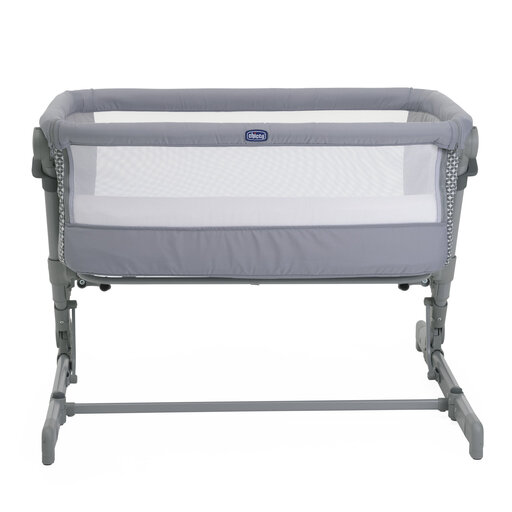
Why it's a great fit: Designed for parents who are always on the go or want to move the crib flexibly between rooms without sacrificing safety.
It solves the problem of immobility. Thanks to its quick folding mechanism and included travel bag, it serves as a fully-functional travel cot that avoids the compatibility trap with its 6-level height adjustment.
Very lightweight and compact. The incline function can help provide relief for babies with reflux or congestion. Large mesh windows ensure optimal ventilation.
We have compiled a complete, up-to-date list of products that fully meet these strict selection criteria and safety regulations.
The top of the mattress on box spring beds is often between 60 cm and 75 cm. A suitable co-sleeper for box spring beds should have a sleeping surface that can be adjusted to at least this height to ensure a level and gap-free connection. Measure your bed precisely before purchasing and check the maximum height adjustment in the product specifications.
Standard co-sleepers with a sleeping surface of around 90x45 cm are generally suitable for the first 6 to 9 months, or until the child starts to sit up or pull themselves up independently. A convertible baby bed with a larger sleeping surface (e.g., 120x60 cm) and conversion options can be used up to the age of 4-5 years.
Not always. Especially with very budget-friendly complete sets, the mattress quality can be insufficient. Look for a breathable mattress with a point-elastic core and a washable cover. Good air circulation is a key factor for a safe sleep environment. When in doubt, it is advisable to purchase a separate, high-quality co-sleeper mattress.