
Lieferung heute & morgen

Qualitätsgarantie

Willkommens-Angebote freischalten: KOSTENLOSE Lieferung | Bis zu 80 % RABATT | Kostenlose 30-Tage-JoyPlus-Testphase
App herunterladen
Purchasing the first set of essentials for a baby is a task that occupies many expectant parents. A co-sleeper complete set promises a convenient and safe solution for the first few months. However, the market can be overwhelming, and not every product advertised as "complete" actually meets the essential requirements. Before you make a decision, it's crucial to understand the common pitfalls that can lead to purchase regret.
Many parents only realise after purchase that their chosen model doesn't match their bed's height, the included mattress is inadequate, or fundamental safety features are missing. This guide will show you the objective criteria that truly matter, enabling you to make an informed choice for a safe and functional co-sleeper.
To avoid these problems, you should base your selection on a few key technical parameters. These features define the safety, functionality, and longevity of a co-sleeper.
A good height-adjustable baby bed offers multiple levels for adapting the sleeping surface. Measure the height of your mattress from the floor and ensure the co-sleeper's adjustment range covers this height. For a co-sleeper for box spring beds, models with at least 6-7 levels or special extension kits are often the right choice. An included, robust safety strap for securely anchoring the co-sleeper to the parent's bed frame is essential to prevent it from slipping away.
The EN 1130:2019 standard is the current benchmark for the safety of cribs and co-sleepers for domestic use. It specifies requirements for stability, materials, the spacing of bars, and secure attachment. Look for this certification in the product description. A bassinet with a mattress that is breathable is equally important. Models like the roba safe asleep system promote air circulation and contribute to a safe sleep environment. A sturdy frame made from materials like white wood ensures the necessary durability.
A 3-in-1 or 4-in-1 co-sleeper offers added value beyond the first few months. Such models can later be converted into a freestanding bassinet, a bench for toddlers, or a small cot. This significantly extends its lifespan and makes the initial investment more sustainable. The common size for a 90x45 cm baby co-sleeper provides ample space for the first year of life.
Instead of making blanket recommendations, we have identified models that meet the specific needs of parents and purposefully avoid the pitfalls mentioned earlier.

Why it's a great fit: This set is aimed at parents for whom certified safety is the top priority. It combines a sturdy wooden construction with the 'safe asleep' system, which is designed for a safe sleep environment.
It meets the EN 1130:2019 safety standard and comes with a breathable mattress and a safety strap, thus avoiding the "incomplete set" and "vague safety promises" traps.
Patented fabric barrier to prevent rolling out; 3-in-1 function for long-term use as a co-sleeper, bassinet, and children's bench.
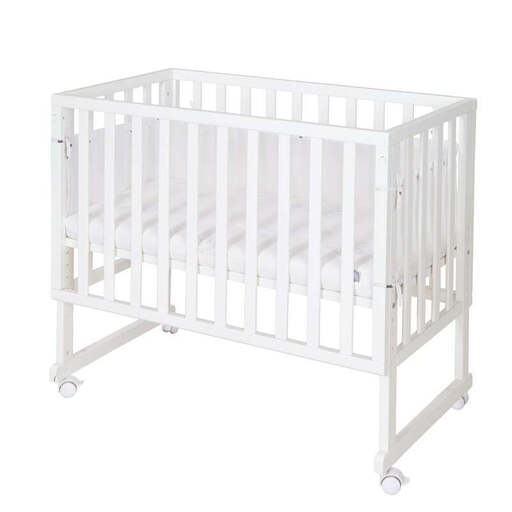
Why it's a great fit: This model is specifically designed for height flexibility. It is suitable for parents with non-standard height beds, especially high box spring beds.
With 7 height settings (22.4 to 44.6 cm) and a separately available extension kit (item no. 204105), it solves the compatibility trap for non-standard and box spring beds.
Breathable mesh insert for optimal air circulation; includes castors with a brake function for flexible use as a bassinet.
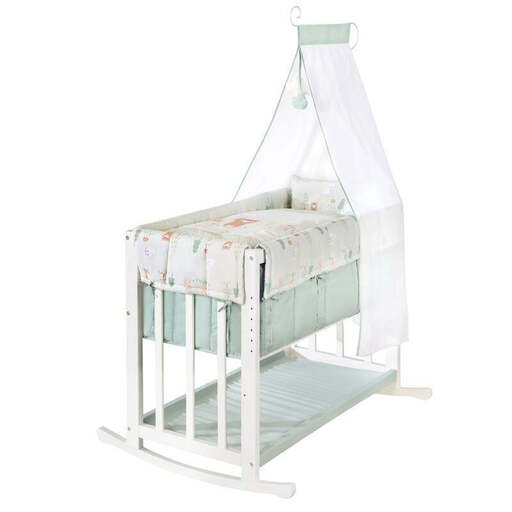
Why it's a great fit: For parents seeking a true all-in-one solution to save time and effort searching for matching accessories. This set includes not only the bed but also the complete textile furnishings.
It decisively solves the "incomplete complete set" problem, as bedding, a bumper, mattress, canopy, and canopy rod are already included. It also complies with the EN 1130:2019 standard.
4-in-1 function (cradle, co-sleeper, bassinet, bench); 6-level height adjustment for good adaptability; practical storage compartment under the sleeping surface.
We have compiled a complete, up-to-date list of products that fully meet these strict selection criteria and safety regulations.
The co-sleeper's sleeping surface should be exactly level with the top of the parent's mattress to create a seamless, gap-free surface. To do this, measure the height from the floor to the top edge of your mattress. Look for a co-sleeper whose maximum height setting matches or exceeds this measurement. Models with 7 or more adjustment levels and optional extension kits are often a good choice for box spring beds.
This is the current European safety standard that applies specifically to cribs and co-sleepers for domestic use. It defines detailed requirements for stability, the safety of materials used, the absence of sharp edges, correct slat spacing to prevent entrapment hazards, and secure attachment to the parent's bed. A product certified to this standard offers a proven level of safety.
A 90x45 cm baby co-sleeper is generally suitable from birth up to an age of about 6 to 12 months. However, the child's individual development is the deciding factor. As soon as your child begins to sit up, kneel, or pull themselves up independently, the bed should no longer be used in the co-sleeper function for safety reasons. Many models can then be repurposed as a freestanding cot or a bench.