
Lieferung heute & morgen

Qualitätsgarantie

Willkommens-Angebote freischalten: KOSTENLOSE Lieferung | Bis zu 80 % RABATT | Kostenlose 30-Tage-JoyPlus-Testphase
App herunterladen
Purchasing the first bed for a newborn is a major decision. A 60x120 cm co-sleeper crib promises closeness, comfort, and long-term usability. However, the market is flooded with options that often overpromise and underdeliver. Many parents invest in models that turn out to be impractical, short-lived, or even unsafe. This guide will help you avoid common purchasing pitfalls and make an informed decision.
Before you make a choice, you should be aware of the typical problems that arise with many seemingly attractive offers.
To avoid a poor investment, focus on objective, verifiable features. These three parameters are crucial for safety and functionality.
The European standard EN 716 is the most important indicator of a safe children's bed. It sets mandatory requirements, including:
A crib that meets this standard provides a tested baseline of safety for your child.
A good co-sleeper adapts to your needs, not the other way around.
Daily handling determines the practical value.
Based on these objective criteria, we have identified several models that are suitable for different needs and life stages.
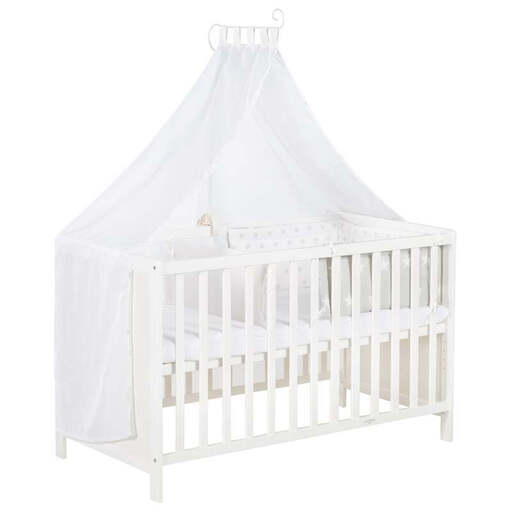
Why This Fits Their Persona: Ideal for parents seeking a one-time investment for the entire toddler period. Its high load capacity and conversion option to a junior bed allow for use up to the age of five.
Avoids the short-lifespan trap with a robust construction that, according to the manufacturer, can support up to 50 kg and facilitates the transition to toddlerhood with 5 removable slip-out bars.
Long service life (0-5 years) and high flexibility thanks to 6-level height adjustment and conversion options. Developed and safety-tested in Germany according to EN 716-1:2017 + AC:2019.
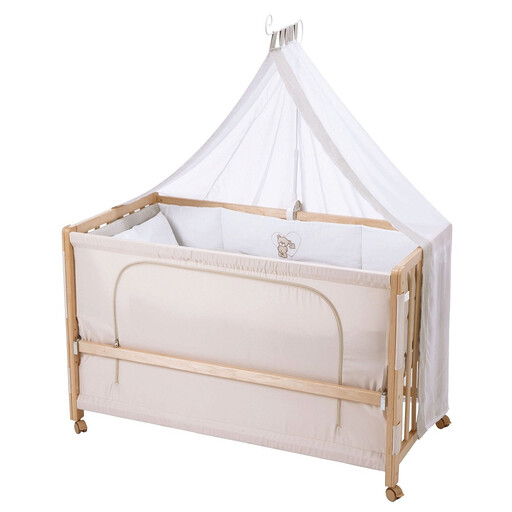
Why This Fits Their Persona: Perfect for parents looking for a hassle-free, all-in-one solution. The complete set saves the trouble of searching for matching individual parts, and the fabric side with a zipper maximizes comfort for nighttime feeding.
Sidesteps the "all-in-one" trap by offering a coordinated set including a mattress, bedding, and canopy. The fabric side with a zipper is a practical detail missing from many standard cribs.
A comprehensive complete baby crib set with 6-level height adjustment and lockable casters. The removable fabric side significantly eases nighttime access to the child.
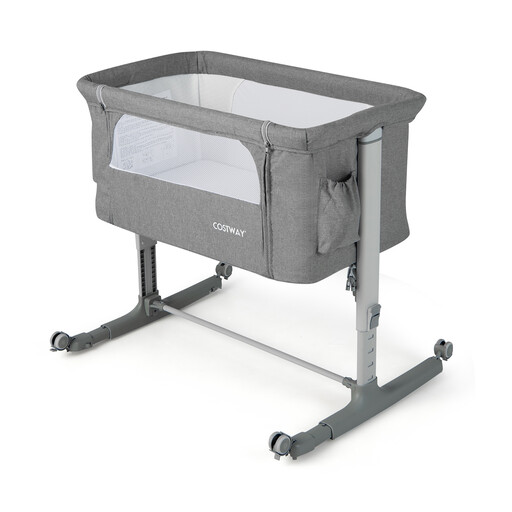
Why This Fits Their Persona: A great choice for parents who need a compact, mobile, and highly flexible solution specifically for the newborn phase (0-5 months). Ideal for smaller bedrooms or as a second crib at the grandparents' house.
Solves the problem of rigid height adjustment with 5 height settings and retractable feet that allow for an especially close fit to the parent's bed. The sides can be adjusted independently.
Combines a bedside sleeper, cradle, and bassinet in one. Lightweight and portable thanks to the included travel bag. Breathable mesh panels on both sides for good air circulation and visibility.
We've compiled a complete, up-to-date list of products that fully meet these strict selection criteria and safety regulations.
The sleeping surface of the co-sleeper should be set at the exact same height as the top edge of the parent's mattress. There should be no step or gap. Measure the height of your mattress from the floor and choose a crib whose adjustment levels cover this height.
The lifespan depends on the model. A simple bedside sleeper with a mattress is often only suitable for the first 6-9 months. In contrast, a convertible toddler bed of size 60x120 cm can be used up to the age of 4 or 5, depending on its construction and weight limit—first as a crib and later as a junior bed without the side rails.
Yes, the mattress is a crucial factor. It should have the exact dimensions of the sleeping surface (e.g., 60x120 cm) to avoid gaps. Look for a medium-firm, point-elastic, and breathable mattress with a removable and washable cover to ensure a safe and hygienic sleeping environment.