
Lieferung heute & morgen

Qualitätsgarantie

Willkommens-Angebote freischalten: KOSTENLOSE Lieferung | Bis zu 80 % RABATT | Kostenlose 30-Tage-JoyPlus-Testphase
App herunterladen
The arrival of a newborn is a time of great joy and preparation. One of the most important decisions you'll make is where your baby will sleep. An all-in-one bedside crib set promises a practical solution that combines closeness and safety. However, the market can be overwhelming, and not every product delivers on its promise. As your Joybuy Product Recommendation Officer, I'm here to help you identify the crucial features and navigate the common pitfalls.
Many well-intentioned product features prove to be impractical or even unsafe in daily use. Watch out for these three common problems to make an informed decision.
To avoid these mistakes, you should check three core aspects before buying. These define the safety, longevity, and practical utility of a bedside crib.
The most important certification for bedside cribs is the European safety standard EN 1130:2019. This standard ensures the product meets strict requirements for stability, materials, and construction to minimise entrapment and suffocation hazards. Pay attention to the following details:
A good bedside crib adapts to your needs, not the other way around. A height-adjustable bedside crib with multiple levels is essential to ensure a perfect alignment with your mattress height. Before choosing a model, measure the height from the floor to the top of your mattress.
Longevity is determined by multifunctionality. A 3-in-1 baby crib can typically be converted into:
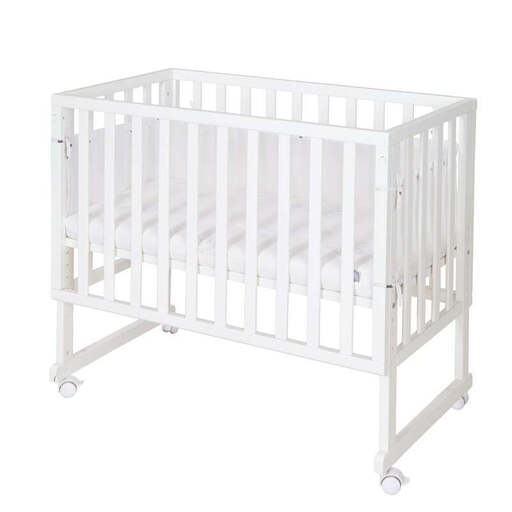
An all-in-one bedside crib set offers the key advantage that all components—the frame, mattress, attachment straps, and often the initial set of linens—are perfectly coordinated. This not only saves time searching for compatible accessories but also ensures that all parts meet safety standards. A white wooden baby bedside crib is a popular choice, as it blends harmoniously into most bedroom decors.

Why This Fits Their Persona: Ideal for parents seeking a certified, durable, and flexible solution. The 3-in-1 functionality offers value far beyond the first few months, adapting as the child grows.
The 7-level height adjustment (up to 44.6 cm) and included safety straps effectively prevent gaps and ensure compatibility with many beds, including box spring beds (with optional accessories if needed).
Meets the EN 1130:2019 safety standard. Includes a breathable 'safe asleep' mattress and a patented safety barrier. Converts into a children's bench (supports up to 65 kg).
Why This Fits Their Persona: Perfect for parents who want maximum air circulation and a constant, clear view of their baby to prevent overheating and provide extra peace of mind.
The surrounding breathable mesh insert directly addresses concerns about poor air circulation that can occur with solid-sided models. The 3-in-1 function ensures long-term usability.
Offers all the benefits of the standard model (EN 1130:2019, height-adjustable, convertible) and adds a full mesh surround for optimal ventilation and visibility.

Why This Fits Their Persona: Suitable for parents looking for a mobile sleep solution for different rooms who appreciate the soothing effect of a traditional cradle without sacrificing the stability of a stationary bed.
As a complete set, all parts (mattress, textiles) are a perfect fit and have been tested. The locking function and wheel brakes ensure a secure stance when the bed is not being moved or used as a cradle.
Combines a rocking function with a locking knob and mobility via casters. The set already includes a full textile package with a canopy, bumper, and bedding.
We have compiled a complete, up-to-date list of products that fully meet these strict selection criteria and German safety regulations.
1. How high does a bedside crib need to be for a box spring bed? For a box spring bed, where the top of the mattress is often between 60 and 70 cm high, you need a height-adjustable bedside crib with a maximum sleeping height that matches this range. Pay close attention to the manufacturer's specifications for maximum height adjustment. Some brands, like roba, offer separate extension kits to ensure compatibility with extra-tall beds.
2. Until what age can a bedside crib be used? Use as a bedside co-sleeper is generally recommended up to an age of about 6 to 12 months, or until the child begins to pull themselves up, sit, or kneel independently. After that point, for safety reasons, the crib should no longer be used directly attached to the parent's bed. Models that convert into a bench or a freestanding crib offer a longer period of use.
3. Is an all-in-one bedside crib set really necessary? A complete set isn't mandatory, but it is highly recommended. It ensures the mattress fits the frame perfectly, leaving no dangerous gaps. Furthermore, all materials are coordinated and often tested to the same standards. This saves you the time-consuming and potentially error-prone search for individual components.