
Lieferung heute & morgen

Qualitätsgarantie

Willkommens-Angebote freischalten: KOSTENLOSE Lieferung | Bis zu 80 % RABATT | Kostenlose 30-Tage-JoyPlus-Testphase
App herunterladen
Coat hooks create storage space without taking up much floor area. In the hallway, they keep jackets and bags close at hand; in the bedroom, they help organise clothes and accessories, while in the bathroom they can be used as towel hooks. However, not every coat rack or wall-mounted coat rack is suitable for every living situation.
Before buying, you should therefore check the mounting method, load capacity and material. This is especially important in small homes, where poorly chosen coat hooks can quickly become a nuisance: a door may no longer close fully, a self-adhesive fixing may come loose, or a hook rail may offer less space than expected.
A hook rail with lots of coat hooks may seem practical at first. However, the distance between the individual hooks is what really matters. If they are positioned too close together, several thick jackets, rucksacks or handbags may get in each other’s way. Families may also benefit from arranging the hooks at different heights.
With an over-door hook or over-door coat rack, you should also check whether the hooks are suitable for the door thickness. Models designed for doors up to around 4 cm thick will not automatically fit every interior door.
The load capacity of a wall-mounted coat rack depends not only on the material, but also on the wall and the fixing materials. Plugs for plasterboard are used differently from plugs for concrete, brick or tiles. A manufacturer’s specification such as 25 kg maximum total load is therefore only meaningful when the rack has been professionally fixed to a suitable wall surface.
Freestanding solutions have another potential weak point: a narrow clothes rail can tip over if the load is unevenly distributed. The footprint, overall weight and even distribution of garments are important purchasing criteria.
Metal hooks may be made from steel, iron or aluminium. Powder coating can protect the surface from scratches, but it does not replace suitable care. In the bathroom, rust-resistant materials and adequate ventilation are advisable. Wooden surfaces should be protected from prolonged contact with water.
The shape also matters: rounded edges and smooth hook ends reduce the risk of textiles catching. You should not use hooks without a clearly stated load capacity for heavy coats or filled bags.
Measure the intended area before placing your order. For a narrow hallway, a vertical coat rack with a footprint of around 40 to 45 cm may be more suitable than a wide coat hook rail. Behind a door, the construction must not obstruct either the door leaf or the frame.
In the bedroom, additional hooks for bags, belts or the next day’s outfit may be useful. In the bathroom, there should be enough space between the towel hooks and the wall to allow textiles to dry.
Distinguish between load capacity per hook and maximum total load. For example, a wall-mounted coat rack with six hooks may support a total load of 30 kg, while individual hooks may still only be designed to carry a limited proportion of that weight. For products without a specific load rating, we recommend using them for lightweight items such as scarves, hats or keys.
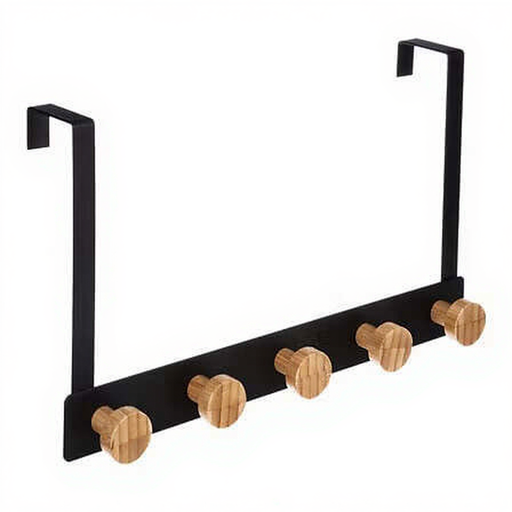
Why this product suits this profile: The five hooks simply hang over a standard door up to 4 cm thick. This makes them practical for rented homes or rooms where drilling is not an option.
The suitable door thickness is clearly specified. This allows you to check before buying whether the model is compatible with your existing door.
Five hooks, tool-free installation and a black-coated metal construction.
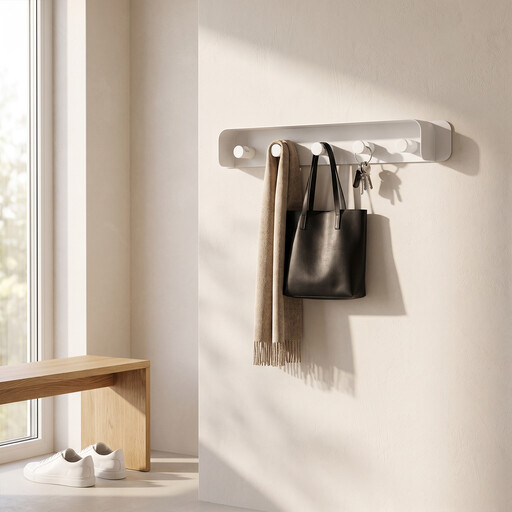
Why this product suits this profile: The combination of five hooks, an aluminium construction and a shelf is suitable for hallways, bedrooms or bathrooms when you need additional storage space.
The specified maximum load of 25 kg makes it easier to assess whether this is the right choice. However, it must still be mounted to the wall using suitable plugs.
Water- and rust-resistant aluminium, five hooks and an integrated shelf.

Why this product suits this profile: Ten hooks provide plenty of hanging space for jackets, bags, hats and towels in the bedroom, bathroom or wardrobe.
The dimensions of 19,5 × 12,5 × 41,7 cm and the 5 cm depth of the handle area make it easier to check compatibility before buying. Overloading should be avoided.
Ten hooks, a steel construction and installation without drilling or tools.
We have put together a complete, regularly updated list of products that fully meet these strict selection criteria and the safety regulations applicable in the EU.
For one person, three to five hooks in the hallway are often enough. Families need more space depending on the number of jackets, bags and accessories. Allow for an additional one or two spare hooks for guests or seasonal clothing.
Over-door hooks are practical when you do not want to drill. Whether they are suitable for heavy coats depends on their construction, the door thickness and the manufacturer’s specifications. For consistently heavy loads, a correctly mounted wall-mounted coat rack is usually easier to plan for.
Their service life depends on the material, installation, moisture and load. Stainless steel and coated metal are suitable for regular use, provided the surface remains intact. Overloading, aggressive cleaning products and unsuitable wall plugs can significantly reduce their service life.