
Lieferung heute & morgen

Qualitätsgarantie

Willkommens-Angebote freischalten: KOSTENLOSE Lieferung | Bis zu 80 % RABATT | Kostenlose 30-Tage-JoyPlus-Testphase
App herunterladen
Jackets slung over a chair, bags on the floor, and scarves draped across the dresser—it's a common sight in many hallways and bedrooms. A well-chosen coat rack is a simple yet effective solution to eliminate this clutter and make smart use of unused space. But the selection is vast, ranging from the classic wooden coat rack to a modern wall-mounted coat rack design.
As your Joybuy Product Recommendation Officer, I'm here to help you understand the different options. This guide presents objective criteria and a selection of models to help you make an informed decision for your home.
Before you decide on a model, several practical aspects should be considered. The right choice depends on your living situation, your interior design style, and the intended use.
The method of attachment is a crucial criterion, especially for renters.
The material determines not only the look but also the durability and maintenance requirements.
A coat rack for the hallway must meet different requirements than one for the bathroom. In the entryway, heavy winter coats and backpacks are often hung, which requires a high load capacity and stable anchoring. In the bathroom, on the other hand, rust-free materials and good resistance to moisture are most important. A wall hook set offers flexibility, as the individual hooks can be distributed according to need and available space.
Here is a selection of different coat racks that cover various needs and applications.

Why it stands out: This model combines a rack made of FSC-certified rubberwood with hooks made of an aluminium alloy. According to the manufacturer, the design was honoured with the Muse Design Award and the French Design Award in 2023. The construction is designed for a high load capacity and offers ample space with six hooks.
Advantages:
Who it's for: Ideal for homeowners and renters looking for a durable, high-capacity, and visually appealing solution for the entryway, hallway, or living room.

Why it stands out: This over-the-door rack is a practical solution that requires no drilling whatsoever. It is simply hung over a standard interior door. Made of chrome-plated steel, it offers five sturdy hooks for jackets, towels, or bags.
Advantages:
Who it's for: Perfect for renters, students, or for use in rooms where drilling is not permitted. A flexible solution for bathrooms, bedrooms, or storage rooms.
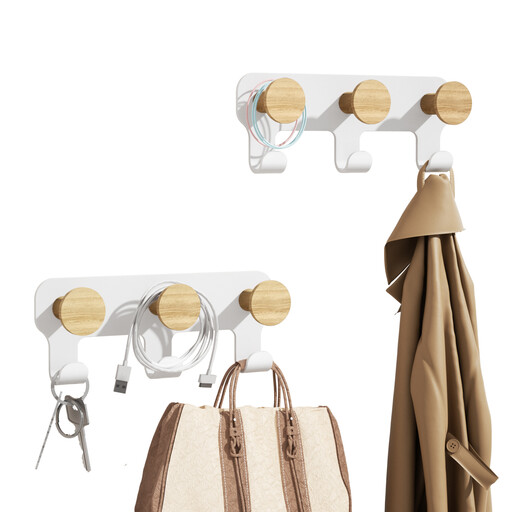
Why it stands out: This wall hook set offers maximum flexibility. It consists of six individual dual hooks that can be arranged freely on the wall. Each hook combines a wooden element with a metal one, creating double the hanging space. A rubber pad on the back protects the wall.
Advantages:
Who it's for: For creative decorators looking for a customisable solution. Ideal for narrow walls, alcoves, or for creating a unique coat rack arrangement in the hallway, office, or bedroom.
Haven't found the right solution for you yet, or are you specifically looking for more models that can be easily attached to a door? In our category, you'll find a wider selection of practical organisational helpers.
? Discover more over-the-door rack models here
1. At what height should a coat rack be mounted? A standard mounting height for adults is between 1.70 m and 1.75 m from the floor. This ensures the hooks are easily accessible and long coats don't drag on the floor. For households with children, a second, lower-mounted rack can be useful.
2. Can you install a coat rack without drilling? Yes, there are several options. Over-the-door racks, like the Coaty model presented, are simply hung over the door. Alternatively, there are coat racks that are attached with special adhesive strips or suction cups. With these solutions, however, it is crucial to strictly follow the manufacturer's maximum weight specification, as they are generally less load-bearing than screwed-in models.
3. What is the difference between a coat rack and a wall hook set? A coat rack or hook rail refers to a continuous board or rail on which several hooks are mounted at a fixed spacing. A wall hook set consists of several individual hooks that can be attached to the wall independently and in a freely chosen pattern. This allows for a more flexible and individual design.