
Lieferung heute & morgen

Qualitätsgarantie

Willkommens-Angebote freischalten: KOSTENLOSE Lieferung | Bis zu 80 % RABATT | Kostenlose 30-Tage-JoyPlus-Testphase
App herunterladen
A coat rack should hold jackets, coats, bags and scarves reliably without unnecessarily obstructing the hallway. In practice, however, poor purchases are often caused not by the design but by unclear information about load capacity, installation and space requirements. If you are comparing a wall-mounted coat rack, a freestanding coat rack and a wooden coat rack, you should therefore check a few technical details before buying.
A coat rack with 6 hooks does not automatically have room for six bulky winter coats. The distance between the coat hooks, the shape of the hooks and the permitted load per hook are all important. With thick coats or fully packed rucksacks, a densely loaded wall-mounted coat rack can quickly become cluttered.
A wall-mounted coat rack can only support as much weight as the wall, wall plugs and screws allow. The stated maximum load capacity therefore does not apply universally to every wall. Plasterboard, brick, concrete and tiles each require suitable fixings. A freestanding coat rack, on the other hand, needs a secure footing and should not be placed on an uneven floor.
In a hallway, width is not the only consideration. A wall-mounted coat rack usually projects less into the room than a coat stand with a wide base. With a freestanding model, you also need to consider the floor space, height and distance from doors. For small entrance areas, a wall-mounted coat rack or a slim wall-mounted coat rack rail may be the more practical solution.
Look out for two specifications:
Weight should be distributed as evenly as possible. A single heavy bag can put more strain on a coat hook than several lightweight scarves. With wall-mounted models, the load-bearing capacity of the fixing system must be suitable for the type of wall.
A wooden coat rack can be made from solid wood, bamboo, pine or MDF. These materials should not be treated as equivalent. Solid rubberwood and pine, for example, differ from an MDF construction. A paint or protective coating is also relevant, particularly if the coat rack is used in the bathroom or near an entrance door.
With metal hooks, a smooth surface and rounded edges are practical, as they make it less likely for fabrics to catch. For humid areas, material details such as rust-resistant metal parts or a sealed wooden surface should be stated clearly in the product description.
Check the following before buying:
A model with a shelf can help keep an entrance area more organised. For bedrooms or dressing rooms, however, a combination of a wall-mounted coat rack and clothes rail may be more practical. You can find more options in our selection of wooden holder clothes rails.
The following models are arranged according to their intended use. The information is based on the respective product descriptions and should be checked against the latest detailed specifications before ordering.
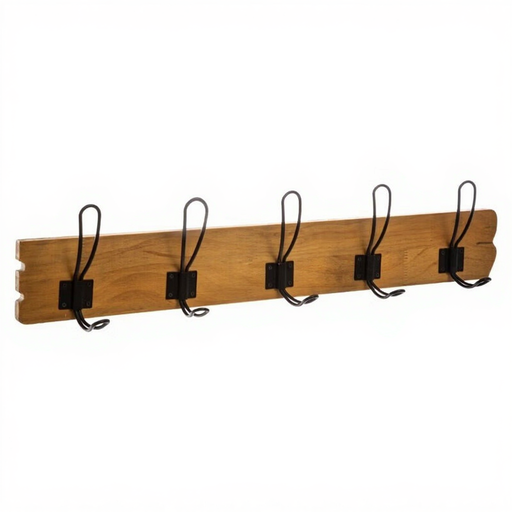
Why this product suits this profile: This compact wall-mounted solution with five double hooks is suitable for a small household or a narrow hallway. According to the product information, the frame is made from pinewood and the hook system from iron.
The clearly stated length of around 63.6 cm makes it easier to plan the installation on the wall. Nevertheless, you should check the wall’s load-bearing capacity before mounting it.
Five double hooks, a wooden frame and a stated depth of 14 cm provide a practical basic setup.
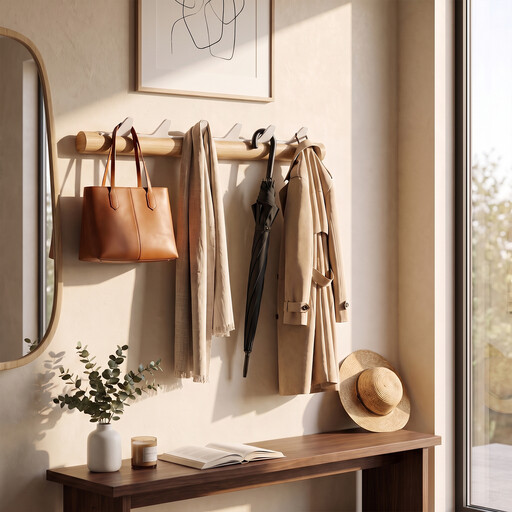
Why this product suits this profile: The combination of FSC-certified solid rubberwood, aluminium hooks and six hanging points appeals to buyers who value clear material details and stated load capacity.
The product information states a maximum load of up to 30 kg. This applies only when suitable wall anchoring is used and must not be exceeded.
Six hooks, rounded edges and a painted wooden surface make it suitable for hallways, bedrooms, offices or bathrooms.
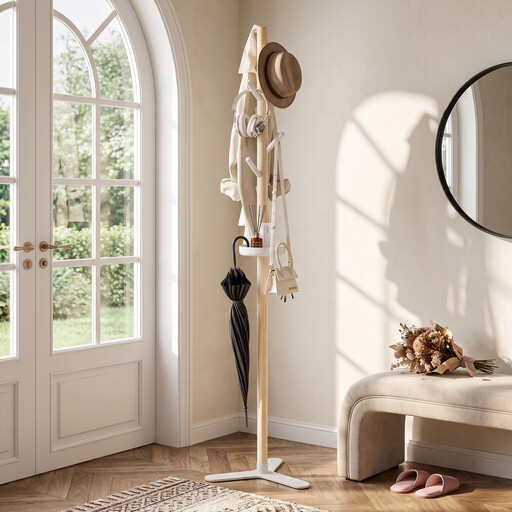
Why this product suits this profile: This freestanding coat rack is designed for households that do not want to drill into the wall and need extra storage space for keys, glasses or small items.
The construction includes a 6 mm-thick steel plate and a 4 mm-thick anti-vibration pad. A level surface is required for secure stability.
Seven hooks, two adjustable heights and a round shelf extend its usefulness in the hallway, bedroom or office.
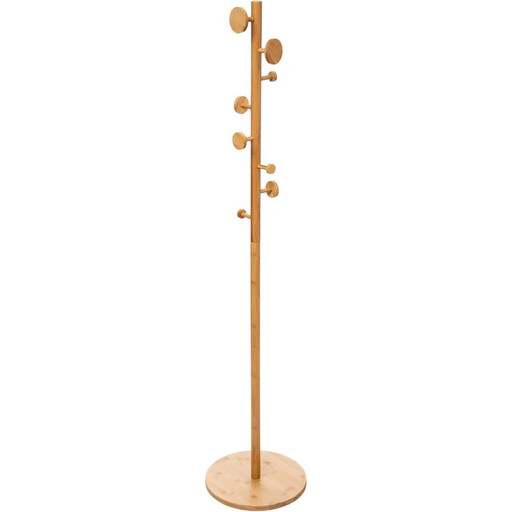
Why this product suits this profile: Eight hooks at different heights allow adult and children’s clothing to be hung separately. The model is designed for use at home or in the office.
The product data states a wide base with a diameter of 38 cm and a maximum total load of 24 kg. This makes it easier to assess the space required in advance.
The bamboo structure, steel fittings, eight hooks and height of 175 cm provide several hanging levels.
We have put together a complete, regularly updated list of products that fully meet these strict selection criteria and the safety regulations applicable in the EU.
First, check the wall material and the route of any cables or pipes. Then select wall plugs and screws suitable for the wall. With heavy jackets, it is advisable to attach the rack to load-bearing areas. After installation, all screws should be firmly tightened and checked regularly.
This depends on the number of people and the amount of clothing. Five hooks may be enough for a small household. Families often benefit from six to eight hooks, particularly if bags, hats and scarves also need to be stored. The distance between the coat hooks remains important.
A wall-mounted coat rack makes use of the wall and keeps the floor clear. A freestanding coat rack does not require drilling, but it does take up floor space. A freestanding model may be more practical for rented homes or changing room layouts; in a narrow hallway, a wall-mounted coat rack rail is often easier to accommodate.