
Lieferung heute & morgen

Qualitätsgarantie

Willkommens-Angebote freischalten: KOSTENLOSE Lieferung | Bis zu 80 % RABATT | Kostenlose 30-Tage-JoyPlus-Testphase
App herunterladen
A cluttered entryway, jackets draped over chairs, and the daily search for your keys—it's a common problem in many households. A well-chosen wall-mounted coat rack or a suitable coat stand can quickly and effectively restore order. However, the market is flooded with products that look great at first glance but prove to be impractical or unstable in daily use.
As your Joybuy Product Recommendation Officer, I'll help you identify the common pitfalls. Instead of falling for marketing promises, we'll focus on the facts that truly matter. This way, you'll find a solution that not only looks good but also serves its purpose in the long run.
Many coat racks look appealing in the online shop, but their weaknesses only become apparent after purchase. Watch out for these three common problems to avoid disappointment.
To avoid the problems mentioned above, you should check three core parameters before buying. These will give you an objective basis for your decision.
The material determines durability and maintenance.
Load-bearing capacity is a crucial factor, especially for families.
A good coat rack is more than just a row of hooks.
Here are some models tailored to specific requirements and living situations that successfully avoid the pitfalls mentioned.
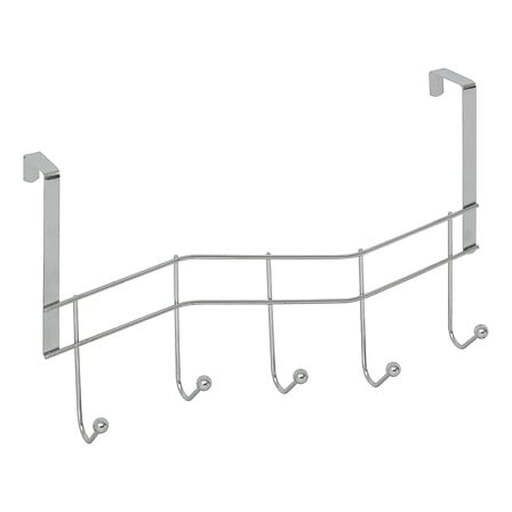
Why This Fits Their Persona: Ideal for renters or for rooms like the bathroom or bedroom where permanent holes in the wall are not an option. This over-the-door rack instantly creates storage space without tools and without leaving lasting marks.
Completely bypasses the wall-mounting problem. Instead of dealing with unsuitable anchors or weak walls, it uses the existing door for stable support.
Tool-free installation; utilises unused space behind the door; robust steel construction with a load capacity of up to 10 kg.
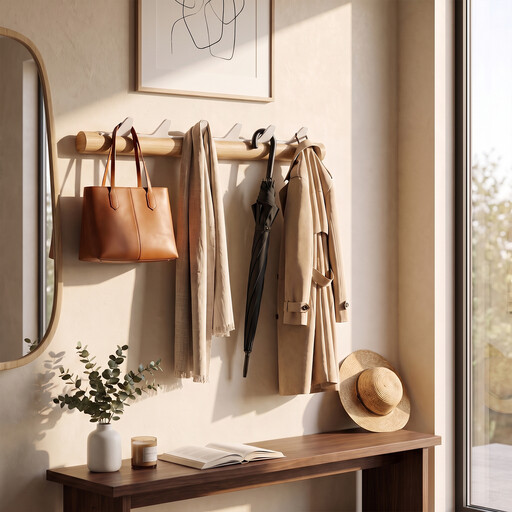
Why This Fits Their Persona: For those who see a coat rack not just as storage, but as a modern design element. The combination of FSC-certified solid wood and powder-coated aluminium is both visually appealing and durable.
Counteracts the "unstable construction" and "impractical design" pitfalls. The high load capacity of approx. 30 kg (according to the manufacturer) and the rounded, smooth edges of the hooks protect clothing and ensure stability.
High-quality, rust-resistant materials; award-winning design (Muse Design Award and French Design Award 2023); high load capacity.
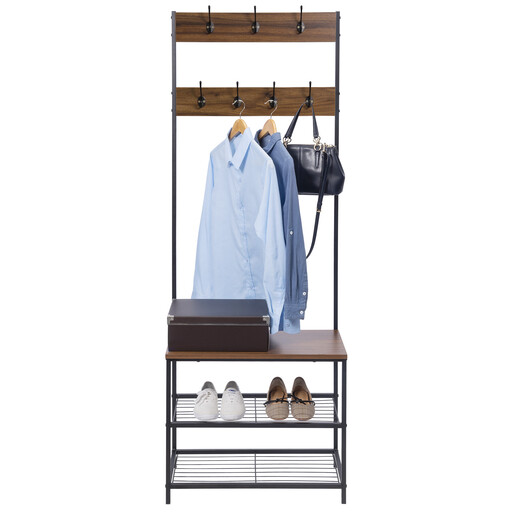
Why This Fits Their Persona: This multifunctional coat rack is a complete solution for the family hallway. It combines hooks for jackets, a shoe rack, and a bench—perfect for taming morning chaos and helping kids put on their shoes.
Solves the problem of impractical design by combining multiple functions in one piece of furniture. Instead of several small, unstable solutions, this model offers a stable, well-designed, all-in-one structure for the entire entryway.
3-in-1 functionality (hooks, shoe rack, bench); high load capacity for hooks (5 kg) and shelf (20 kg); stable, freestanding design.
We have curated a comprehensive selection of coat racks, pre-vetted for you based on objective criteria like material quality, load capacity, and functionality.
A common mounting height for the hooks is between 1.70 m and 1.75 m (5'7" to 5'9") from the floor. This allows most adults to access it comfortably while ensuring long coats don't touch the ground. In households with children, a second, lower-mounted coat hook rail at a height of about 1.10 m to 1.30 m (3'7" to 4'3") can be useful.
The choice of anchor depends on your wall. For concrete or solid brick walls, standard expansion anchors are sufficient. For drywall or hollow walls, you will need special hollow-wall anchors (e.g., toggle bolts or metal anchors) to ensure a secure hold and full load capacity. Always read the manufacturer's installation instructions and check the condition of your wall.
Yes, this is possible but requires special care. Lightweight coat racks for a few jackets can be attached with special drywall anchors. For heavy coat racks or when a high load is expected, it is advisable to screw the rack directly into the underlying wood or metal studs of the wall's framework. A stud finder can help locate these supports.