
Lieferung heute & morgen

Qualitätsgarantie
App herunterladen
Kategorien
Organizing clothes and accessories is a challenge in many homes, especially when space is limited. A functional wardrobe is essential for a tidy entryway, hallway, or bedroom. Choosing the right model depends on objective criteria such as available space, required storage volume, and material properties. This guide analyzes the technical differences between various wardrobe types and presents a selection of models for specific use cases.
The decision for a wardrobe should be based on an analysis of your personal needs and spatial conditions. Two basic designs dominate the market: freestanding models and wall-mounted systems.
Freestanding coat racks, also known as coat stands or garment racks, are standalone items.
Wall-mounted coat racks are attached directly to the wall.
The choice of material influences both the durability and the aesthetics of the coat rack.
Based on an analysis of technical specifications and functional design, we present three distinct garment storage solutions.
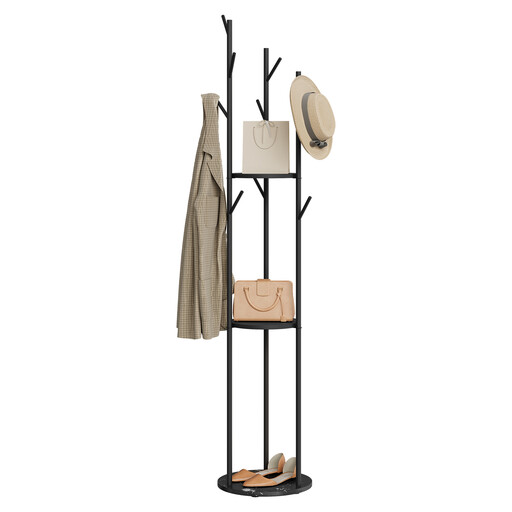
Why we recommend this product: This model combines high functionality with a compact footprint. The heavy marble base (35 x 35 cm) ensures excellent stability, allowing for the safe hanging of even heavy winter coats. The nine hooks are placed at different heights, making it easy for multiple people to use. The three integrated shelves provide additional storage for bags, boxes, or shoes, thus maximizing vertical space utilization.
Advantages:
Who it's for: Individuals and families looking for a flexible and stable freestanding coat rack with integrated storage for a hallway, bedroom, or office, and who have the necessary floor space.
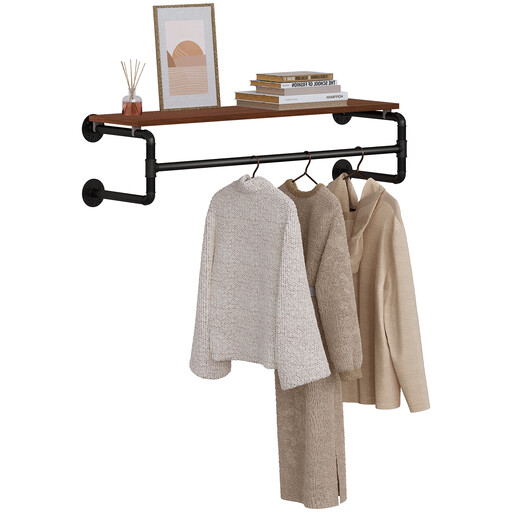
Why we recommend this product: This wall-mounted coat rack is a space-saving 2-in-1 solution that combines a clothes rail with an overhead shelf. The industrial-style metal pipe construction is not only visually striking but also designed for high load capacity. According to the manufacturer, the clothes rail can hold up to 40 kg and the shelf up to 20 kg, which is sufficient for most private use cases. The open design ensures a clear overview and quick access.
Advantages:
Who it's for: Users with limited floor space who are looking for a durable, high-capacity wall-mounted clothes rail and prefer an industrial interior design style.
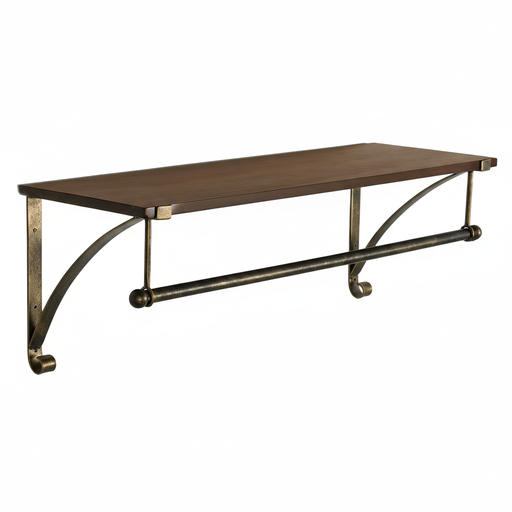
Why we recommend this product: This model focuses on a minimalist yet decorative function. It combines a bronze-finish metal clothes rail with a solid wood floating shelf. With a width of 90 cm, it offers enough space to display select garments or an outfit for the next day. Its shallow depth of 30 cm makes it an unobtrusive addition to bedrooms, dressing rooms, or boutiques.
Advantages:
Who it's for: Users looking for a stylish and compact hanging solution for a limited number of garments who value design and quality materials.
For needs that exceed the capacity of a typical coat rack, such as storing seasonal clothing in a basement or outfitting commercial spaces, specialized shelving systems can be a practical alternative. These systems are often modular and designed for maximum load capacity and durability.
Explore our selection of metal storage racks for robust and scalable storage solutions.
1. What is the difference between a coat stand and a freestanding coat rack? Technically, there is no standardized difference; the terms are often used interchangeably. A coat stand often refers to a model with a central pole and hooks (like the eSituro tree model), while a freestanding coat rack can also be a structure with a horizontal clothes rail on two supports. Both are freestanding wardrobe solutions.
2. How high should a wall-mounted coat rack be installed? The installation height depends on the users' height and the length of the garments to be hung. A common height for the clothes rail is between 160 cm and 175 cm from the floor. This ensures that long coats do not touch the ground and the rail is easily accessible for most adults. Hook strips are often mounted at a height of about 170 cm.
3. What is the most stable material for a garment rack? For maximum stability and load capacity, solid metal, especially steel, is the top choice. A metal garment rack with a wide, heavy base or a solid frame construction offers the highest load-bearing capability. For wall-mounted models, stability depends less on the material and more on the quality of the wall anchoring.