
Lieferung heute & morgen

Qualitätsgarantie

Willkommens-Angebote freischalten: KOSTENLOSE Lieferung | Bis zu 80 % RABATT | Kostenlose 30-Tage-JoyPlus-Testphase
App herunterladen
A coat rack is often the first piece of furniture your guests see and the last one you use before leaving the house. However, choosing the right model can be more complicated than it seems. An unsuitable coat rack is not just a visual nuisance; it can quickly become a functional problem. Many buyers only realise after a short time that their new furniture can't handle the demands of daily life.
Before you make a decision, it's helpful to know the most common pitfalls that lead to a bad purchase:
To avoid these problems, you should check three crucial criteria before buying. These will help you objectively assess the quality and functionality of a coat rack.
The first fundamental decision concerns the design, which largely depends on your available space and needs.
coat stand is ideal for corners or larger entrance areas.wall-mounted coat rack offers very high stability, provided it is properly installed with the appropriate wall plugs and screws for your wall type. Models that combine a coat rack with a shelf maximise storage in a small footprint.The material determines not only the look but also the load capacity and durability.
black coat rack made of metal fits well with a modern or industrial interior style. Aluminium is lighter and also rust-proof, which makes assembly easier.The sheer number of coat hooks is less telling than their design and arrangement. Check the following points:
Based on these objective criteria, we have selected a few models for different user profiles.
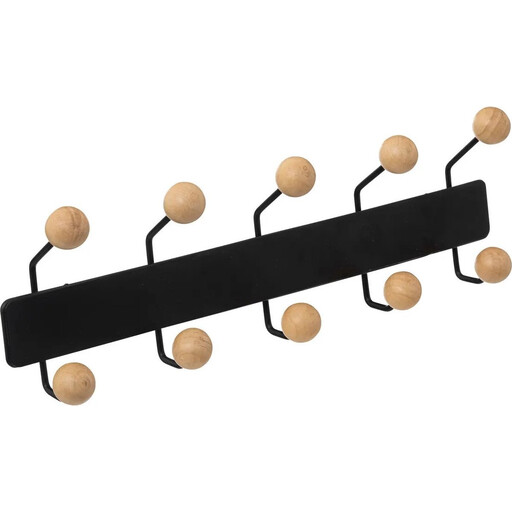
Why it's a great fit: Ideal for narrow hallways or small apartments where every centimetre counts. As a wall-mounted rack, it makes optimal use of wall space without taking up valuable floor area. With 10 hooks in a compact width, it offers high capacity for jackets, bags, and scarves.
The construction of steel and Schima wood is designed for daily use. The firm wall mounting completely eliminates the instability problem common in budget-friendly freestanding models.
High hook density in a small area (10 hooks on a 44 cm width). Pre-drilled holes facilitate a straightforward and quick installation.
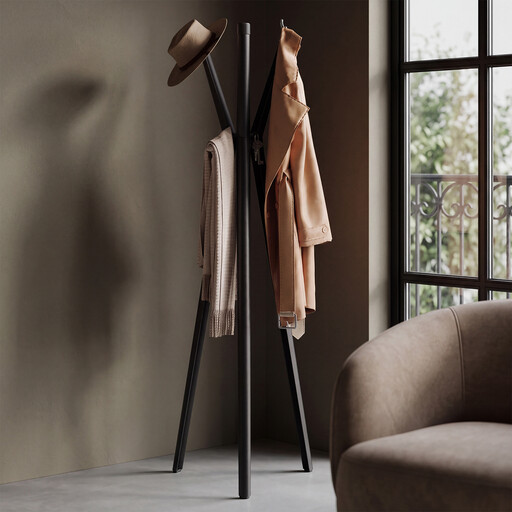
Why it's a great fit: For those who see a coat rack not just as storage, but as a modern design object. The simple, tree-like silhouette fits seamlessly into minimalist or modern interiors without overwhelming the space.
This model proves that design doesn't have to come at the expense of function. According to the manufacturer, it was honoured with the German Design Award 2022. The high-strength aluminium alloy construction is not only visually appealing but also waterproof, rust-proof, and stable.
High load capacity of 5 kg per hook and 30 kg total. The manufacturer states that assembly is tool-free and takes just a few minutes. The reinforced base with non-slip pads ensures stability.
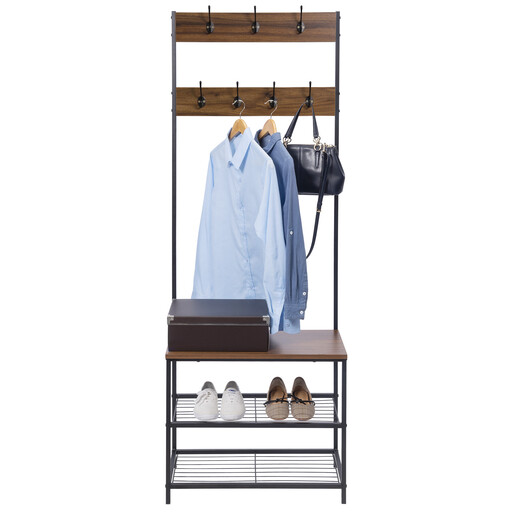
Why it's a great fit: This hall tree is a complete solution for the entryway. It combines hooks for jackets, a shoe rack, and a bench—perfect for families to avoid morning chaos. The bench makes it easier for both children and adults to put on their shoes.
Instead of just offering hooks, this model solves the broader problem of hallway organisation. The rectangular base and alloy steel frame provide greater stability than simple stands. The load limits are clearly defined (5 kg per hook, 20 kg for the shelf).
Multifunctional 3-in-1 solution: coat rack, shoe rack, and bench in one. The combination of a steel frame and vintage-look composite wood is both functional and decorative.
We've compiled a complete, up-to-date list of products that fully meet these strict selection criteria and applicable regulations.
The safety of a wall-mounted coat rack depends on correct installation. Always use the appropriate wall plugs and screws for your wall type. For solid concrete or brick walls, expansion anchors are suitable. For plasterboard walls (drywall), you should use special hollow-wall anchors that grip behind the board. For maximum stability, ideally mount the rack where there are supporting studs in the wall.
The load capacity varies greatly depending on the model and material. Simple models often have a total capacity of only 5-10 kg. However, high-quality coat stands made of solid wood or metal with a sturdy base can support 20-30 kg or more. Pay attention to the manufacturer's specifications for maximum load per hook (often 2-5 kg) and total load. Always distribute the weight evenly across the hooks to prevent tipping.
Both materials are easy to care for with the right treatment. Powder-coated or painted metal is very resilient and can be easily wiped with a damp cloth. It is resistant to moisture from wet coats. Varnished or oiled wood is also well-protected but should not be exposed to prolonged moisture. Dust is easily removed from both surfaces. Untreated wood is the most maintenance-intensive, as it is susceptible to stains and moisture.