
Lieferung heute & morgen

Qualitätsgarantie

Willkommens-Angebote freischalten: KOSTENLOSE Lieferung | Bis zu 80 % RABATT | Kostenlose 30-Tage-JoyPlus-Testphase
App herunterladen
The right coat rack keeps things tidy without unnecessarily obstructing the entrance area. However, product images and sales descriptions often mention numerous hooks, decorative design or high load capacity, while omitting important details. If you want to buy a wall-mounted coat rack, coat rack rail or clothes stand, you should therefore check the installation, dimensions and intended use above all else.
A maximum load capacity is only meaningful if it can be achieved with a suitable wall and appropriate wall plugs. Concrete, solid brick, plasterboard and lightweight partition walls differ considerably. With a wall-mounted coat rack with shelf or a metal coat rack, several jackets can quickly create high pulling forces at the fixing points.
So make sure you check:
If there is no clear information, the coat rack should not be planned for heavy winter coats.
A coat rack with several hooks may look suitable for a family on paper. However, the crucial factor is the distance between the hooks. If they are too close together, thick jackets and bags overlap. With a coat hook that has a small supporting surface, scarves or bags can also easily slip off.
For the hallway, it is worth planning realistically: how many people use the coat rack every day? Will it hold only jackets, or also rucksacks, hats and umbrellas? A coat rack rail with five hooks may be enough for a small household, while families may need several levels or additional shelf space.
A wooden coat rack adds a warm look to the entrance area, while a black metal coat rack often appears slimmer and more industrial. However, the material alone says little about its suitability. MDF, solid wood, steel and aluminium have different properties when it comes to moisture, weight and care.
For the bathroom, the product description should explicitly state that the materials are suitable for humid rooms. In the hallway, the edges, hook shape and distance from the wall are important. A coat rack with sharp metal edges can be awkward in narrow passageways.
Measure the available wall or floor space before ordering. A wall-mounted coat rack usually takes up less floor space than a freestanding clothes stand. Nevertheless, check that doors, drawers and the passageway will still be fully usable.
As a practical guide:
Look for specific information such as 50 kg static load capacity per rail or 2 kg per hook. A static load describes an evenly distributed, stationary weight. Additional forces occur when taking off a jacket or knocking against the rack. The stated capacity should therefore not be used to its limit on a permanent basis.
With a wall-mounted coat rack featuring several hooks, the fixing method is also crucial. Use wall plugs that are suitable for the wall material and distribute heavy items as evenly as possible.
Powder-coated steel can provide an even, matt finish. Aluminium is corrosion-resistant and lightweight, while wood and MDF depend more heavily on the surface finish. Most models can be cleaned with a dry or slightly damp cloth. Abrasive cleaners can damage paintwork, coatings and wooden surfaces.
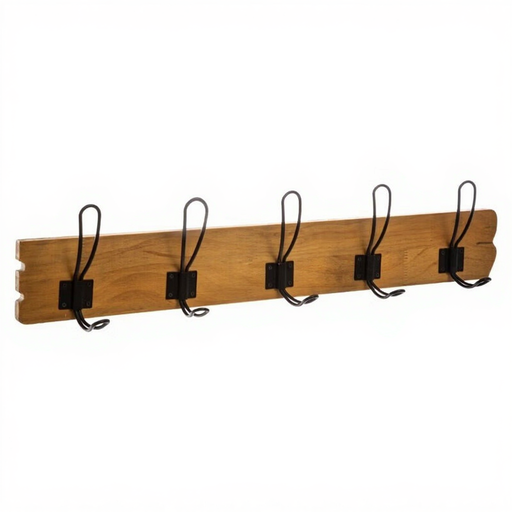
Why this product suits this profile: The 63.6 cm-wide pine frame with five double hooks is suitable for a small household and can hold jackets, scarves or bags.
The number of hooks and the product dimensions are clearly stated. This makes it easier to assess the available space before buying.
Compact format, product weight of 0.61 kg, plus a combination of pine wood and iron hooks.
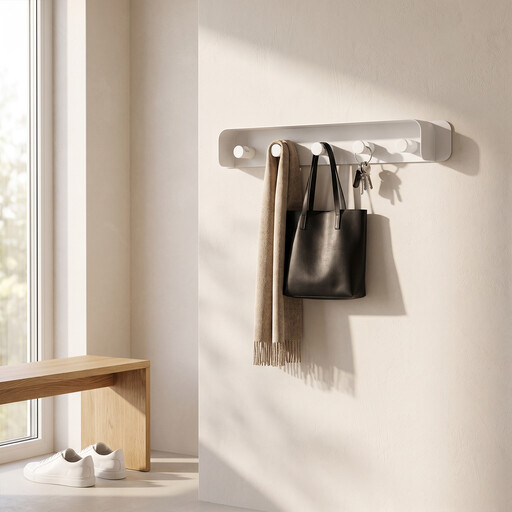
Why this product suits this profile: The combination of five hooks and a shelf appeals to households that want to keep jackets and smaller items in one place.
The product details specify the material, five hooks and a maximum load capacity of 25 kg. However, you must still check that the wall fixing is suitable.
Aluminium construction, wall contact surface with rubber padding and additional shelf space.
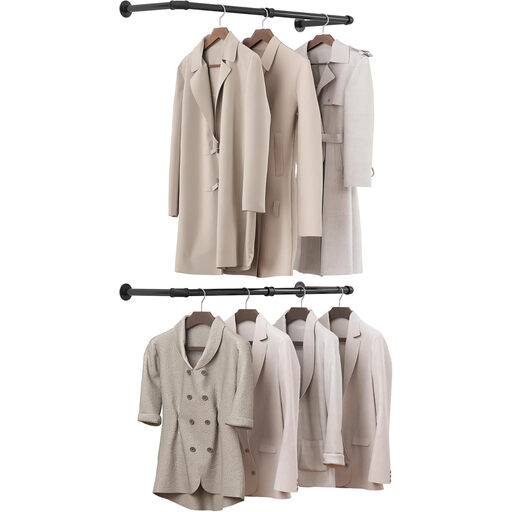
Why this product suits this profile: Two 100 cm-long wall-mounted clothes rails are suitable for clothes, towels or kitchen utensils, making use of wall space in the bedroom, hallway or utility room.
According to the product details, the maximum static load of 50 kg per rail is expressly specified for solid walls. The type of wall remains crucial for installation.
Powder-coated metal, industrial design, mounting hardware and two rails in the set.
We have put together a complete, regularly updated list of products that fully meet these strict selection criteria and the safety regulations applicable in the EU.
First, mark the drill holes using a spirit level. When drilling into tiles, work slowly and without the hammer function to avoid damaging the surface. Use special cavity wall plugs for plasterboard and check whether the construction is suitable for the intended load.
A freestanding clothes stand should be placed on a level floor. Distribute jackets evenly across the hooks and observe the stated total load. A narrow base saves space, but can reduce stability if the load is concentrated on one side. In a household with children, the coat rack must not be used as a climbing aid.
Remove dust with a soft cloth and occasionally check the screw connections on wall-mounted models. Moisture, harsh cleaners and bags left hanging for long periods can shorten the service life of surfaces and fixings.
For narrow hallways, wall hooks, a slim coat rack rail or a wall-mounted coat rack with shelf are generally more space-saving than a clothes stand. The key factors are the available wall width, the distance from the door and the number of hooks required.
Plan for at least one regularly used hook per person. Additional hooks are useful for children’s jackets, bags, scarves and hats. Make sure there is enough space between them so that garments do not hang on top of one another.
Its durability depends on the material, workmanship, use and installation. A correctly secured coat rack with evenly distributed weight can remain functional for longer than a model that is continually used above its stated load capacity. Check the hooks, surface and screws regularly.