
Lieferung heute & morgen

Qualitätsgarantie

Willkommens-Angebote freischalten: KOSTENLOSE Lieferung | Bis zu 80 % RABATT | Kostenlose 30-Tage-JoyPlus-Testphase
App herunterladen
A coated frying pan with lid can bring together frying, sautéing, braising and stir-fry dishes in a single piece of cookware. However, not every non-stick pan delivers the right results in daily use. Details such as hob compatibility, rim height, coating type and cleaning often determine whether the cookware remains practical in the long run.
A pan suitable for all hob types should be explicitly approved for induction, gas, electric and ceramic hobs. For induction, a magnetic base is essential. If there is no clear information about the base structure or compatible hob type, heat transfer may be uneven, or the cookware may not be recognised at all.
Differences also exist with halogen and infrared hobs. A product description that only mentions gas and induction should not automatically be assumed to work with every other hob type.
Names like ceramic, granite, titanium or honeycomb describe different surface concepts. A ceramic frying pan is often made from a coated aluminium or stainless steel body, not from solid ceramic. With claims such as PFAS-free pan or PTFE-free pan, you should check exactly what the statement refers to.
Care is also crucial: even a coated surface can be damaged by overheating, metal utensils or abrasive scourers. “Non-stick” therefore does not mean that every use is without limitations.
A pan may be oven-safe while the glass lid is only intended for hob use. Information such as “up to 230 °C” or “up to 260 °C” must therefore always be read together with the lid specification. Plastic or Bakelite handles can also have a lower temperature limit.
Aluminium distributes heat relatively quickly and is often used in lightweight pans. Stainless steel is robust and can be combined with an aluminium core to improve heat distribution. With a coated wok pan or a deep sauté pan, you should also pay attention to the wall height and capacity.
For low-fat cooking, an intact non-stick surface can be helpful, as food releases easily with little oil. This is not a medical claim, however, but a functional property of the surface. Manufacturer information about PFAS, PTFE, PFOA or PFOS freedom should be checked directly on the respective product data sheet.
A braising pan with lid needs sufficiently high sides so that liquids do not easily spill over the edge when simmering. For sauces, vegetables, pasta or braised dishes, high walls are often more practical than a shallow frying pan.
“Dishwasher-safe pan” does not automatically mean that the coating remains unchanged after frequent machine washing. Some models may be dishwasher-safe but still recommend hand washing. Mild liquid soap, a soft sponge and low to medium heat help protect the surface.
Basic rules for coated cookware:
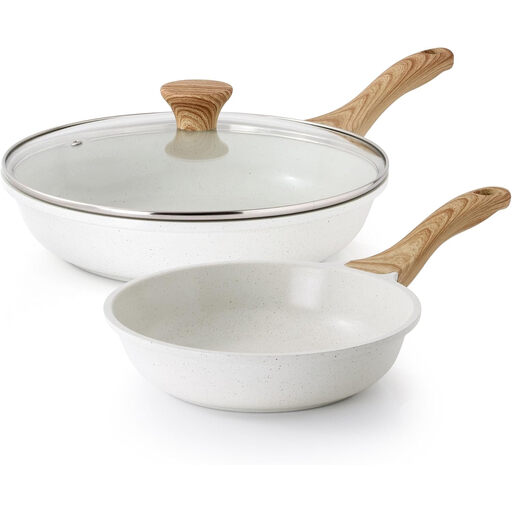
Why this product fits the profile: The set includes an 8-inch omelette pan and an 11-inch pan with a glass lid. According to the product information, the ceramic coating is free from intentionally added PFAS and PTFE. The pans are designed for induction, gas and electric hobs.
The two sizes cover both small and larger portions. The product information also clearly states “Dishwasher Safe: No”, so the necessary hand washing is not overlooked.
Two pan sizes, glass lid and compatibility with multiple hob types. Cleaning is done by hand with a soft sponge.
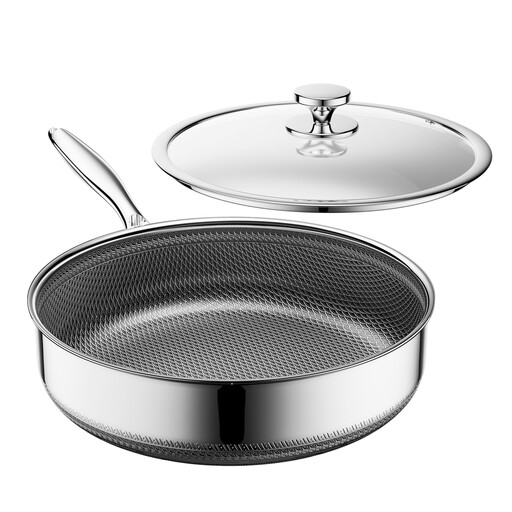
Why this product fits the profile: According to the product description, this deep stainless steel pan combines an aluminium core with a ceramic coating. It is suitable for gas, electric, ceramic, halogen and induction hobs, and can go in the oven up to 260 °C without the lid.
The temperature limits for the pan and glass lid are stated separately: according to the product information, the lid is oven-safe up to 148 °C. This reduces misinterpretation when using it in the oven.
All-hob compatibility, deep design and dishwasher-safe construction. Hand washing is recommended to protect the coating.
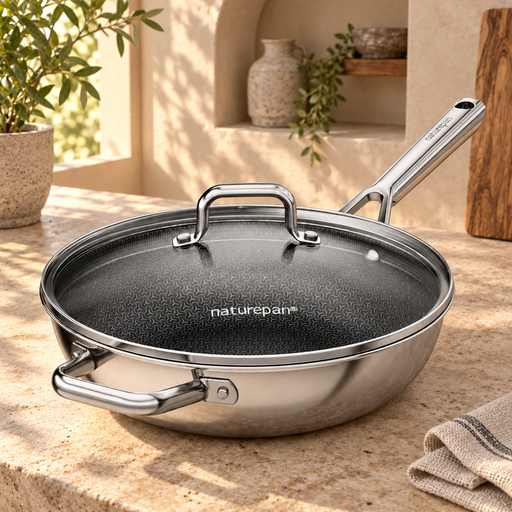
Why this product fits the profile: This 28 cm sauté pan has high sides, an aluminium heat core and a textured stainless steel-ceramic surface. It is therefore suitable for frying, sautéing and braising dishes with the lid.
The specifications list the permitted hob types as well as an oven temperature of up to 230 °C without the lid. For halogen or infrared hobs, additional manufacturer testing is recommended.
28 cm diameter, high sides, glass lid and dishwasher-safe construction. Hand washing is recommended for the coating.
We have compiled a complete, regularly updated list of products that fully meet these strict selection criteria and the safety regulations in force in the EU.
For multiple portions, a diameter of 26 to 28 cm is usually practical. A high sauté pan also offers extra space for sauces, vegetables or braised dishes. For very large quantities, a 30 to 32 cm pan may be useful, provided your hob and storage space are suitable.
Yes, provided the manufacturer explicitly mentions induction and the base is magnetically conductive. An induction frying pan should be centred on the appropriate cooking zone. If you are unsure, a magnet test on the base can give an initial indication; the product specification remains definitive.
It is not possible to give a reliable fixed lifespan. It depends on heat, frequency of use, utensils and cleaning. Low to medium temperatures, wooden or silicone utensils and avoiding abrasive cleaners can help protect the coating. If the surface becomes visibly damaged or parts start to flake off, the pan should no longer be used.