
Lieferung heute & morgen

Qualitätsgarantie

Willkommens-Angebote freischalten: KOSTENLOSE Lieferung | Bis zu 80 % RABATT | Kostenlose 30-Tage-JoyPlus-Testphase
App herunterladen
A coated pan should release food reliably, heat evenly and be easy to clean. In practice, however, unclear product descriptions and unsuitable designs often lead to disappointing purchases. The type of coating, hob compatibility and how the pan handles high temperatures are particularly important.
A non-stick pan can have either a PTFE or a ceramic coating. These two types differ in terms of care, temperature behaviour and suitable cookware:
A pan may be suitable for gas and ceramic hobs, but not automatically for induction. For an induction pan, the base must be magnetic and the manufacturer must explicitly state that it is suitable for induction hobs.
Aluminium bodies therefore require a suitable induction base. If you are planning to change your hob in the future, look for a pan with the broadest possible compatibility with induction, gas, electric and ceramic hobs.
With an oven-safe pan, the stated maximum temperature does not necessarily apply to the lid, coating and handle equally. A plastic handle can limit oven use. With some models, the lid must be removed before placing the pan in the oven.
Before buying, you should therefore check three details:
An aluminium body usually heats up quickly and distributes heat evenly. Stainless steel constructions with an aluminium core, on the other hand, can offer more stability and even heat distribution from the base to the rim.
When choosing a coated frying pan, you should also check whether the manufacturer provides specific care instructions. These include the recommended temperature, suitable kitchen utensils and cleaning methods. A PTFE coating should not be used with knives or metal turners. With ceramic pans, abrasive cleaners and sudden temperature changes can damage the surface.
A 28 cm pan is often suitable for two to four portions and works well with many hobs that have a cooking zone of around 22 cm. For smaller meals, a 20 cm or 24 cm pan is often sufficient. Family households, on the other hand, benefit from a 28 to 32 cm pan or a pan set with several sizes.
The shape determines the intended use:
A dishwasher-safe pan can be conveniently cleaned in the machine. However, this does not mean the coating will remain unchanged in the long term. Detergent, high temperatures and contact with other dishes can stress the surface more than gentle hand washing.
For a longer lifespan, we recommend:
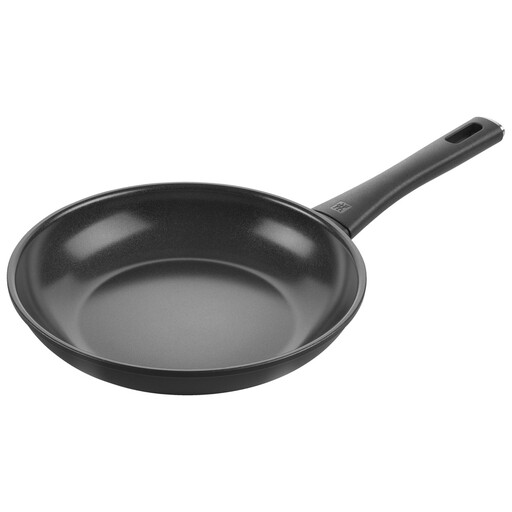
Why this product fits the profile: The 24 cm pan is handy and suitable for smaller households and everyday portions. The forged aluminium body distributes heat quickly; according to the product information, the CeraForce ceramic coating is PTFE- and PFOA-free.
The product data specifies the hob types, oven suitability up to 250 °C and guidance on using low to medium heat. This makes it easier to assess compared to vague non-stick claims.
24 cm diameter, aluminium body, induction compatibility and a cool-touch stainless steel handle. Hand washing is recommended to preserve the coating.

Why this product fits the profile: The set combines 24 cm and 28 cm pans, covering both smaller and larger portions. According to the product information, the pans are made from Cromargan 18/10 stainless steel and feature a mineral-hardened ceramic coating.
The technical description states that the pans are suitable for all common hob types including induction, and that the coating is heat-resistant up to 400 °C. The specific oven approval should be checked against the manufacturer's instructions before use.
Two diameters, TransTherm universal base and wide pouring rims. The hollow handles are designed to reduce heat transfer, according to the product information.
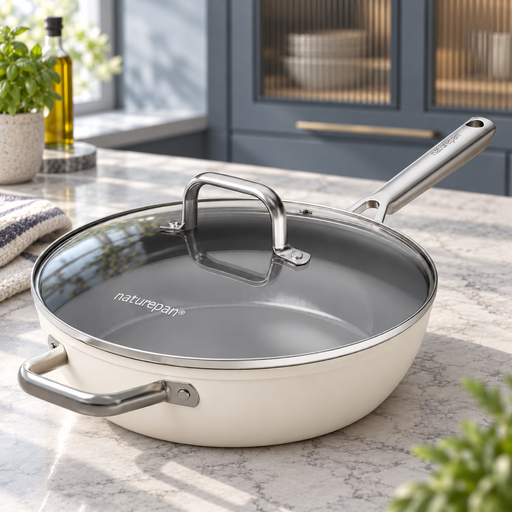
Why this product fits the profile: The 28 cm sauté pan with lid has a body height of 7.5 cm and is suitable for larger portions, braising and dishes with liquid. According to the product information, it is coated aluminium, not solid ceramic.
The specifications list the usable hob types, the oven limit of 230 °C without the lid, and the restriction for microwaves. This makes the usage limits clearer than with a pan that claims to be “suitable for everything”.
28 cm diameter, matching lid, induction, gas, electric and ceramic hob compatibility, and a dishwasher-safe design. Hand washing is recommended to care for the coating.
The lifespan depends not only on the coating, but also on temperature, cleaning and storage. Let a hot pan cool down before washing it and avoid running cold water over the heated material. If you notice deep scratches, peeling or a significantly altered coating, the cookware should no longer be used.
For induction hobs, there is an additional point: the pan should sit centrally on the correct cooking zone. A significantly larger or smaller diameter can affect heat distribution and energy consumption.
We have put together a complete, regularly updated list of products that fully meet these strict selection criteria and the safety regulations in force in the EU.
Look for the explicit label “suitable for induction” or “induction compatible”. Aluminium pans require a magnetic base. The product description should also list the other hob types if you want the pan to be versatile.
A general lifespan cannot be given. The coating type, temperature, kitchen utensils and cleaning methods are all decisive factors. Low to medium heat, hand washing and soft tools can protect the surface. Metal utensils, prolonged empty heating and abrasive cleaning products increase wear.
Some models are labelled as dishwasher safe by the manufacturer. However, hand washing with mild detergent and a soft sponge is often gentler on the coating. Check the specific care instructions for each product before buying.