Preparing portions for the week
If you want to divide a batch of cobbler between several lunch boxes, the usable area of your dish and the number of batches you can bake are key considerations.


When making portions of cobbler to take with you, first check whether the dish you plan to use, along with the quantity you want to bake, will fit inside the oven. A countertop oven is an option if the dish and the space available suit it; for larger batches, a built-in oven may be more practical, provided you have a suitable housing unit. Compare heating methods and energy consumption figures on a like-for-like basis, and remember to plan how you’ll chill your lunch boxes after baking.
If you want to divide a batch of cobbler between several lunch boxes, the usable area of your dish and the number of batches you can bake are key considerations.
If you’re making smaller portions and have limited worktop space, check that you have room for the specific countertop model, including the required safety clearances, and that your dish will fit inside it.
If you use your oven often, weigh up the energy consumption figures and cleaning requirements against the features of each model.
A good fit if: you’re making smaller quantities, don’t want to use a built-in housing unit and have confirmed that your dish fits inside the specific model.
Things to weigh up: A smaller usable cooking area may mean baking in additional batches. You’ll also need a suitable spot for the countertop appliance.
A good fit if: you want to prepare several portions and need a freestanding appliance rather than a built-in oven.
Things to weigh up: The larger casing takes up worktop space, and the stated capacity in litres or measurements for round dishes don’t confirm that a rectangular cobbler dish will fit.
A good fit if: you have a suitable housing unit and regularly bake larger dishes or other meals.
Things to weigh up: The housing unit dimensions and accessories must suit the specific model. A fan setting for several shelves doesn’t, by itself, guarantee the same cobbler results on every shelf.
If you’re choosing an oven for cobbler portions to take with you, the key considerations are the dish and number of portions, kitchen space, running costs and cleaning.
| Priority | What to check before buying | Who is this important to? |
|---|---|---|
| Dish size and number of portions | Measure your dish, including its rim and handles, and compare it with the usable dimensions of the specific appliance. A stated capacity in litres or measurements for round dishes don’t confirm that a rectangular dish will fit. | If I’m baking ahead for several lunch boxes, I want my dish to fit and, ideally, to cook everything in one batch. Around 36% of consumers put preparing a week’s worth of portions and dish size first. |
| Space and oven type | Compare the appliance’s external dimensions and door opening with the space available, and check the installation or housing requirements for the exact model. | In a small kitchen, I need to know in advance whether there’s a safe spot for a countertop appliance or a suitable place to install a built-in oven. Around 29% of consumers say limited space is their main concern. |
| Electricity consumption | According to Verbraucherzentrale, figures for ovens with an energy label show consumption per standard cycle and heating method. Small and portable ovens are exempt from the relevant energy-labelling rules, according to the European Commission. Don’t assume standard figures will apply directly to your cobbler. | If I bake often, I want to compare energy consumption figures on a like-for-like basis. Around 21% of consumers prioritise running costs. |
| Cleaning | Check the cleaning instructions, removable trays or crumb trays, and any specific cleaning function listed. A cleaning function doesn’t guarantee a particular cleaning time. | After baking regularly, I want to know how easy it is to reach the oven interior and accessories. Around 14% of consumers put easy cleaning first. |
A recipe may call for a rectangular dish, while the manufacturer’s specifications may describe round dishes or a pizza stone. Those measurements won’t tell you whether your dish will fit inside the oven.
Compare the external dimensions of your dish, including its handles, with the usable space inside the exact model.
Energy-label figures are based on defined standard cycles and heating methods, not directly on the baking time for a cobbler recipe. Small and portable ovens aren’t covered by the same labelling rules, according to the European Commission.
Only compare figures based on the same measurement method and heating setting. Don’t assume you’ll save energy per cobbler unless you have suitable consumption measurements.
The German Federal Institute for Risk Assessment notes that inadequate chilling during storage and transport can allow harmful bacteria to multiply.
Plan how to store your cobbler based on its ingredients and the actual transport conditions, and make sure you can keep it suitably chilled.
Rommelsbacher lists an 18-litre capacity and round dishes up to 25 cm for the BG 1055/E, and a 30-litre capacity and round dishes up to 29 cm for the BGE 1580/E.
Severin describes the TO 2068 as a baking and toasting oven with a capacity of around 20 litres, top and bottom heat, and a fan setting.
For the HBA514BS3 built-in oven, Bosch lists 3D hot air and hydrolytic cleaning assistance.
This selection includes built-in ovens and countertop appliances for different kitchens and batch sizes. For each model, check your dish dimensions and make sure you have a suitable place to position or install it.
 No image available
An option if you have a suitable place for a built-in oven and are looking for a model with fan-assisted cooking.
The product name lists 70 l, 3 kW, a grill, a pizza function and AquaClean steam cleaning. Fan-assisted cooking and baking on several shelves are also mentioned. A suitable housing unit is required.
 No image available
Worth considering if you have a suitable space for a built-in oven and top and bottom heat and fan-assisted cooking are useful for your recipes.
This product is listed as having a 71-litre capacity, several heating methods, top and bottom heat, and 3D hot air. Pyrolytic self-cleaning is also mentioned. The built-in dimensions and professional installation must be suitable for your kitchen.
 No image available
A freestanding option if you’re considering a countertop oven with top and bottom heat.
The product name lists a capacity of 28 litres. The description includes top heat, bottom heat and a combined setting, as well as a baking tray, rack and crumb tray. Measure your dish and compare it with the usable interior dimensions.
 No image available
Could be worth considering for larger batches if the stated housing unit dimensions suit your kitchen.
The model is listed as having a 78-litre capacity, nine cooking functions, a baking tray and a hydrolytic cleaning system. Check the housing unit dimensions before choosing it.
 No image available
A freestanding appliance to consider if you want to prepare several portions and are looking for a model with a baking function.
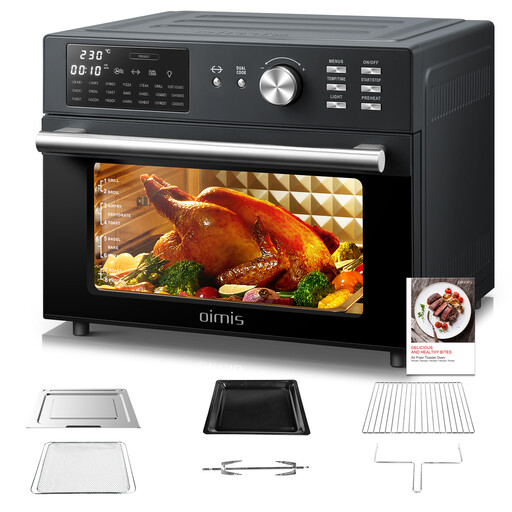
The product name lists a 30-litre capacity and 1800 W. The description includes baking and 360° air circulation. The capacity alone doesn’t confirm that your cobbler dish will fit inside.
A recipe from Einfach Backen calls for top and bottom heat at 180 °C or fan-assisted cooking at 160 °C, using a dish measuring around 20 × 30 cm and baking for around 20–25 minutes in a preheated oven. Other recipes and smaller dishes may need different settings.
No, not unless they use the same labelling and measurement basis. The European Commission lists small and portable ovens as exempt from the scope of these oven energy-labelling rules. Figures for labelled ovens are also based on defined standard baking cycles, rather than directly on a portion of cobbler.
Don’t leave portions unrefrigerated for longer than necessary. If you’re using perishable ingredients, make sure you can keep them suitably chilled during storage and transport. The German Federal Institute for Risk Assessment notes that inadequate chilling during storage and transport can allow harmful bacteria to multiply. Your choice of oven alone doesn’t determine how long the cobbler can be stored safely.
Electric ovens placed on the market in Germany and operating at 50 to 1.000 V AC must meet the requirements of the EU Low Voltage Directive. These include a conformity assessment, an EU declaration of conformity and the manufacturer’s CE marking. CE is not an independent quality mark. Verbraucherzentrale also distinguishes between the statutory guarantee and a voluntary warranty. Check the details for the specific appliance and offer.