Cobbler bakers with their own dish
If you want to use a dish you already have, first check whether it will fit in the oven, including its handles and height.


If you can use the communal oven and your ovenproof dish fits, you don’t necessarily need to buy your own appliance for the occasional cobbler. A countertop oven could be a good option if you want to bake independently and both the dish and the oven fit your kitchen’s available space and placement requirements. So it’s not just about the capacity in litres: you’ll also need to consider the dish’s dimensions, heating functions, controls and cleaning.
If you want to use a dish you already have, first check whether it will fit in the oven, including its handles and height.
If you want to bake without relying on the communal oven, you’ll need a safe spot that meets the requirements for the specific appliance.
If several people use the oven, clear, easy-to-follow settings and parts that are simple to clean after baking can make all the difference.
A good fit if: you can use the oven when you need to bake and your dish fits – particularly if you bake occasionally or use a larger dish.
The trade-off: You won’t need another appliance or an additional space to store it, but you’ll have to coordinate with other people.
A good fit if: you want to bake smaller portions independently and have a suitable dish and a permitted place to put the oven.
The trade-off: The internal dimensions alone don’t confirm that a dish with handles will fit with enough clearance from the heating elements.
A good fit if: you want to use a larger suitable dish more often, or use the oven for other bakes too.
The trade-off: More cooking space may take up more room; a stated capacity for round dishes doesn’t tell you whether a rectangular cobbler dish will fit.
First compare your dish with the usable interior space, then check you have a safe place for the oven. After that, consider which features you’ll actually need for baking and cleaning.
| What matters to you | What to check before buying | Who will find this important? |
|---|---|---|
| Whether your cobbler dish will fit | Compare the dish’s external dimensions, including handles and height, with the specific oven’s internal dimensions, shelf space and door opening. | If I want to keep using my rectangular dish, I need to know that I can get it in and out of the oven. Around 31% of consumers say fitting their dish is their main concern. |
| A safe place for the oven | Check the appliance’s dimensions, model-specific clearance requirements, a suitable location and access to a socket. | If I have limited worktop space in a shared kitchen, I need to know in advance whether I can safely put the appliance there. Around 31% of consumers say finding space for it is their top priority. |
| Easy-to-follow baking settings | Check whether you can select top and bottom heat and, where applicable, a fan setting, and whether the controls suit your recipe. | If several people use the oven, I want to be able to set and understand the heating function and cooking time easily. Around 23% of consumers put control settings first. |
| Cleaning after shared use | Check what’s included, whether the crumb tray, baking tray and, where applicable, door can be removed, and what the cleaning instructions say. | If I want to leave the oven clean after baking, I pay particular attention to parts that are easy to reach and remove. Around 15% of consumers say cleaning is their main concern. |
Even if the capacity looks right, a rectangular dish may still be too wide, deep or tall, or its handles may get in the way.
Measure the dish on the outside and compare its dimensions with the specifications for the exact model.
You may need to buy a smaller ovenproof dish that fits.
You may need to leave extra clearance around the appliance, as specified in the instructions for that particular model. In a shared kitchen, this could take up valuable worktop space.
Check the intended location against the instructions for the exact model, and don’t assume the safety clearances are the same for other appliances. For example, the instructions for the Steba KB M19 require a 10 cm gap between the back of the oven and the kitchen wall.
The rated power alone doesn’t show the measured electricity use for baking a whole cobbler.
Verbraucherzentrale recommends looking at the appliance’s actual electricity consumption. Only compare figures measured on the same basis and for the same use.
The BG 1055/E and BGE 1580/E models differ in several ways, including cooking capacity and the dish size specified by the manufacturer.
The KB M19 is a compact countertop oven. Its internal dimensions and placement requirements can help you plan where to put it.
The TO 2079 is a countertop oven with several heating settings.
The TO 26 SilverStyle is another countertop oven option with several heating functions.
Built-in ovens may be worth considering if you want to equip an existing kitchen with a larger oven for the long term.
This selection includes compact and larger countertop ovens, as well as a 2-in-1 appliance with an oven function, as options for baking independently. Check whether your cobbler dish will fit by comparing its dimensions with the usable interior space of the specific model.
 No image available
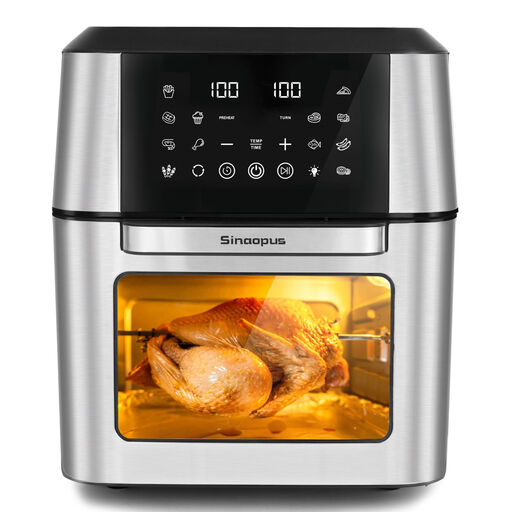
This model could be a good option if you’re looking for one appliance that offers an oven function and additional programmes.
The product name lists a 12 L capacity and 1800 W. The product description specifies a temperature range of 80–200 °C, 12 programmes and a removable non-stick drawer.
 No image available
The higher stated capacity may make this an interesting option if you’re looking for a roomier countertop oven, but it doesn’t confirm that your dish will fit.
The product name lists a 32 litre capacity and 1600 W. The product description specifies 100–250 °C, a 60-minute timer and a crumb tray.
 No image available
A compact countertop oven for baking independently, provided the appliance and your dish fit in the space available.
The product description lists a 10-litre capacity, top and bottom heat, 100–230 °C and a 60-minute timer. Its external dimensions are given as 37 × 26.5 × 21 cm.
 No image available
This model may suit you if you’re looking for a countertop oven with several heating settings and removable accessories.
The product description lists a 28-litre capacity, top heat, bottom heat and combined top and bottom heat. It also specifies 100–230 °C, a 60-minute timer and removable accessories, including a crumb tray.
No. Measure your ovenproof dish, including its handles and height. For example, LECKER’s blackberry cobbler recipe uses a rectangular dish measuring around 17 × 25 cm; a manufacturer’s stated size for round dishes doesn’t confirm that a rectangular dish will fit.
Follow the instructions for the specific model. The instructions for the Steba KB M19 specify a 10 cm gap between the back of the oven and the kitchen wall, warn that surfaces can get hot and say not to cover the ventilation slots. These requirements don’t automatically apply to other ovens.
Let the appliance cool down and clean it according to its instructions. The Rommelsbacher models mentioned have a removable crumb tray; for the BGE 1580/E, the manufacturer also describes a door that can be taken apart for cleaning.
You can’t work this out for the same portion of cobbler based on wattage or cooking capacity alone. Verbraucherzentrale recommends looking at the appliance’s actual electricity consumption; a comparison requires figures measured on the same basis. Also consider whether you can use the communal oven.
For consumer purchases in Germany, statutory rights relating to faulty goods apply against the seller and are separate from any voluntary manufacturer’s guarantee. Verbraucherzentrale states that, in general, new goods are covered by statutory consumer rights for two years from delivery.