Those portioning a supply of beans
You divide a larger supply into separate portions and want to open each one as rarely as possible. CASO Design and Rommelsbacher describe bar vacuum sealers for sealing portions like these.


If you have a large supply of beans and want to divide it into individual portions that you rarely open, a bar vacuum sealer with suitable bags is a good option. If you regularly take beans from the same supply, a reusable vacuum container is more practical. According to the Specialty Coffee Association, freshly roasted beans continue to release CO₂. So take the roast date and the roaster’s advice into account, and store the beans in a cool, dark and dry place, whatever the packaging, as Tchibo recommends.
You divide a larger supply into separate portions and want to open each one as rarely as possible. CASO Design and Rommelsbacher describe bar vacuum sealers for sealing portions like these.
You buy beans soon after roasting and want to take their continued release of CO₂ into account when choosing packaging and deciding when to pack them. The Specialty Coffee Association explains that roasted coffee continues to release CO₂.
You regularly take beans from the same supply and want to reseal it, rather than opening new bags of beans each time. Tchibo recommends storing coffee in an airtight container, protected from light, heat and moisture.
A good choice if: you want to divide a larger supply into individually sealed portions.
The trade-off: each portion needs its own bag. If the beans are still releasing gas, the vacuum in a tightly sealed pack may change.
A good choice if: you regularly take beans from the same supply and want to reseal the container afterwards.
The trade-off: air gets back in every time you open it. Store transparent containers in a dark place, and make sure the pump and container are compatible.
A good choice if: you use smaller amounts as you go and mainly want to store them airtight in a cool, dark and dry place.
The trade-off: this option does not actively remove air from the space left in the container, so you do not necessarily need a vacuum sealer for this approach.
| What to consider | What to look for | Who is this important for? |
|---|---|---|
| Portioning | Check the bag width, sealing function and whether the bags are suitable for food contact. | If I’m dividing a large supply into portions that I’ll open infrequently, I want to be able to seal each pack individually. Around 36% of consumers put portioning their supply first. |
| Freshly roasted beans | Check the roast date and the roaster’s packaging advice; don’t assume there is a standard waiting time. | When buying freshly roasted beans, I want to take their continued release of CO₂ into account when choosing packaging. Around 29% of consumers prioritise how to handle beans that are still releasing gas. |
| Frequent use | Check the usable capacity and that the pump and lid are compatible. | If I take beans from the same supply every day, I want to be able to reseal the container after opening it. Around 21% of consumers prioritise being able to access their beans repeatedly. |
| Accessories and effort | Compare what’s included, which bags you can buy as replacements and whether spare parts are available for the specific model. | If I’m preparing several batches of packs, I want to know in advance which accessories are compatible with my device or container system. Around 14% of consumers focus mainly on accessories and the ongoing effort of packaging. |
Storage conditions still matter: Tchibo identifies light, heat, oxygen and moisture as factors that affect coffee’s aroma. Freshly roasted beans also continue to release CO₂, as the Specialty Coffee Association explains.
Take the roast date and the roaster’s advice into account. Store beans in a cool, dark and dry place rather than assuming general information about a device tells you how long they will keep.
According to CASO Design, the CASO VC 10 comes with a container hose, but not an adapter for CASO VacuBoxx containers.
Before buying, check that the hose, adapter and specific container model are compatible.
Depending on the combination, you may need to buy a suitable adapter or container separately.
Sealed portions need suitable bags; reusable containers require compatible pumps and lids.
For the number of portions you plan to prepare, compare what’s included and whether suitable consumables or spare parts are available.
The VC 10 is a bar vacuum sealer for sealing individual portions.
The VAC 285 is designed for sealing several bags of portions and for use with suitable containers via a hose connection.
Fresh & Save includes pumps, bags and containers for repeated use or pre-portioned supplies.
According to LAICA, the VT3240 XPro is a bar vacuum sealer for sealing portions one after another and using compatible containers.
For separate portions or supplies of beans you use repeatedly, this selection includes a handheld vacuum sealer as well as coffee and vacuum containers. Check each model to see whether it seals bags, provides a vacuum system or is described as a coffee canister.
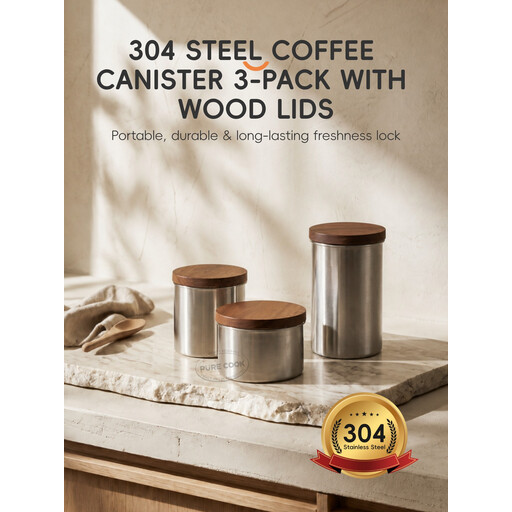 No image available
For storing separate supplies of beans without an additional vacuum device; check that the set is suitable for direct contact with food.
Three canisters with capacities of 400, 450 and 600 ml; wooden lids with sealing rings.
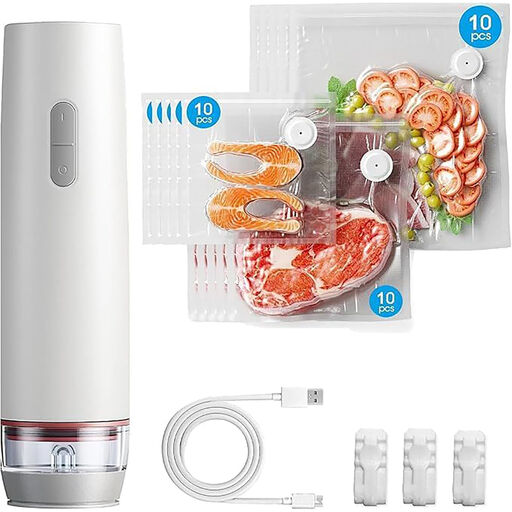 No image available
For anyone who wants to vacuum-seal portions in bags; check that the bags are suitable for food contact and for the intended use with coffee beans.
The product name specifies a suction power of 60 kPa and 30 reusable bags.
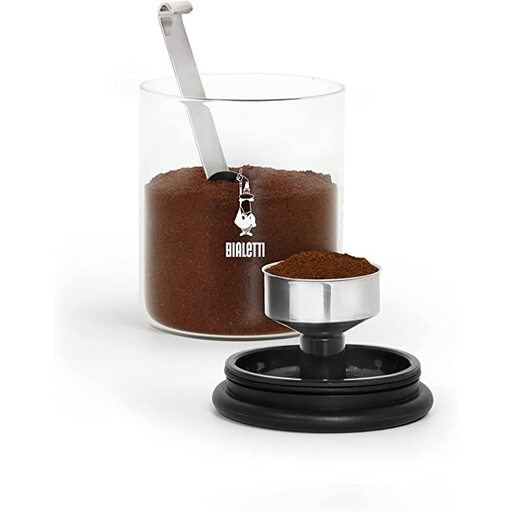 No image available
Described as a coffee jar for storage close to where you prepare your coffee; check the seal before using it to store beans for longer.
Glass container with Moka lid.
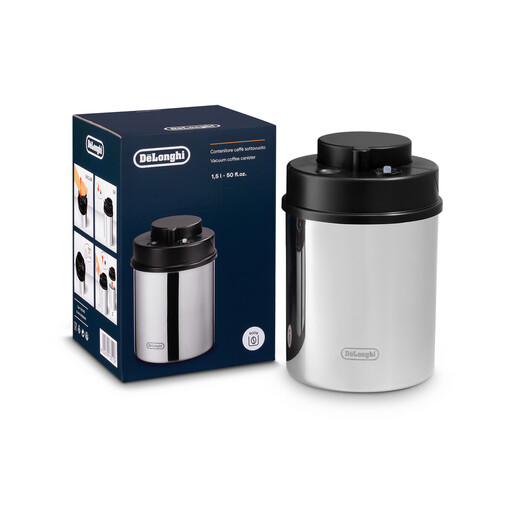 No image available
For a supply of beans you use repeatedly; the product name describes it as a manual vacuum coffee container.
Stainless steel container with manual vacuum operation.
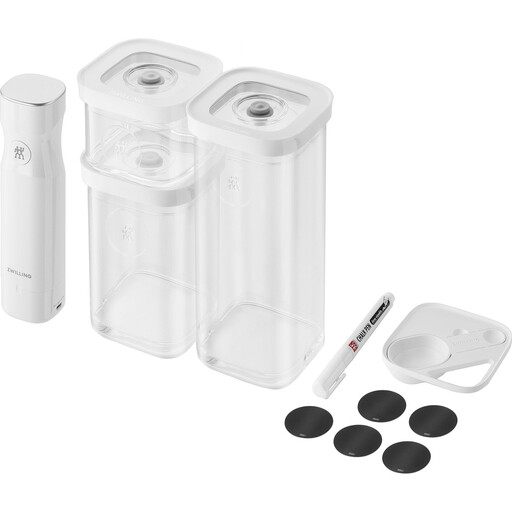 No image available
For taking beans from storage containers repeatedly; the compatible ZWILLING vacuum pump is sold separately.
Transparent plastic; 33 × 12 × 25 cm.
No, a vacuum sealer isn’t essential. Tchibo also recommends an airtight container in a cool, dark and dry place. A vacuum sealer is another option if you want to prepare lots of separate portions.
Roasted beans continue to release CO₂, as the Specialty Coffee Association explains. If your beans are very fresh, ask the roaster about packaging and timing; there is no universally applicable waiting time.
Protect whole beans from light, moisture and heat, and grind them just before brewing. Tchibo says airtight freezing is an option for longer-term storage and recommends letting the beans come to room temperature before use; this is not a guarantee of freshness.
Check which compatible bags are included and whether you can buy more. According to LAICA, bags, rolls and seals are among the spare parts listed for the LAICA VT3240 XPro; what’s included and what’s compatible varies by model and system.
Under EU Regulation (EC) No 1935/2004, materials must be made so that, under normal or foreseeable conditions of use, they do not transfer constituents to food in quantities that could endanger health or bring about an unacceptable change in the food. Check the intended use of the specific bag or container. The German Federal Institute for Risk Assessment says that BfR recommendations are not legally binding regulations.