People with a strict sugar limit
You don’t want to confuse ‘sugar-free’ with ‘no added sugar’, so you check the total sugars in the nutritional information.


When choosing chocolate or a chocolate bar to enjoy with your coffee, first decide whether you’re looking for a product specifically labelled ‘sugar-free’ or one with no added sugar: these terms don’t mean the same thing. Compare the sugar content per 100 g and, for bars, the amount per serving too. Ingredients, sweeteners and allergens may also affect your choice.
You don’t want to confuse ‘sugar-free’ with ‘no added sugar’, so you check the total sugars in the nutritional information.
You’re looking for a bar to enjoy with your coffee that has no added sugar, but you still compare the cocoa content, total sugars and sweeteners.
You prefer an individually portioned bar for the office or when you’re out and about, and want to know how much sugar each serving contains.
First, decide which sugar figure matters most to you. Then you can work out whether a bar of chocolate or a portioned snack bar better suits your coffee break and ingredient preferences.
| Criteria | What to check when buying | Who it matters to |
|---|---|---|
| Total sugars | Check the ‘of which sugars’ figure per 100 g and don’t assume ‘no added sugar’ means ‘sugar-free’. | If I want to stick to a strict sugar limit, a claim on the front of the pack isn’t enough. This is a priority for around 36% of consumers. |
| Type of chocolate | For chocolate bars, compare the cocoa content, total sugars and sweetener used. | I want chocolate with no added sugar to enjoy with my coffee, but I also want to choose between milk and dark chocolate. This is the main concern for around 29% of consumers. |
| Serving size | For snack bars, compare the pack size and the sugar content per serving and per 100 g. | For a short break, I need an individually wrapped portion that I can take with me without having to split it up. Around 21% of consumers prioritise this. |
| Ingredients | Check the dietary information, ingredients and precautionary allergen statements for the specific variety. | If I’m shopping for vegan products or need to avoid certain allergens, the ingredient labelling determines my choice. This is a priority for around 14% of consumers. |
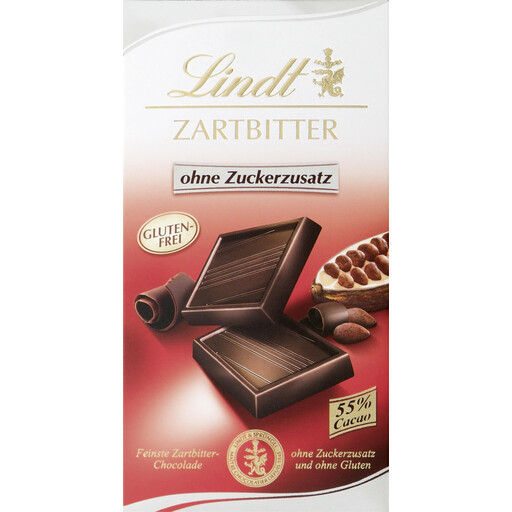
Chocolate with no added sugar can still contain sugar. Lindt Deutschland lists 1.0 g of sugar per 100 g for its dark chocolate bar with no added sugar and 9.0 g per 100 g for its milk chocolate bar.
For the variety you’re buying, check the exact product description against the ‘of which sugars’ figure per 100 g.
Some chocolate bars and snack bars contain sugar alcohols such as maltitol or xylitol. The Verbraucherzentrale (German consumer advice centre) notes that sugar alcohols can have a laxative effect if consumed in large quantities.
Read the ingredients and consumption guidance, especially if you eat several products sweetened with these ingredients on the same day.
The sugar content alone doesn’t tell you how much energy a chocolate bar or snack bar provides.
Check the energy and fat figures per 100 g in the nutritional information too, and consider how much you actually plan to eat.
Depending on the variety, ingredients such as milk, peanuts, hazelnuts or soya may be relevant. Products labelled vegan may also carry separate trace warnings.
Before buying, check the ingredients and highlighted allergens on the packaging of the specific variety.
Lindt Deutschland offers milk and dark chocolate bars labelled ‘no added sugar’.
Xucker offers premium dark and milk chocolate bars sweetened with xylitol.
CORNY free Schoko is a portioned cereal bar with chocolate, labelled ‘no added sugar’.
NEOH Peanut Zero is an individually portioned chocolate bar with a peanut flavour.
ahead Hazelnut Cacao is a 35-g chocolate bar with hazelnut and cocoa notes.
This selection includes a portioned cereal bar for your coffee break and a dark chocolate bar with no added sugar. If you’re specifically looking for a product labelled ‘sugar-free’, check the product information to confirm.
 No image available
An option if you’re looking for a portioned cereal bar rather than a bar of chocolate to enjoy with your coffee.
The product description lists six bars, each weighing 20 g, and states ‘no added sugar’. To check whether it fits your sugar limit, look at the ‘of which sugars’ figure, ingredients and allergens on the specific pack.
 No image available
A bar to enjoy with your coffee if you prefer dark chocolate to an individually wrapped snack bar.
Lindt Deutschland lists at least 55% cocoa, 1.0 g of sugar per 100 g and maltitol as a sweetener for this variety. Here too, ‘no added sugar’ doesn’t mean the bar contains no sugar.
No. ‘No added sugar’ on its own doesn’t tell you how much sugar the chocolate contains overall. Lindt Deutschland lists 1.0 g of sugar per 100 g for its dark chocolate with no added sugar and 9.0 g per 100 g for its milk chocolate with no added sugar.
Both figures are useful for different reasons: the amount per 100 g makes it easier to compare products, while the serving figure tells you how much is in the recommended bar portion. For example, REWE lists 1.5 g of sugar per 100 g and 0.3 g per 20-g serving for CORNY free Schoko. These figures don’t apply to other varieties.
Check the ingredients list and product description. Lebensmittelklarheit explains that foods sweetened in this way must include a notice about sweeteners. The varieties mentioned here include maltitol or xylitol, among other sweeteners.
No. You can’t determine the energy content from the sugar figure alone. Compare the energy and fat figures per 100 g in the nutritional information, and for snack bars, take into account the portion you actually eat.
Keep chocolate containing xylitol out of dogs’ reach. Xucker warns on its product pages that xylitol is dangerous for dogs, so be sure to follow the storage guidance on the pack you buy too.