
Lieferung heute & morgen

Qualitätsgarantie

Willkommens-Angebote freischalten: KOSTENLOSE Lieferung | Bis zu 80 % RABATT | Kostenlose 30-Tage-JoyPlus-Testphase
App herunterladen
Freshly ground coffee beans can make preparing coffee at home, in the office or on the go more flexible. But choosing the right coffee grinder involves more than just wattage or the colour of the casing. The key factors are the grinder type, adjustment options, capacity, ease of cleaning and how you plan to use it.
Many product descriptions sound similar, even though the machines can differ considerably in how they work. An electric coffee grinder with blades works differently from one with burrs and defined grind settings. If you don’t check these differences before buying, you could end up with a grinder that produces an uneven grind for espresso, is too small for several cups or is awkward to clean.
A more powerful motor doesn’t automatically mean a more consistent grind. For an 180 W electric coffee grinder or a 200 W model, the figure initially tells you only how much electrical power it uses. The grinder’s design, grinding time and how much coffee you use also affect the result.
Blade grinders chop coffee beans with rotating blades. The longer you hold down the button, the finer the grounds can become, but you’ll often end up with a mixture of coarse and fine particles. Flat or conical burr grinders, on the other hand, work using a defined gap between the grinding surfaces.
An espresso grinder needs a fine setting that can be reproduced as consistently as possible. A coarse grind is best for French press, while filter coffee and pour-over usually call for a medium grind. A machine with few or no fixed grind settings may be fine for simple everyday brewing, but gives you less control when switching methods.
Coffee residue can build up in the container, around the blades or in the chute. If the casing is difficult to access, old coffee grounds can mix with fresh ones. Before buying, check whether the grinding container and lid can be removed, and whether the motor housing should only be cleaned dry or can be wiped with a slightly damp cloth.
A coffee bean grinder with adjustable grind settings is especially useful if you plan to use several brewing methods. Check how many settings it has and how they work:
Check the technical specifications when a product is described as a coffee grinder with stainless steel burrs. Stainless steel may be used for blades, flat burrs or conical burrs; this alone doesn’t tell you how consistent the grind will be.
For a single cup, 10 to 15 grams of beans is often enough. Households or offices making several cups may benefit from a container holding between 60 and 75 grams. A large capacity can make cleaning more difficult in smaller machines. What matters is whether the maximum capacity suits the amount you usually grind, and whether the machine is designed for short grinding intervals.
For electric models, check that the lid closes securely and that the machine has a safety interlock and either an automatic shut-off or a press-to-operate button. Never open a blade grinder while it’s running. Unplug it before cleaning. For manual models, look for a sturdy handle, clear click-adjustment settings and an easy-to-reach grounds container.
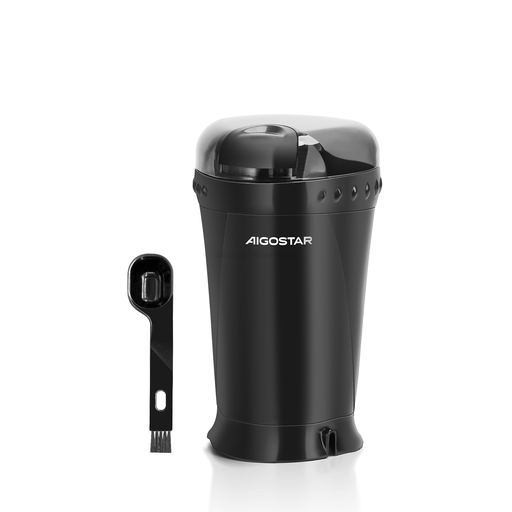
Why this product suits this profile: One-button operation and a transparent 60 g container make this a straightforward choice if you’re new to grinding coffee at home.
The product details explicitly specify a stainless steel blade, with no stepped grind adjustment. This helps you set realistic expectations about how it works.
200 W motor, 60 g capacity and transparent container; the lid must stay closed while the grinder is running.
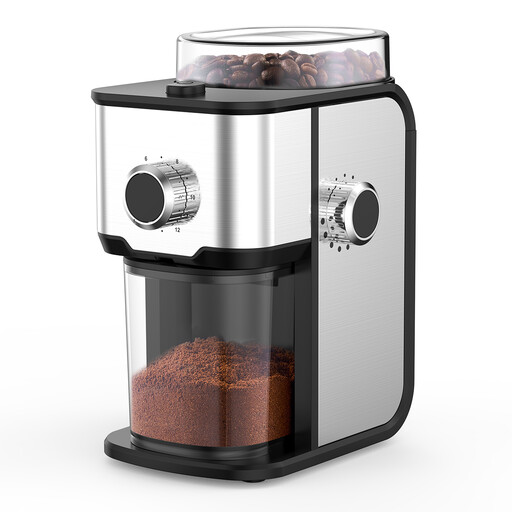
Why this product suits this profile: According to the product description, its 14 grind settings cover a range from finer grounds for espresso to coarser grounds for French press.
The 14 fixed settings are easier to work with than relying solely on a push button to control grinding time.
Flat burr grinder, 14 grind settings and capacity for 2 to 12 cups, according to the supplier.
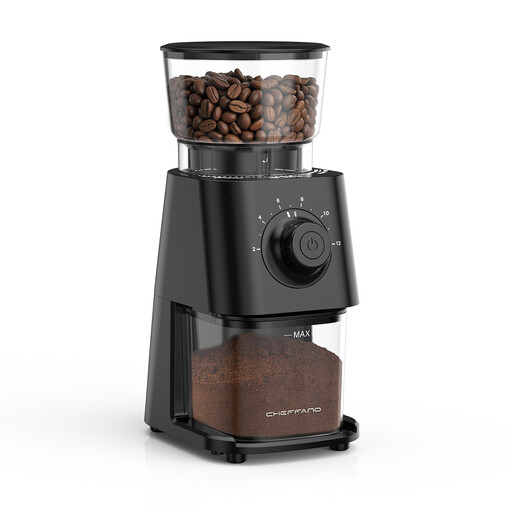
Why this product suits this profile: With 30 grind settings and conical burrs, it’s suited to households that switch between espresso, filter coffee and French press.
The wide choice of settings means you’re less reliant on varying the grinding time to control the grind size.
Conical burr grinder, 30 grind settings and capacity for up to 12 cups, according to the product description.
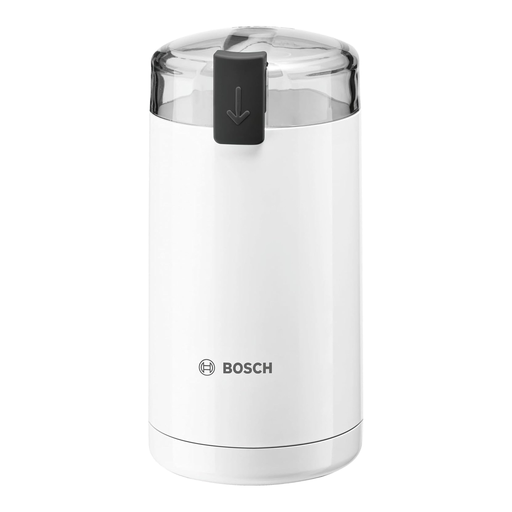
Why this product suits this profile: This compact machine is ideal if you want to grind beans quickly in individual portions and have limited worktop space.
The specifications state that it has 180 W of power, a 75 g capacity and a safety system that prevents it from running if the lid isn’t fitted correctly.
180 W motor, 75 g container, stainless steel blade and dimensions of 90 × 90 × 170 mm, according to the product details.
We’ve put together a complete, regularly updated list of products that meet these strict selection criteria and fully comply with the safety regulations in force in the EU.
For espresso, a coffee grinder with adjustable grind settings and as many fine settings as possible is a good choice. Blade grinders can chop beans finely, but don’t always produce evenly sized particles. If you make espresso regularly, check the details about the burrs and fine adjustment particularly carefully.
Its lifespan depends on how often you use it, how well you clean it, how much coffee you grind and how long you leave it to rest between uses. Don’t run an electric coffee grinder with more beans than its stated capacity. Remove coffee residue regularly and let the motor cool down if you’re grinding repeatedly. For blade models, only clean the sharp parts when the grinder is unplugged.
A manual coffee grinder doesn’t need electricity, so its running costs for energy are practically zero. However, you’ll need to put in some physical effort for every portion. According to the product details, models such as the STARESSO D6 PLUS have a 20 g capacity, stainless steel conical burrs, click adjustment and a fully disassemblable body. This can make them a practical choice for travelling, camping and grinding individual portions.