
Lieferung heute & morgen

Qualitätsgarantie

Willkommens-Angebote freischalten: KOSTENLOSE Lieferung | Bis zu 80 % RABATT | Kostenlose 30-Tage-JoyPlus-Testphase
App herunterladen
Freshly ground coffee beans allow you to tailor your brew more precisely to your chosen coffee method. However, not every coffee grinder automatically delivers the right result. Often, it’s the design, settings and operation that determine whether the grinder is suitable for espresso, filter coffee, mokka or French press.
A high power rating alone tells you very little about the consistency of the grind. What really matters is the burr set, the adjustment options and the overall construction of the machine. An electric coffee grinder with 200 watts and blade grinders can grind quickly, but it usually doesn’t offer clearly defined grind levels.
A coffee grinder with an adjustable grind setting is only practical if the steps are clear and reproducible. With stepless systems, fine-tuning can be greater, but it requires more attention when switching between brewing methods.
A large bean hopper is useful for several people or an office, but for single-dosing it can take up unnecessary space. Equally important: coffee grounds build up on the chute, container and burrs. Hard-to-reach parts increase cleaning effort and can be a nuisance when switching between different beans.
A coffee grinder with conical burrs feeds the beans between two cone-shaped grinding elements. On many models, the grind size can be adjusted from fine to coarse. Conical burrs are found in both electric coffee grinders and manual models.
A coffee grinder with stainless steel burrs can be a robust material choice. However, the material specification alone doesn’t replace checking the grind adjustment and operation. With a blade grinder, the beans are chopped by rotating blades. The desired fineness is often controlled by the running time. This is straightforward, but less precisely reproducible.
If you use several methods, make sure the grinder has a sufficiently wide adjustment range. An espresso grinder with very fine adjustment can work for filter coffee if it also offers coarse settings. Conversely, a simple grinder with few steps isn’t always the right choice for espresso.
For two to four cups, 20 to 75 grams of beans per grind is often enough. Households with several coffee drinkers benefit from larger containers, such as the 220-gram capacity of the BODUM BISTRO model. A coffee grinder with a timer can make the running time more consistent. With manual grinders, there’s no electricity consumption, but each grind requires manual effort.
Also look out for:
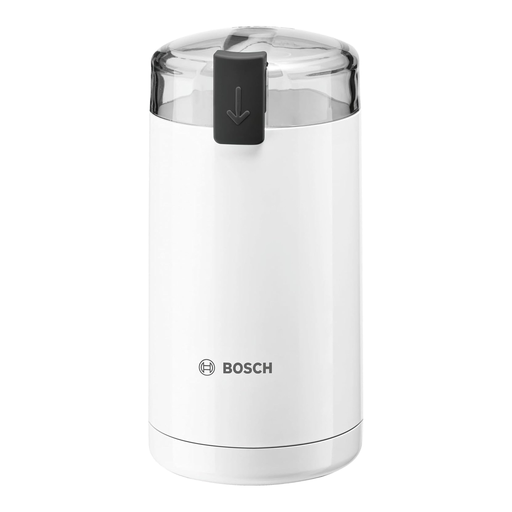
Why this product fits the profile: This compact electric coffee grinder works with a 180-watt motor, holds up to 75 grams and is operated via a push-button switch. It’s ideal for households that want to grind coffee without complicated settings.
The safety lock prevents operation when the lid isn’t correctly fitted. The maximum fill capacity is clearly stated as 75 grams.
Compact dimensions of 90 × 90 × 170 mm, stainless steel blades and simple one-button operation.
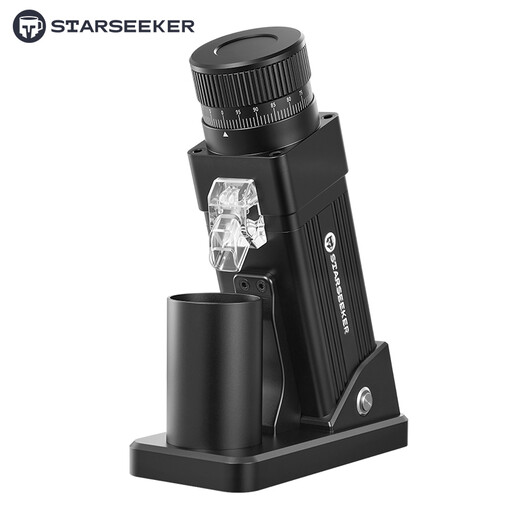
Why this product fits the profile: This grinder features a 55 mm conical burr set made from titanium alloy and a stepless adjustment. It appeals to users who want to fine-tune between espresso and filter coffee.
Instead of just boasting a high wattage, this model provides specific burr and adjustment details. The removable chute makes dry cleaning easier.
Stepless 0.01 mm fine adjustment according to the product specification and an aluminium alloy metal housing.
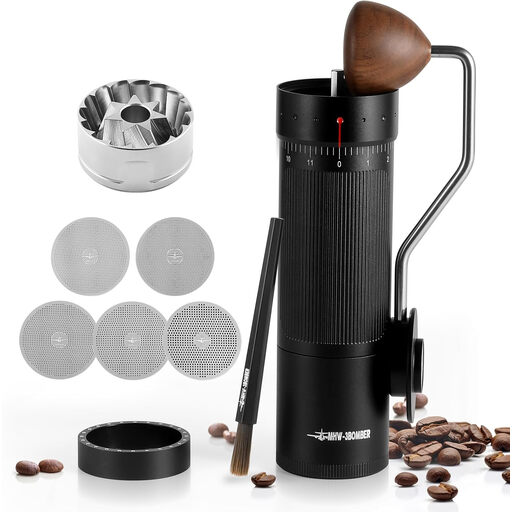
Why this product fits the profile: This hand coffee grinder works without electricity and can be adjusted for espresso, mokka, filter coffee and French press. It’s ideal for travel, camping and households that brew single portions.
The grind size is adjusted externally via 60 clicks per rotation. This means you don’t have to open the grinder to switch between brewing methods.
CNC-machined stainless steel conical burrs, a 20-gram collection container and five included sieves.
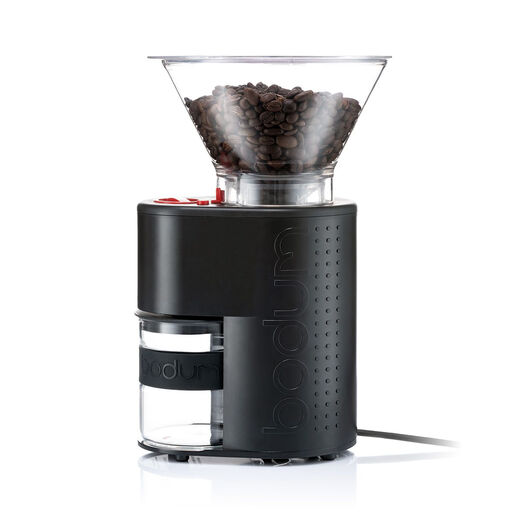
Why this product fits the profile: This electric coffee grinder features conical burrs, a 220-gram capacity and a timer function. This makes it suitable for multiple cups at home or in the office.
The timer function limits the running time, while the adjustable grind size supports various brewing methods. The collection container is made from antistatic borosilicate glass.
160-watt power, 220-gram capacity and conical burrs with fine to coarse settings.
Grinding coffee beans always means regular cleaning. Remove residue with a dry brush and follow the manufacturer’s instructions. Burr sets and motor units should not be submerged in water. With blade grinders, it’s advisable to operate them in short intervals so the motor can cool down between runs.
The ongoing costs of a coffee grinder mainly come from electricity consumption, wear parts and, if necessary, cleaning accessories. A hand coffee grinder doesn’t need mains power, while an electric coffee grinder saves time and can be more practical for larger quantities.
We’ve put together a full, regularly updated list of products that fully meet these strict selection criteria and the safety regulations in force in the EU.
For French press, you need a coarse grind. A coffee grinder with several clearly defined settings or a stepless adjustment gives you more control. It’s also important that the collection container is easy to empty and clean.
The lifespan depends on the burr set, materials, grinding volume and care. Stainless steel burrs and sturdy bearings can be designed for regular use. Without manufacturer specifications, it’s impossible to give a reliable prediction. Clean the grinder dry and don’t exceed the recommended fill capacity.
That depends on usage and the purchase price. A hand coffee grinder has no electricity costs, but it requires more time and effort. An electric coffee grinder is more convenient for multiple portions. So when choosing, you shouldn’t just compare the purchase price, but also the grinding volume, effort involved and the precision you want.