
Lieferung heute & morgen

Qualitätsgarantie

Willkommens-Angebote freischalten: KOSTENLOSE Lieferung | Bis zu 80 % RABATT | Kostenlose 30-Tage-JoyPlus-Testphase
App herunterladen
Freshly ground coffee beans can make your brewing more flexible, whether at home, in the office or on the go. Finding the right coffee grinder isn't just about power or design, though. The burr type, adjustability, ease of use and your intended brewing method all play a crucial role.
Claims like "36 settings" or "48 adjustments" sound impressive. However, on their own they tell you very little about the actual increments, the logic of the adjustment mechanism, or whether the grinder is suitable for espresso. With a coffee grinder for espresso, a fine, reproducible setting is especially important. For French press and filter coffee, on the other hand, you need much coarser ranges.
So pay attention to:
A higher power rating doesn't automatically mean a more consistent grind. With an electric coffee grinder, the motor control, burr set, bean feed and intended operating duration all play a part. A compact model with 150 or 180 watts can be enough for single portions, whereas heavy users should focus more on capacity, cooling and ease of use.
A large bean hopper isn't practical for every household. If you brew just a single cup each day, you often don't need a bulk storage capacity. A smaller hopper can make portioning easier and save space. For multiple people in a household or for office use, however, 50 to 75 grams or a specification for several cups is more practical.
A coffee grinder with blades works using rotating blades. The desired fineness is usually controlled by the running time. This makes operation simple, but control over the grind size is limited. Models of this type are mainly suitable for users who want to grind single portions for classic filter brewing without fuss.
A flat burr grinder crushes the beans between two flat burrs. A conical burr grinder uses two interlocking, cone-shaped burrs. Both types normally offer more defined grind adjustment than a blade grinder. For espresso, pour-over or frequent changes between brewing methods, this can be a relevant selection criterion.
However, the burr type alone is not a guarantee of quality. Also check the materials used, the adjustment range, the hopper size and the cleaning instructions.
An adjustable grind size should suit your brewing method:
On manual models, the grind size is often adjusted via an internal or external ring. Electric coffee grinders may also offer timers, dosing or pre-set portions. For beginners, clear, straightforward operation is often more important than a particularly high number of settings.
The quantity you need can be roughly determined by your daily usage. For a single cup, 15 to 20 grams is typical, while 50 to 75 grams can cover several portions. With a compact coffee grinder, you should also consider the footprint, cable length and weight.
Noise level specifications are often not directly comparable because measurement conditions are not stated. A quiet design can be pleasant, but it shouldn't be your only selection criterion. Even more important is cleaning: coffee residue and oils can build up in the grinding chamber. A dry brush and easily accessible, removable parts make maintenance easier. Electric appliances must not be immersed in water; for burr sets, follow the manufacturer's instructions.
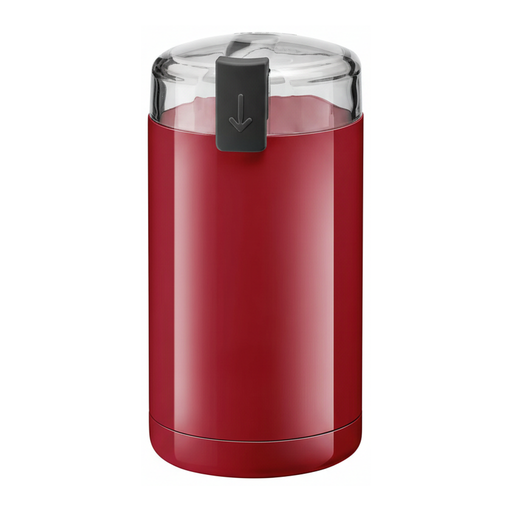
Why this product fits the profile: This electric coffee grinder runs at 180 watts, holds up to 75 g of beans and has a safety feature on the lid. It's straightforward for simple portions at home or in the office.
The specification clearly states a blade grinder (stainless steel blade) and only one grinding option. This makes it clear that fine grind adjustment for different brewing methods is not promised.
75 g capacity, compact dimensions of 9 × 9 × 17 cm and integrated safety mechanism.
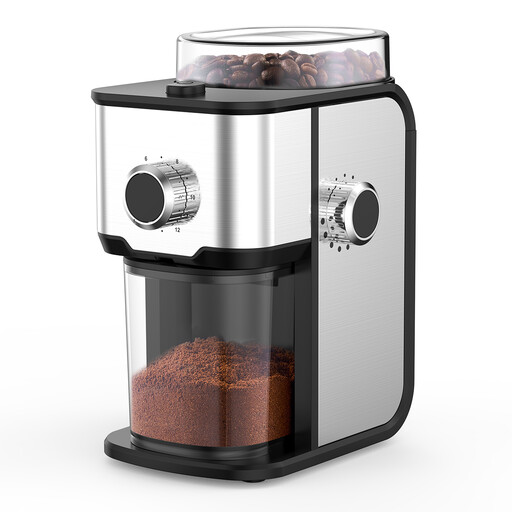
Why this product fits the profile: According to the product details, this electric model features a flat burr grinder, 14 grind settings and a capacity for 2 to 12 cups.
The specifications concretely describe the burr type, number of settings and capacity range. Buyers can therefore better check whether espresso, filter coffee or French press are covered.
Flat burr grinder, 14 settings and designed for 2 to 12 cups.

Why this product fits the profile: This manual coffee grinder requires no electricity and, according to the product description, offers 60 clicks per revolution, a stainless steel conical burr set and a 20 g catch container.
The external adjustment and the stated sieve sizes make the adaptation between espresso, filter and French press traceable, rather than just claiming general versatility.
Can be used without power, 20 g catch container and 60 clicks per revolution.

Why this product fits the profile: This portable electric coffee grinder runs on a rechargeable battery, charges via USB-C, has one-touch operation and an adjustable stainless steel burr set.
Battery capacity and charging time are specified. This allows you to check before purchase whether the grinder is suitable for the office, travel or camping without a direct mains connection.
1000 mAh battery, USB-C charging and suitability for espresso, Moka pot, pour-over and French press according to product details.
We've put together a complete, regularly updated list of products that fully meet these strict selection criteria and the safety regulations in force in the EU.
For espresso, a finely adjustable grind size is important. A conical burr or flat burr grinder with clear, reproducible steps generally offers more control than a grinder with a simple blade. Also check whether the manufacturer explicitly lists espresso as an intended use.
The lifespan depends on the burr type, frequency of use, quantity of beans and cleaning. Overloading, damp or very oily beans, and a lack of maintenance can affect performance. Always follow the operating and care instructions provided by the manufacturer.
The power consumption per grinding cycle is normally dependent on the motor power and the running time. Since grinding only takes a few seconds or short intervals, the actual operating duration is more important than the wattage alone. A manual coffee grinder uses no electricity while grinding, but requires physical effort to operate.