
Lieferung heute & morgen

Qualitätsgarantie

Willkommens-Angebote freischalten: KOSTENLOSE Lieferung | Bis zu 80 % RABATT | Kostenlose 30-Tage-JoyPlus-Testphase
App herunterladen
Whether you enjoy espresso in the morning, filter coffee for the family or cappuccino in the afternoon, your coffee machine should suit your daily routine, available space and preferred level of maintenance. However, many purchasing decisions go wrong not because of the taste, but because of misleading marketing claims and underestimated ongoing costs.
This buying guide from the Joybuy Product Recommendation Officer explains what households, single people, couples, professionals and students should look for when buying a coffee machine.
Figures such as 15 Bar, 19 Bar or 20 Bar stand out on many espresso machines. The value primarily describes the pump performance or the maximum stated pressure. The result in the cup also depends on the grind size, amount of coffee, tamping pressure, water temperature and brewing time.
A coffee machine with 20 Bar is therefore not automatically more suitable for every household than a model with 15 or 19 Bar. What matters is whether you use ground coffee, want to control the extraction yourself and need a steam wand.
A compact coffee machine can be practical for a small kitchen, student accommodation or home office. Nevertheless, the water tank, cable, levers and drip tray must remain accessible. In addition to checking the width, height and depth, consider:
According to the product details, the Nespresso Essenza Mini measures 11 × 20,5 × 32,5 cm and has a 0,6-litre water tank. This makes it an interesting option where space is limited, although households with several people may need to refill it frequently.
With a capsule machine, capsules create ongoing costs. The capsule container and drip tray also need to be emptied. A coffee pod machine uses pods and is generally easy to operate, but it is tied to the relevant pod format.
A bean-to-cup coffee machine, on the other hand, requires maintenance for the grinder, brewing unit and, where applicable, milk system. With an espresso machine with milk frother, the steam wand should be wiped clean and briefly rinsed after every use. A French press or moka pot involves less technology and uses no electricity, but requires manual preparation.
The right coffee machine depends first and foremost on the drinks you want to prepare:
For one person, a tank of under one litre may be sufficient if only a few cups are consumed each day. Families or office communities benefit from larger tanks and bean hoppers.
As a guide based on the product data provided:
A larger tank means fewer refills, but requires more space. Water should not be left in the tank for extended periods.
Look for removable water tanks, detachable drip trays and coffee-ground or capsule containers that are easy to access. For milk systems, automatic rinsing programmes and components that are easy to take apart are useful.
Domestic electrical appliances should be connected to a suitable 220–240-volt socket in accordance with the manufacturer’s instructions. Unplug the appliance before cleaning. Hot surfaces, steam and freshly brewed coffee can cause scalding and should be kept out of children’s reach.
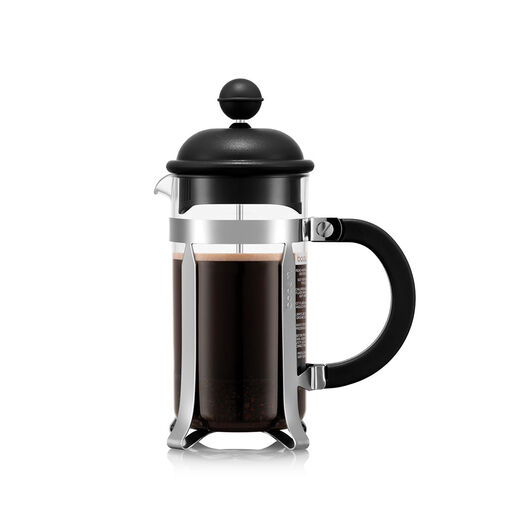
Why this product suits this profile: The French press requires no electric pump and is suitable for individuals or couples who want to prepare coffee manually without the need for complex equipment.
There are no exaggerated pressure claims and no hidden reliance on capsules or pods. Before buying, make sure the 350 ml portion size suits your personal consumption.
Electricity-free preparation and a compact 350 ml size for everyday use.
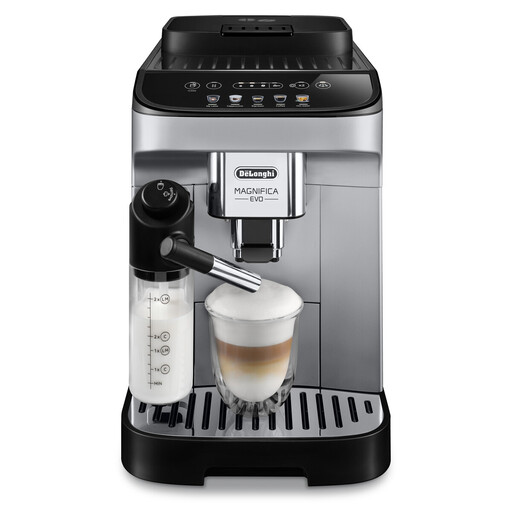
Why this product suits this profile: This bean-to-cup coffee machine is designed for households looking for bean coffee, a choice of several drinks and an integrated milk system in one appliance.
The capacities are clearly stated: a 1,8-litre water tank and a 250-gram bean hopper. Removable parts that are dishwasher-safe according to the product details make regular maintenance easier.
Integrated conical burr grinder with 13 grind settings, seven drink recipes and a function for preparing two espressos at the same time.
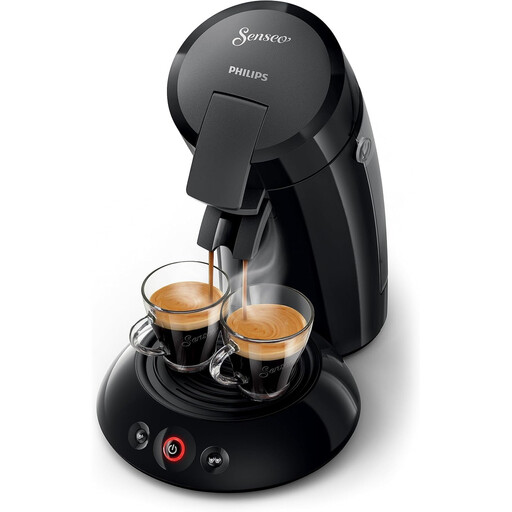
Why this product suits this profile: For professionals, families or house shares who want to prepare coffee quickly with minimal measuring, this coffee pod machine offers a choice of one or two cups.
The product data states a 0,7-litre tank capacity, a preparation time of under one minute and automatic shut-off after 30 minutes. This makes it easier to assess how it will fit into your daily routine.
Prepare one or two cups at the same time, with removable, rinseable components according to the product description.
We have put together a complete, regularly updated list of products that fully meet these strict selection criteria and the safety regulations applicable in the EU.
For espresso, cappuccino and latte, a semi-automatic espresso machine with a steam wand is suitable if you want to control the grind size, coffee grounds and milk foam yourself. Models such as the IAGREEA Espresso Machine and the Xiaomi Semi Automatic Espresso Machine state 20 Bar pump pressure, removable water tanks and functions for single and double shots.
A capsule machine is ideal if you want to minimise the number of steps involved. According to the product details, the Nespresso CitiZ features 19 Bar, a 0,9-litre tank, two programmable buttons and a heating-up time of around 25 seconds. Before buying, check capsule-system compatibility and the recycling options available.
A coffee machine with grinder, such as the De’Longhi Magnifica S, processes beans immediately before brewing. You will therefore need space for the bean hopper and brewing unit, as well as a consistent cleaning routine.
A compact capsule machine, a narrow espresso machine or a French press generally requires less space than a bean-to-cup coffee machine. Measure the available area, including space for opening and cleaning. For very small kitchens, the Nespresso Essenza Mini may be worth considering, with its width of 11 cm.
This depends on the hardness of the water, how often the machine is used and the manufacturer’s instructions. In areas with hard water, more frequent descaling may be necessary. You should also clean the drip tray, outlet and pod or capsule container regularly. Parts that come into contact with milk should be rinsed immediately after use.
Power consumption depends on the appliance’s wattage, heating-up time, standby behaviour and frequency of use. Automatic shut-off can limit unnecessary standby operation. Compare the information in the specifications and switch the appliance off completely when you will be away for an extended period.