
Lieferung heute & morgen

Qualitätsgarantie

Willkommens-Angebote freischalten: KOSTENLOSE Lieferung | Bis zu 80 % RABATT | Kostenlose 30-Tage-JoyPlus-Testphase
App herunterladen
A coffee table is often the unsung centerpiece of the living room. It serves as a resting place for remote controls, a stage for decor, and a hub for evening snacks. Yet, the selection process can quickly become overwhelming. Many models look appealing online but prove to be impractical after a short time. Before you make a decision, it's helpful to know the most common pitfalls that can lead to a poor purchase.
These primarily include three points:
To find a sofa table that not only looks good but also delivers long-term satisfaction, you should examine three core aspects. These objective criteria will help you distinguish marketing promises from genuine product features.
The longevity of a coffee table depends significantly on the materials used.
Functionality is key to how well the table integrates into your daily life.
The shape of the table influences the room's atmosphere and safety. A round coffee table has no hard edges, making it a good choice for households with children or for smaller rooms, as it keeps pathways clear. Rectangular tables often feel more structured and offer more surface area. A modern coffee table is characterized by clean lines and a minimalist design language, while the industrial style focuses on the contrast of a wood and metal coffee table.
Based on the criteria mentioned, we have identified several models that represent a smart choice for different needs and living situations.
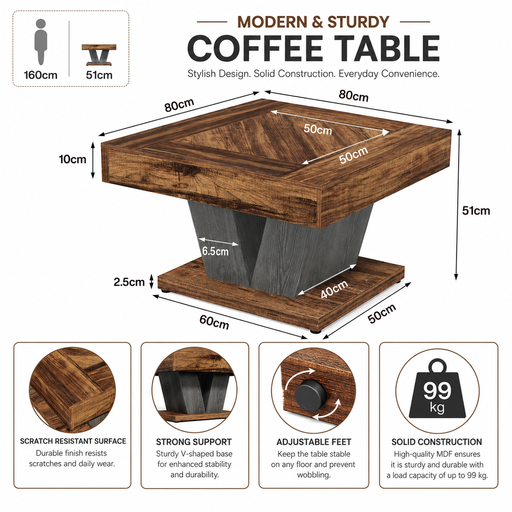
Why it's a great fit: Ideal for anyone seeking a straightforward yet stable and stylish centerpiece for their living room. The square 80x80 cm format provides ample surface area without dominating the space.
The construction, featuring a thickened MDF tabletop and a wooden frame, is rated for a load capacity of up to 100 kg according to the manufacturer, thus avoiding the problem of unstable tables.
The combination of high load capacity and simple assembly makes it a reliable and ready-to-use solution.
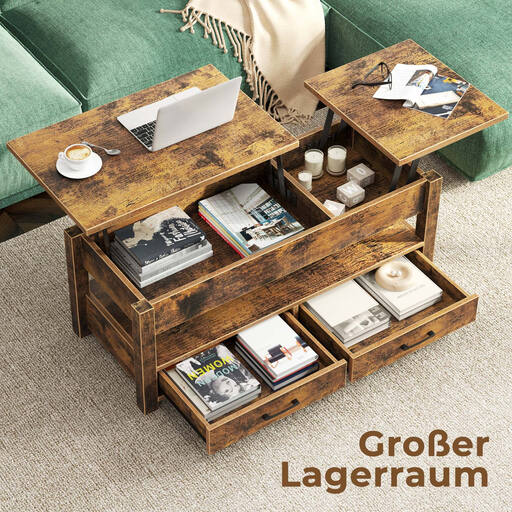
Why it's a great fit: Perfect for those who work, eat, and live in their living room. This table flexibly adapts to different situations and is an excellent choice for small apartments or home office users.
It solves the problem of lacking functionality with a split lift-top, hidden compartments, and additional drawers. This turns the table into the room's multifunctional hub.
The gas-spring lift mechanism ensures a smooth and quiet lifting of the top, while the separate sections allow for simultaneous use by two people.
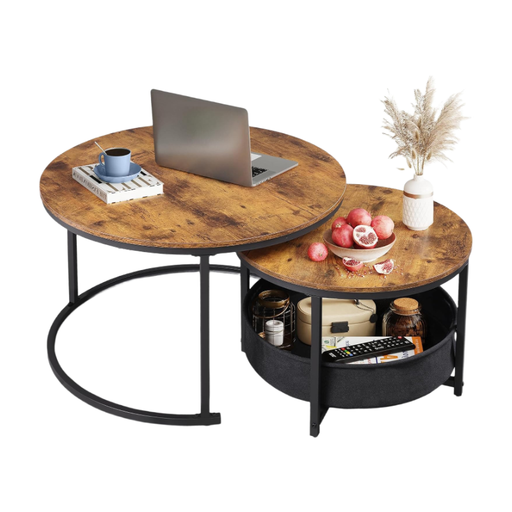
Why it's a great fit: This set of two round tables offers maximum design freedom. It can be used as a nested unit, separately as a coffee and side table, or placed flexibly around the room as needed.
The set provides a clever storage solution with integrated fabric baskets without appearing bulky. The sturdy metal frame ensures the necessary stability for both tables.
The 2-in-1 nesting design allows for space-saving and adaptable use, suitable for both small and large living rooms.
We have compiled a complete, up-to-date list of products that fully meet these strict selection criteria and rigorous quality and safety standards.
As a rule of thumb, the top of the coffee table should be approximately the same height as your sofa's seat cushions, or a few centimetres lower. A typical height is between 40 and 50 cm. This ensures that drinks and other items are within easy reach without obstructing the view of the television.
For low-maintenance daily use, surfaces made of coated engineered wood (like melamine-coated MDF or particleboard) and powder-coated metal are excellent choices. They are resistant to scratches and can be easily cleaned with a damp cloth. Untreated wood or glass surfaces generally require more maintenance.
A coffee table is typically larger and serves as the central table placed in front of a sofa arrangement. A side table is smaller, often taller, and more mobile. It is usually positioned next to an armchair or at the end of a sofa to provide an additional, convenient surface for a lamp, a book, or a drink.