
Lieferung heute & morgen

Qualitätsgarantie

Willkommens-Angebote freischalten: KOSTENLOSE Lieferung | Bis zu 80 % RABATT | Kostenlose 30-Tage-JoyPlus-Testphase
App herunterladen
Freshly ground coffee beans can make preparing coffee at home far more flexible. However, finding the right coffee grinder is not simply a matter of wattage or casing colour. The key factors are the grinding mechanism, adjustment options, capacity and whether the grinder is suitable for espresso, French press, pour-over or everyday filter coffee.
An electric coffee grinder with 150 or 200 watts works quickly. However, the wattage primarily describes the motor power and does not automatically indicate how consistent the coffee grounds will be. With a blade grinder with stainless steel blades, the result depends heavily on the grinding time and short pulses. This can produce both finer and coarser particles at the same time.
For a simple cup of filter coffee, this type of coffee grinder may be sufficient. If you prepare espresso or pour-over coffee, however, you should take a closer look at the grinding mechanism and adjustment options.
Marketing terms such as aroma-preserving are of limited value without technical details. Relevant factors include the contact time between the beans and the grinding mechanism, heat generation, the gap between the grinding discs or cones, and how the ground coffee is stored.
A coffee grinder with a disc or conical burr mechanism generally offers more scope for controlled adjustment than a simple blade grinder. An airtight ground-coffee drawer can also make storage easier, but it does not replace using the grounds promptly.
A coffee grinder with an adjustable grind size is not automatically suitable for every brewing method. Depending on the design, “fine to coarse” can mean different things. Espresso requires a fine, highly reproducible grind. French press, on the other hand, needs considerably coarser particles. With a manual coffee grinder, you should also bear in mind that grinding very finely can require more effort and time.
Before choosing a grinder, you should decide which brewing method you prefer:
A grinder for French press and espresso should ideally have a wide adjustment range and a clearly understandable scale. Stepless systems allow particularly fine adjustments, although you will usually need to record the desired position yourself.
A smaller chamber is often enough for preparing a single serving. The Severin KM 3879 holds around 50 g of coffee beans. An electric coffee grinder with a larger container is more practical if several people in your household drink coffee. According to the product specifications, the Severin KM 3880 has a bean container with a capacity of 240 g and a dosage setting for 2 to 12 cups.
You should also look for:
A stainless steel coffee grinder may have a robust, easy-to-wipe outer casing. However, this does not automatically say anything about the quality of the internal grinding mechanism.
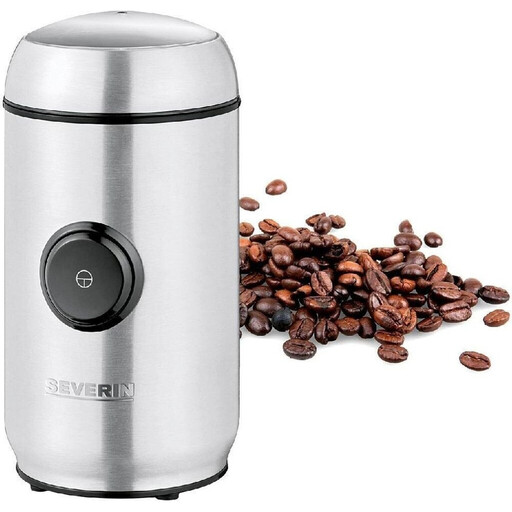
Why this product suits this profile: This compact 150-watt appliance operates at the touch of a button and holds around 50 g of beans. It is suitable for small quantities and straightforward daily coffee preparation.
The transparent cover lets you see the grinding process. Short grinding pulses help you control the desired fineness more effectively than continuous operation.
150 W power, stainless steel blade, 50-g capacity and cable winder.
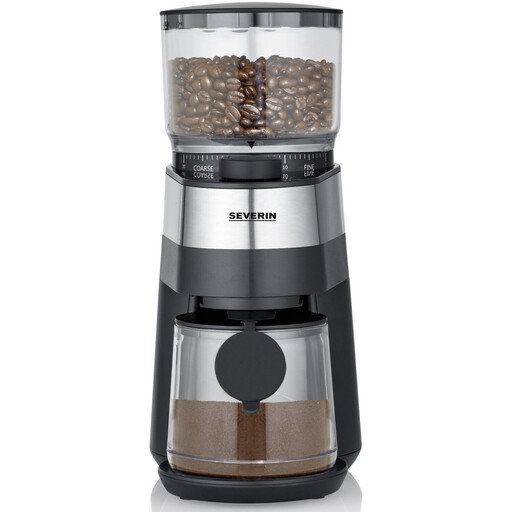
Why this product suits this profile: With 30 grind settings, a 240-g bean container and dosage settings for 2 to 12 cups, it is ideal for households that switch between espresso, filter coffee and French press.
The grind settings are clearly numbered. This makes it easier to find the right setting again for each brewing method.
Flat stainless steel grinding mechanism, 30 grind settings, quantity selection for 2 to 12 cups and removable containers.
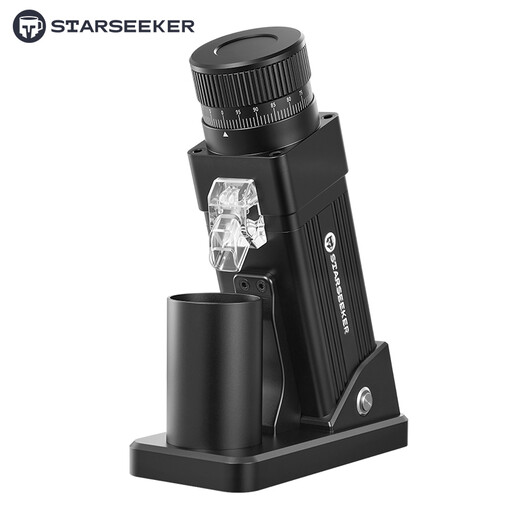
Why this product suits this profile: This electric espresso grinder is aimed at users who switch between espresso and pour-over and want particularly detailed control over the grind size.
The stepless adjustment means users are not limited to just a few preset positions. The removable outlet assembly makes dry cleaning easier.
55-mm conical grinding mechanism made from titanium alloy, stepless adjustment and 72-W AC motor.
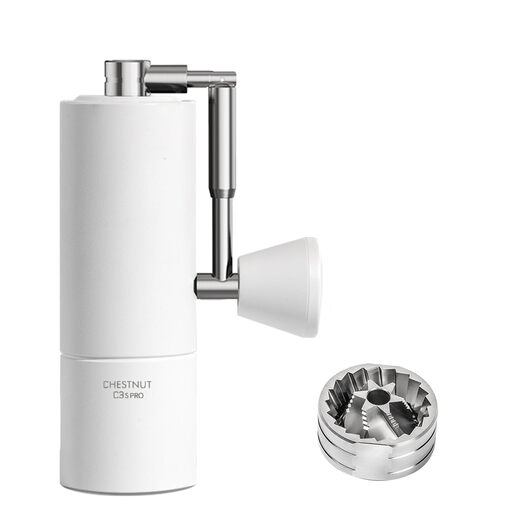
Why this product suits this profile: A manual coffee grinder does not require electricity and can be used in the office, while travelling or when camping. The folding handle makes it easier to transport compactly.
Manual operation reduces reliance on batteries, sockets and charging accessories. The grind-size adjustment is designed for everything from espresso to French press.
S2C stainless steel conical grinding mechanism, folding handle and adjustable grind size.
Only fill the bean container up to the stated maximum capacity. With a blade grinder, grinding in short pulses is recommended. This allows you to monitor the consistency more effectively and gives the motor a break between cycles. An electric coffee grinder should be allowed to cool down after longer periods of operation.
Remove coffee residue with a dry brush or a suitable air blower. Keep water away from the motor, electronics and internal grinding units. Removable containers should only be cleaned in accordance with the operating instructions and must be dried completely. An electric pepper mill or spice grinder is not automatically suitable for coffee beans. Conversely, coffee blade grinders should only be used to grind spices if the manufacturer expressly approves this use.
We have put together a complete, regularly updated list of products that fully meet these strict selection criteria and the safety regulations applicable in the EU.
For espresso, an espresso grinder with finely adjustable grind size is a sensible choice. Conical or disc grinding mechanisms with numerous settings or stepless adjustment make it easier to fine-tune the grind. A simple blade grinder may be sufficient for initial experiments, but it may produce less consistent particles.
Its service life depends on how often it is used, the grinding mechanism, cleaning and correct operation. Do not exceed the stated capacity, avoid moist ingredients and allow electrical appliances to cool down during extended use. If the cable, switch or motor develops a fault, stop using the appliance.
Running costs are normally low because grinding sessions are short. The key factors are power, grinding time and frequency of use. Battery-powered models also involve charging cycles, while a manual coffee grinder uses no electricity at all. So do not base your decision solely on energy consumption: also consider the quantity, ease of use and the level of grind-size control you want.